
Nearly Five Moon-Orbits Out, and It Still Makes the List
The gap between an asteroid and Earth’s surface can be 142 Earth diameters wide and still earn a place in the catalog as a close approach worth watching. That is not a technicality. It is just the arithmetic of the solar system, where even your nearest planetary neighbor averages tens of millions of miles away.
On October 8, 2026, asteroid 2015 TS238 will pass Earth at a miss distance of 4.72 lunar distances, the standard unit for near-Earth close approaches, where one lunar distance equals the Earth–Moon separation: 238,855 miles (384,399 km). Multiply by 4.72 and you get roughly 1.13 million miles (1,813,910 km) between Earth’s center and the asteroid at its closest. The clearance from Earth’s surface is approximately 142 Earth diameters. It will miss.
The unit label is not a formality; it is load-bearing. A lunar distance is the Earth–Moon separation, not the Moon’s diameter, those two values differ by a factor of roughly 110. Confuse them and a routine flyby reads as a razor-thin near-miss. At the other end, one astronomical unit (the Earth–Sun distance, about 92.96 million miles, or 149,597,870.7 km) is roughly 389 times larger than a lunar distance. The number on the table for October 8, 2026 is 4.72 lunar distances, and that unit is doing real work.
How the Orbit Gets Computed
The designation 2015 TS238 is a datestamp. In the Minor Planet Center’s provisional naming system, “2015 T” places the first confirmed observation in the first half of October 2015; “S238” counts its position within that two-week batch. One of the automated sky-survey programs that sweep the sky nightly recorded its first positions on a CCD frame and reported them to the Minor Planet Center, the international clearinghouse for small-body discoveries.
From those positions, and from every astrometric measurement added since, JPL’s Center for Near-Earth Object Studies (CNEOS) has computed an orbital solution: six numbers representing position and velocity in three dimensions that, fed into a full gravitational model of the solar system, reproduce all the observations and project the orbit forward in time. The relative velocity at closest approach is listed in the CNEOS orbital solution as approximately 9.8 miles per second (15.8 km/s), roughly 45 times the speed of sound in air at sea level.
One note on precision: the exact miss distance and the exact time of closest approach carry a small formal uncertainty corridor that narrows as new observations are added. The figures here reflect the orbital solution available at time of writing. The current CNEOS close-approach table will carry the most refined numbers at any given moment.
The Size: An Estimate Built on an Assumption
No radar dish has painted 2015 TS238. No spacecraft has visited it. What exists is a single photometric quantity: an absolute magnitude of H = 25.4, meaning the brightness the asteroid would show at a standardized reference geometry (one astronomical unit from both the Sun and Earth, fully illuminated at zero phase angle).
From that number, a diameter can be inferred, but only by assuming the surface’s geometric albedo, meaning the fraction of sunlight it reflects. A geometric albedo around 0.05 is typical of dark, carbon-rich objects; around 0.25 is more typical of brighter, rockier types. Plug in those two extremes and the diameter range for H = 25.4 runs from roughly 72 ft to 161 ft (about 22 m to 49 m). Both are genuine possibilities. This is an estimate, not a measurement, and the range is the honest consequence of not knowing the reflectivity. Under the standard albedo assumptions, the object falls well below the 140-m threshold that defines a Potentially Hazardous Asteroid, even at the darkest end of the bracket.
What Remains Open
Several things about 2015 TS238 are, as of the orbital solution used for this article, not known. Its composition is unknown, no published spectrum classifies it as rocky, carbonaceous, metallic, or anything else. Its rotation period is unknown; no confirmed light curve exists. Its shape is unconstrained. The true diameter is open until an independent measurement closes it, and the albedo that drives the size estimate is itself unknown.
Whether a radar observation of 2015 TS238 is planned near October 8, 2026 is not confirmed in sources available at time of writing. If radar data is acquired, it would be the first direct size constraint on this object. Until then, this object is a brightness value and an orbital path. The rest is still to come.
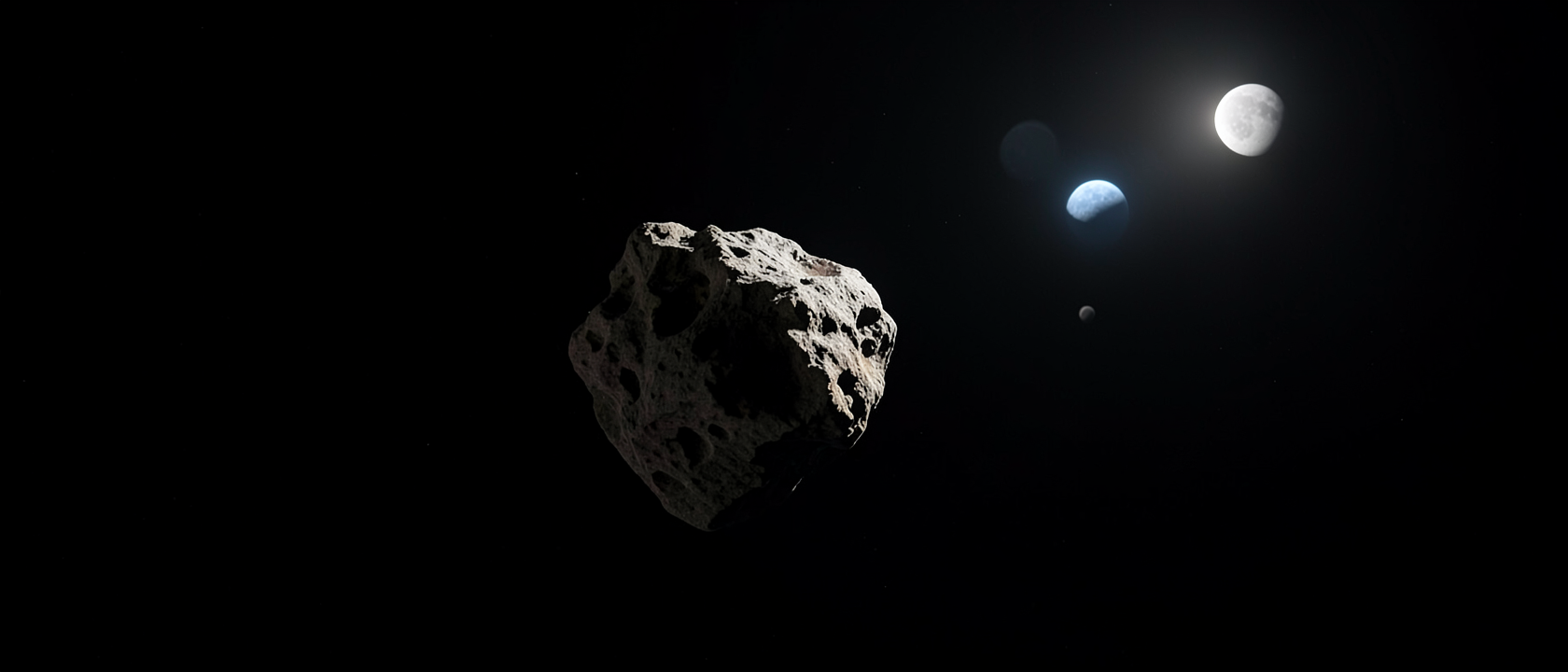
Close-approach data from the JPL/CNEOS orbital solution and JPL Small-Body Database, verified September 2026. Size range estimated from H = 25.4 using the standard albedo bracket 0.05–0.25 per Minor Planet Center methodology; this is a derived estimate, not a direct measurement. No photograph of 2015 TS238 exists; any image accompanying this article is an orbital diagram from the JPL Small-Body Database or an artist’s illustration, and is labeled as such.