
A House-Sized Rock Slipped Past Earth, Close Enough to Log and Far Enough to Ignore
It passed close enough to be logged and far enough that nobody blinked. On October 18, 2026, near-Earth asteroid 2026 TS crossed Earth’s neighborhood at a measured distance of about 563,600 miles (907,000 km), roughly 0.00606 of an astronomical unit (AU), the average Earth–Sun distance of 149,597,870 km that serves as the standard ruler out here. The figure came out of a database, not a photograph.
The measuring stick: how far out is “close”?
A number in kilometers doesn’t mean much until you set it against something you’ve actually watched cross the sky. The Moon sits an average of 238,854 miles (384,399 km) from Earth, close enough that you’ve tracked it rising over a parking lot more nights than you can count. 2026 TS passed about 2.36 times farther out than that: stack two and a third Earth–Moon gaps end to end, and that’s the lane it used. Astronomers reach for lunar distances instead of the AU for exactly this reason, it’s the ruler people already carry in their heads.
How we know
Nobody caught 2026 TS in one photograph announcing its position. NASA JPL’s Center for Near-Earth Object Studies (CNEOS) built the distance and date from repeated astrometric measurements, survey telescopes clocking the asteroid’s position against background stars, night after night, fed into orbit-fitting software. The result, logged in CNEOS’s Close-Approach Data, is a calculated trajectory refined from many observations, not a single snapshot. Public mirrors of that dataset place the moment of closest approach at 06:16 UTC. Those same mirrors list a closing speed near 10.3 kilometers per second (about 23,000 mph), consistent with the rest of the entry, but not yet checked against JPL’s own primary listing, so treat that number as provisional.
Estimate: how big is it, really?
Size is the one figure nobody measured directly. Public listings give 2026 TS an absolute magnitude, a standardized brightness value, corrected for distance, of H=24.06. Run that through the standard brightness-to-size conversion, assuming a surface reflectivity (astronomers call it albedo) somewhere between 0.25 and 0.05, and the diameter comes out between roughly 135 and 302 feet (41 to 92 meters): the spread between a single-family house and a mid-rise apartment block. That magnitude value hasn’t been cross-checked against a primary JPL catalog page either, so this size range is an estimate stacked on an estimate, useful, but not settled.
Why “2.36 times the Moon” sounds safer than it is
Earth-scale instincts don’t transfer well out here. Nearly four hundred thousand extra miles of empty space feels comfortable, but on the scale where distances get quoted in astronomical units, this is roughly the solar system’s front yard. 2026 TS is catalogued as an Apollo-group asteroid, meaning its path around the Sun crosses Earth’s own, and it was never aimed at this planet to begin with. A pass this routine gets logged, not alarmed over. The real story isn’t a near miss. It’s that ground-based survey networks are now sharp enough to track something this small, this far out, as a matter of bookkeeping.
What’s still open
2026 TS’s exact diameter within that 41-to-92-meter estimate, its true albedo and composition, its precise closing speed, and which survey telescope first picked it up all remain unresolved in the record available for this piece. CNEOS refines its solutions as more observations arrive; none of these numbers is locked down yet.
The picture
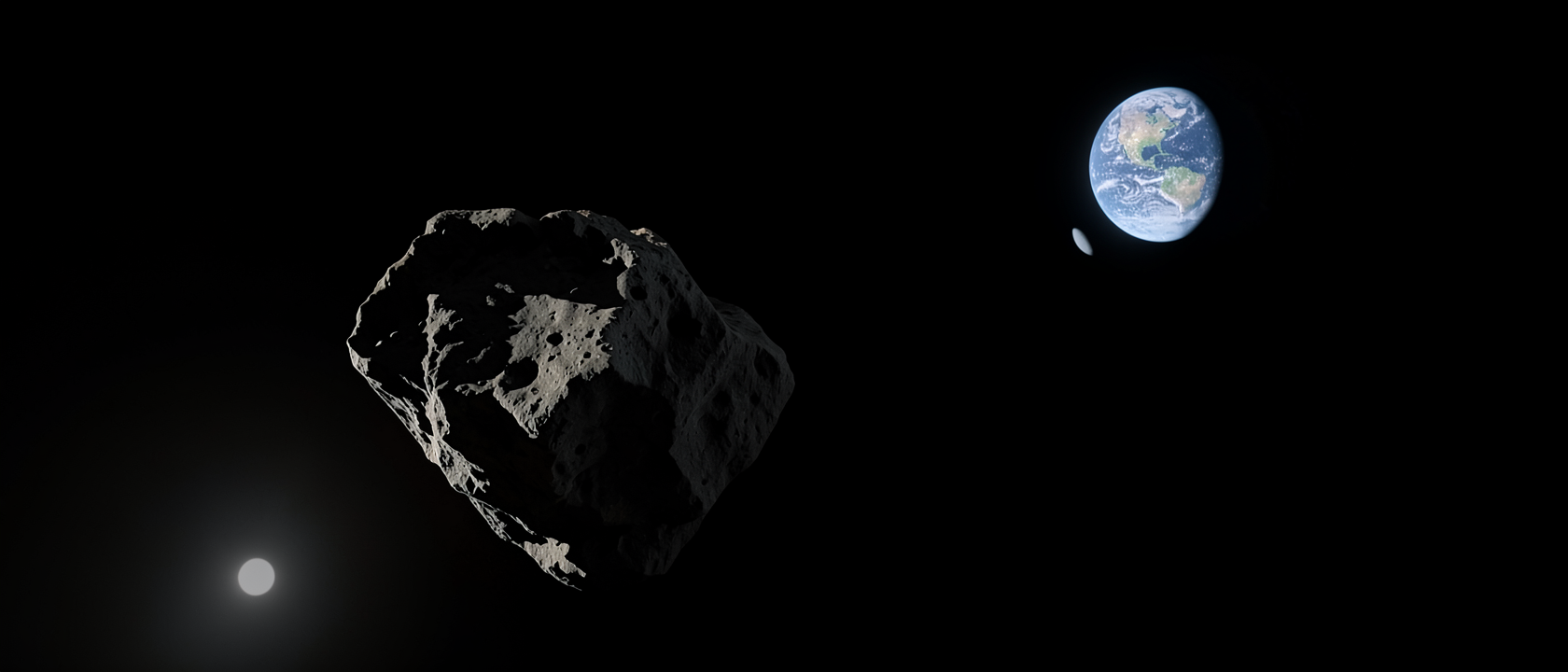
There’s no photograph of 2026 TS, it’s too small and too fast for anything but survey telescopes built to catch a moving point of light, not a shape. What exists is a CNEOS orbit diagram: a plotted curve showing the asteroid’s calculated path sliding past Earth’s, generated by the same orbit-fitting software that produced the distance and the date. It carries no individual photo credit, it’s a product of the math, not a snapshot from any one observatory. It’s a diagram, not a photograph, and that’s the honest way to show this flyby.