
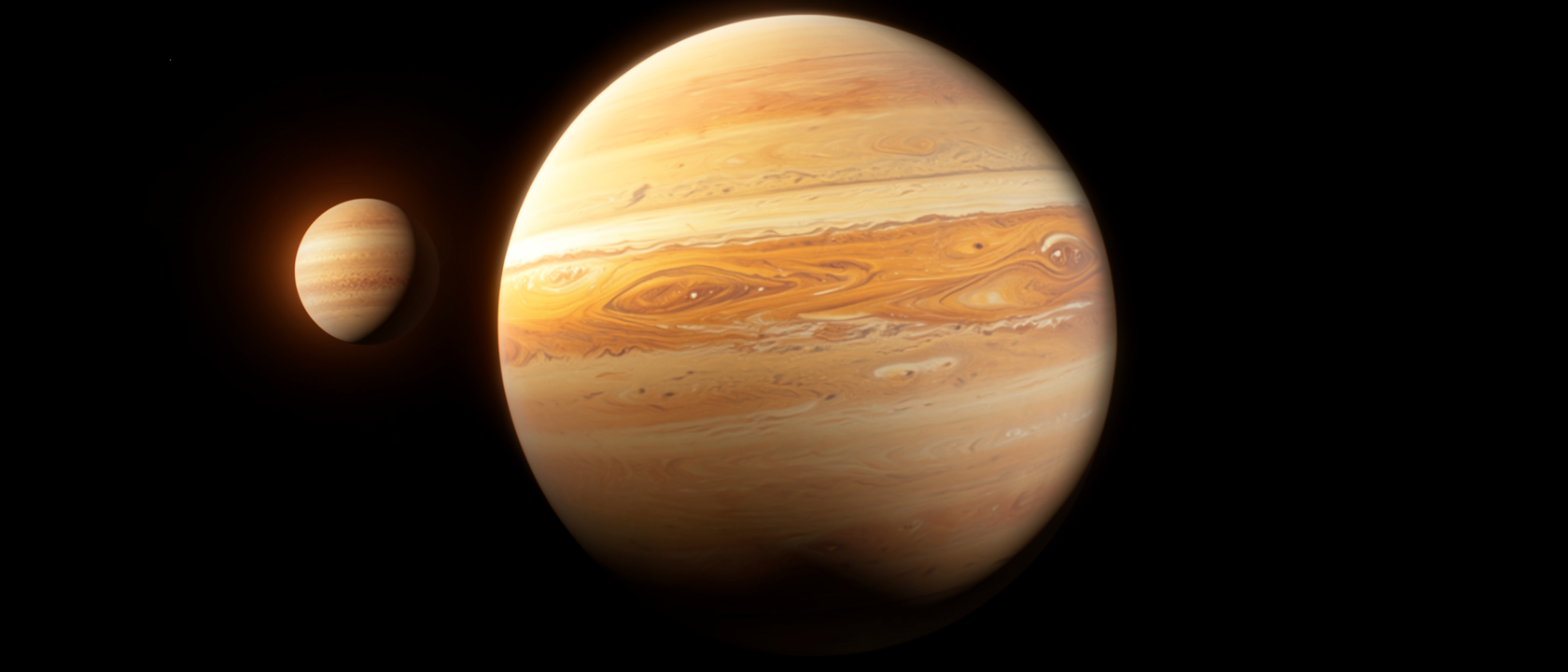
A Gas Giant Roughly Twice Jupiter’s Size, Built Like Foam
Start with Jupiter, the banded giant on every solar-system poster, then stretch it, with a caveat attached. HIP 65 A b, a planet orbiting a small, orange-tinted star called HIP 65 A, has an estimated radius of about 90,160 miles (145,100 km), roughly twice Jupiter’s own radius of 43,430 miles (69,900 km), and close to 22.8 times Earth’s radius of 3,959 miles (6,371 km). Jupiter is already the biggest planet in our own solar system. This one appears to be built on a noticeably bigger frame, and, as the numbers below show, packed with a lot less material than that size suggests. But hold that number loosely. It’s the best estimate we have, not a settled measurement.
The measuring stick comes with an asterisk
That radius isn’t as solid as it sounds. HIP 65 A b’s orbit is tilted so that, from our line of sight, the planet skims the very edge of its star’s disk instead of crossing the middle, what astronomers call a grazing transit. That geometry makes the resulting dip in starlight much harder to read cleanly, so the size pulled from the data is genuinely fuzzy. The discovery team’s best estimate is 2.03 Jupiter radii, but the honest range runs from 1.54 to 2.64 Jupiter radii. A later re-analysis landed on roughly the same answer and flagged the same problem: with a transit this grazing, the exact size stays unreliable no matter how carefully you crunch the light curve. “Roughly Jupiter-sized, possibly twice over” is closer to the truth than any single clean number.
How we know
Astronomer L. D. Nielsen and colleagues confirmed HIP 65 A b in July 2020, using brightness data from NASA’s TESS mission, alongside two other ultra-short-period hot Jupiters, gas giants that circle their stars in hours instead of years, reported in the same paper. No telescope has photographed this planet, and none will: it sits roughly 202 light-years away, worked out from its measured distance of 61.89 parsecs (a parsec runs about 3.26 light-years). What exists instead is a light curve, a tiny repeating dip in starlight each time the planet crosses in front of its star. The depth of that dip gets translated into a radius, and a grazing, edge-skimming transit leaves plenty of room for error in that translation.
Lighter than it looks
Pair that oversized, uncertain radius with a measured mass of 6.099 × 10^27 kg, about 1,021 Earth masses, worked out from the gravitational tug the planet puts on its star, and the arithmetic gives an estimated bulk density of roughly 480 kg per cubic meter. Saturn, the solar system’s own “would float in a bathtub” planet, is denser than that, at about 687 kg per cubic meter. HIP 65 A b undercuts it. This density figure rides on both a shaky radius and a solid mass, so treat it as an estimate layered on an estimate. Even at the low end of the uncertainty, this is a world built from puffed-up gas, not packed-in material.
A day longer than its year
HIP 65 A b completes one full orbit in about 84,756 seconds, roughly 23.5 hours, timed precisely from TESS observations. That’s shorter than one full spin of the Earth on its own axis. Modeling built from the star’s brightness and the planet’s orbital distance puts its equilibrium temperature, a theoretical balance between starlight absorbed and heat radiated back out, not a direct thermometer reading, at around 2,080°F (1,411 K), with sunlight striking it at about 899,621 watts per square meter, roughly 661 times what Earth receives from the Sun. That intense heating is one plausible reason the planet puffed up this far, though it isn’t a settled answer.
What’s still open
Why HIP 65 A b holds a radius this large on a mass this modest isn’t resolved. Heavy stellar heating is a plausible driver, not a proven one. Separate research teams even disagree on whether the planet’s ultra-short orbit is slowly shrinking or holding steady over time, one study found the orbit lengthening by about 22 milliseconds a year, another found no measurable change at all. Every number here, radius, density, temperature, sits in a catalog that gets revised as better observations come in. What you won’t find, now or ever, is a photograph: there’s only the dip in starlight, the arithmetic built on top of it, and at best an artist’s illustration guessing at the color of a world no eye or camera has actually seen.