
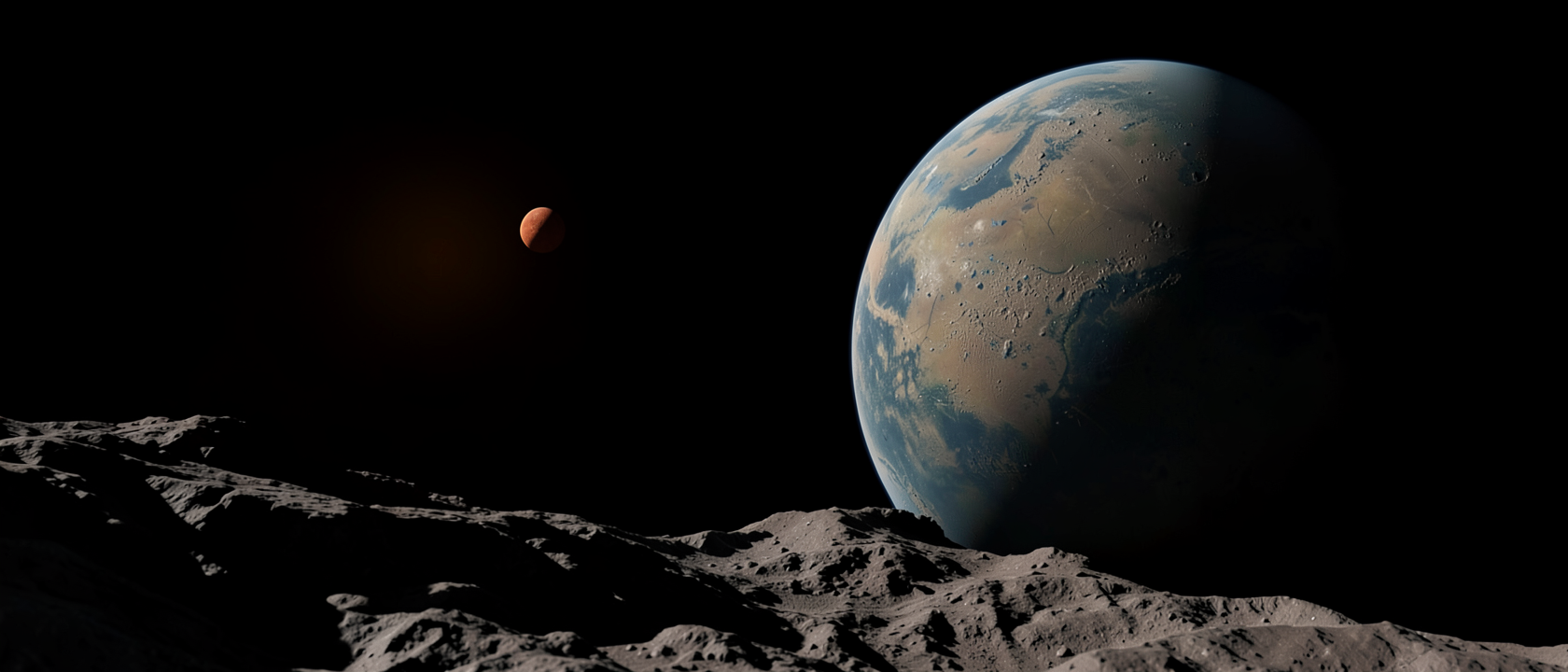
Kepler-49 e: Checking a Number That Didn’t Add Up
A density figure has been circulating for a planet orbiting another star: something like a hundredth of Earth’s own heft, light enough to beat packing foam. Run the actual catalog numbers for that planet, mass and radius, both on file with NASA, and the figure doesn’t survive the math. The planet is Kepler-49 e, a world about 1.56 times Earth’s radius, orbiting a small red dwarf star roughly 1,024 light-years away (a light-year is a distance, not a stretch of time, about 9.46 trillion kilometers). Recalculated honestly, its density comes out to roughly 4,400 kilograms per cubic meter (4.4 grams per cubic centimeter), nowhere near a hundredth of anything.
The Real Measuring Stick
Earth’s own average density, 5,514 kilograms per cubic meter, is the number every solid planet gets stacked against. Kepler-49 e lands at about 0.80 times that figure, lighter than Earth, but only modestly, nothing close to the gap a hundredth of Earth’s density would represent. A hundredth of Earth’s density would mean something closer to a gas giant’s puffed-up outer layers, a thick envelope wrapped around very little mass. That’s not what the measured numbers support here. What exact mixture of rock, water, or gas makes Kepler-49 e a bit lighter than Earth is still an open question, but “a bit lighter” is the honest range, not “a hundred times lighter.”
How We Know
No telescope has ever resolved Kepler-49 e into a disk. It was found the way most close-orbiting exoplanets are: NASA’s Kepler space telescope caught its star dimming by a tiny, repeating fraction of its light every 18.6 days, as the planet’s silhouette crossed in front of it. That dip in brightness, a transit, hands over the radius directly: the deeper the dip, the bigger the disk doing the blocking. Kepler-49 e’s radius works out to about 1.56 times Earth’s, roughly 6,176 miles (9,940 km), measured outward from the planet’s center, never across it.
Kepler-49 e is the outermost of four transiting planets found around the same star. It and the innermost planet, Kepler-49 d, were the last two confirmed, validated by Rowe et al. in 2014, a year after the system’s two middle planets had already been confirmed through transit-timing variations: small gravitational tugs that show up as each planet’s transit arrives slightly early or slightly late, depending on where its neighbor sits in orbit at the time. For those two middle planets, the tug was clean enough to pin down real masses.
What We Don’t Know
For Kepler-49 e, that same method came up short. The published models don’t meaningfully constrain its mass. The catalog’s working figure, 3.05 Earth masses, most likely comes from a different approach entirely, a model estimating typical mass from typical radius, not a direct dynamical mass measurement. Confusingly, another part of the same NASA catalog entry lists 1.04 Earth masses for the same planet instead. That’s not two independent measurements landing on different answers; it’s one unresolved mismatch sitting inside a single data table.
Neither of those two mass figures, paired with the measured radius, gets anywhere close to the hundredth-of-Earth figure that has been circulating. There’s no honest route from NASA’s own numbers to that claim, it reads like a data error picked up somewhere outside the original sources, not a newer or better measurement. The planet’s orbit is also listed as a perfect circle, eccentricity, the measure of how stretched an orbit is, at zero, though for a close, short-period world like this one, a circular orbit is sometimes a modeling default rather than a tightly measured shape. Worth flagging, not worth treating as settled.
What’s left is an honest shrug: until Kepler-49 e gets a secure, independent mass measurement, its real density, and what it’s actually built from, stays open. No camera has ever captured it, and none will with current instruments; what exists is Kepler’s light-curve data and any illustration drawn from those numbers, which is exactly that, an illustration, never a photograph. Checking the number, in this case, mattered more than repeating it. Next time a jaw-dropping exoplanet stat crosses your feed, you now know the two questions worth asking before you pass it on: whose instrument made this, and is it a measurement or someone’s best guess?