
A Planet That Can’t Sit Still
Picture a planet that packs into ten days what Earth spreads across an entire year: swinging in close enough to scorch, then flung back out far enough to freeze, every single lap, with no gentler orbit to fall back on. That planet has a name: GJ 3222 b, orbiting a star 59.5 light-years away.
The Measuring Stick
Orbital eccentricity is a ratio from 0 to 1. Zero is a perfect circle; closer to 1 means a longer, thinner ellipse, until it opens into a parabola that never closes. Mercury, the Solar System’s own lopsided outlier, measures 0.2056, already the planet astronomers point to when they want an example of “eccentric.”
GJ 3222 b measures 0.929 (+0.042/−0.080 in the current fit). Divide that by Mercury’s number and the orbit comes out about 4.5 times more eccentric than the most extreme planet we have at home. Past that point, Mercury stops being the useful comparison, a long-period comet, swinging in from the outer dark and back out, is the shape that actually fits. For scale, Earth’s own orbit sits at 0.017, close enough to round that nobody noticed it wasn’t a perfect circle until instruments could measure it, GJ 3222 b’s orbit is roughly 55 times more stretched than that.
How We Know
Nobody has watched GJ 3222 b cross its star, and no camera has photographed it. It was found by radial velocity, a spectroscopic method that studies the star, not the planet: as the planet orbits, its gravity tugs the star back and forth, stretching and compressing the star’s light in a pattern a spectrograph can catch. That wobble was pulled from GJ 3222’s spectrum in 2022 by Feng and colleagues, and the orbit was refined in 2023 by Philipot and colleagues, the analysis that fixed the eccentricity at 0.929.
The planet laps its star in 10.667 days (921,601.8 seconds), at an average distance of 0.091 AU, an astronomical unit being the average Earth-Sun distance, about 93 million miles. That works out to roughly 8.46 million miles (13.61 million kilometers) of semi-major axis, a tight loop for an orbit this extreme. Earth spreads its seasons across 365 days; GJ 3222 b runs its whole year in barely more than a week, with a scorching pass near periastron, an orbit’s closest point to its star, followed by a swing out toward apastron, on repeat.
Numbers That Come With a Warning Label
Several of this planet’s vital statistics were never measured, they’re modeled, and the catalog says so. Its minimum mass stands on firmer ground: about 6.83 × 10^25 kilograms, roughly 11.4 times Earth’s mass, calculated from how hard the planet pulls on its star. Even that carries an asterisk, radial velocity can’t fix the orbit’s tilt, so 11.4 Earth masses is a floor, not a confirmed total.
The radius is modeled through and through: about 13,480 miles (21,700 kilometers), or 3.4 times Earth’s own radius, estimated from a mass-to-radius relation used when a planet doesn’t transit and can’t be measured directly. Pair that modeled radius with the minimum mass and density comes out to roughly 1,600 kilograms per cubic meter, about 0.29 times Earth’s 5,513 kilograms per cubic meter, a number that reads less like rock and more like a small, puffy world built from gas and ice, closer in kind to a scaled-down Neptune.
Temperature follows the same rule. An equilibrium temperature near 811 K (538 °C) and an average insolation, the starlight energy a planet receives, of roughly 67.6 times Earth’s own are both calculated from orbital distance and stellar brightness, not measured by any instrument reading the planet’s atmosphere. And “average” hides the real story: on an orbit this stretched, there’s no steady day to average, only a searing pass close in, then a cooler one farther out, repeating every 10.667 days.
The Picture That Doesn’t Exist
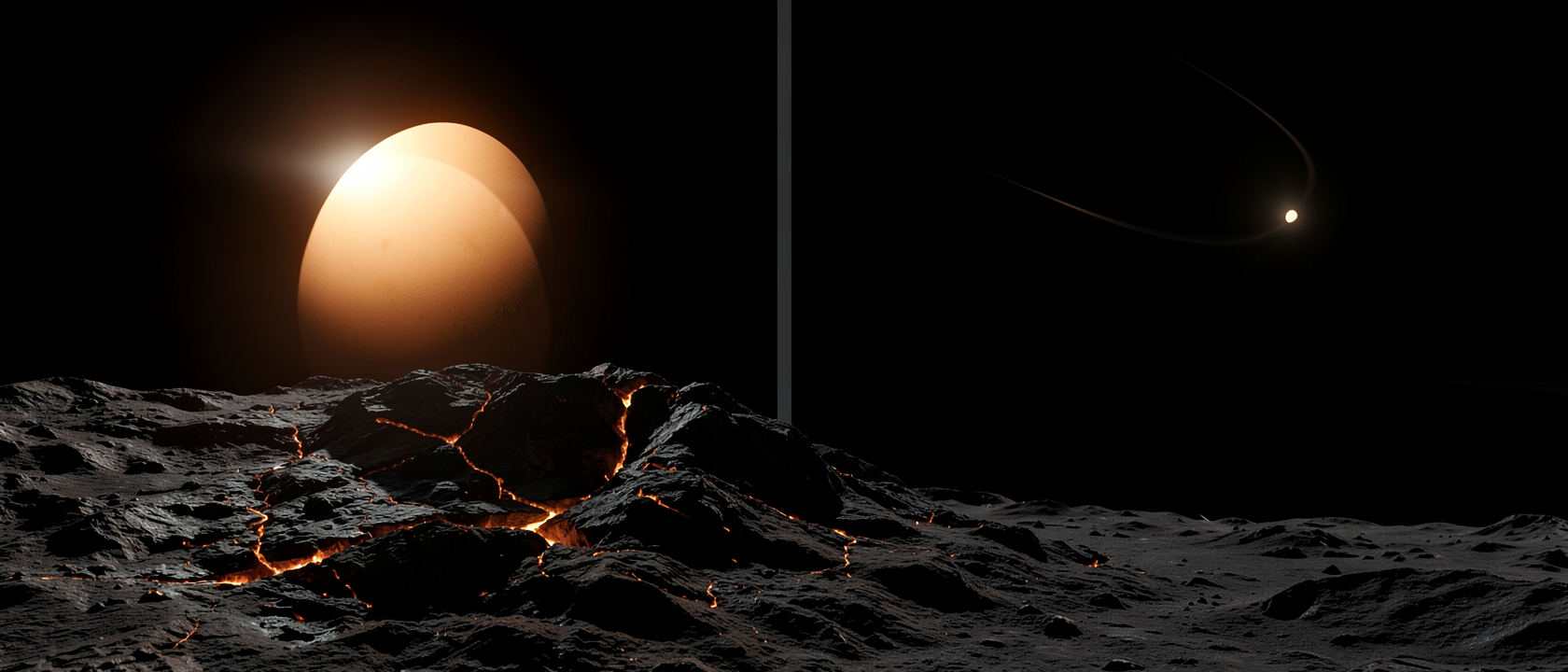
There is no photograph of GJ 3222 b, and the method that found it means one isn’t coming soon. Radial velocity reads a wobble in starlight; it never puts the planet itself inside a camera’s field of view. Any image attached to this planet’s story is an artist’s illustration, not a capture, the honest picture here is a diagram: a near-perfect circle for Earth’s orbit, next to a long, narrow ellipse for this one.
What’s Still Open
Two things remain unresolved. One is dynamical: tidal forces near periastron should, over long stretches of time, round an orbit out rather than keep it this stretched. An eccentricity of 0.929 is hard to explain as something that lasts, and a stability study of the GJ 3222 system has flagged this planet’s fitted orbit, alongside a more massive companion planet in the same system, as dynamically unstable under current assumptions.
The other is the number itself. 0.929 carries its own built-in uncertainty, +0.042 and −0.080, and figures this extreme tend to shift as more observations come in. It’s a real result from real spectroscopy, not a guess, but it’s also exactly the kind of number worth checking against the latest catalog entry before it gets repeated as settled fact.