
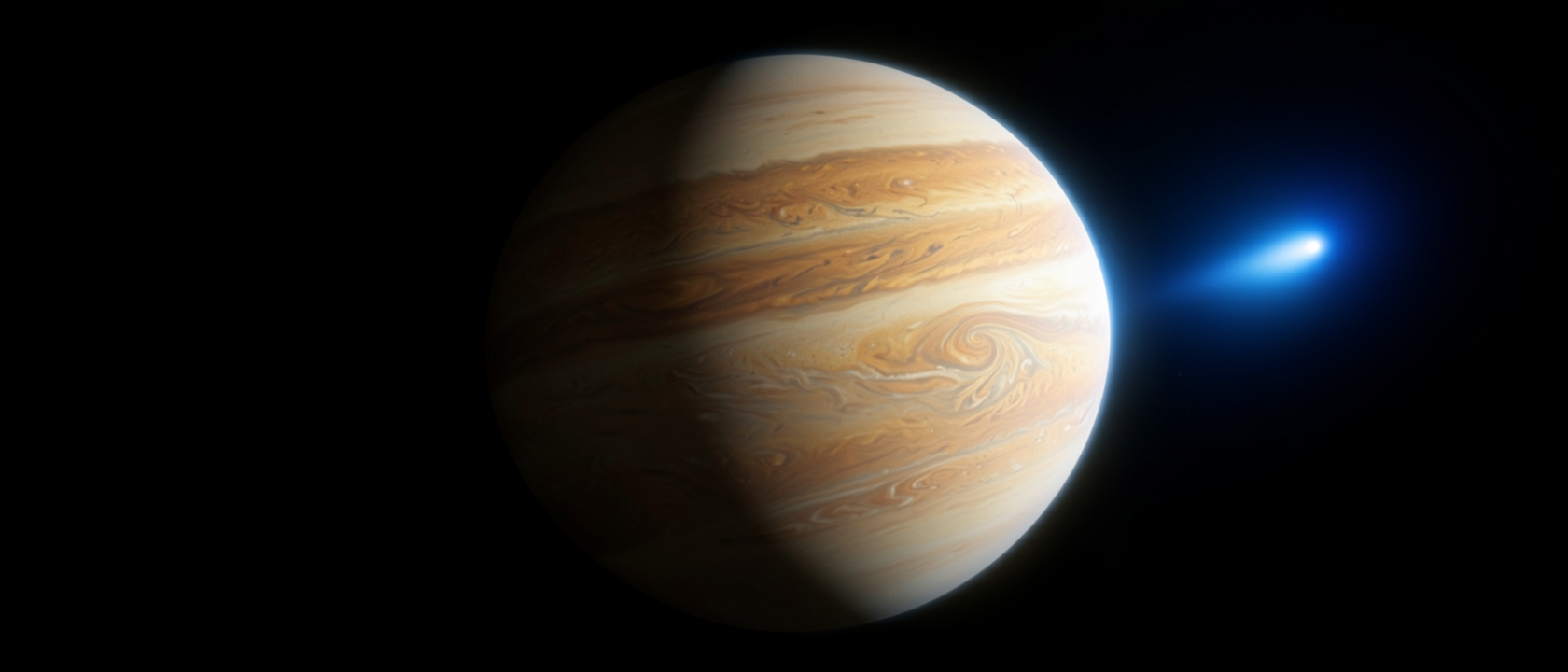
The Giant Planet That Would Float
Drop TOI-791 b into an ocean big enough to hold it, and it would bob on the surface like a beach ball. The planet’s bulk density works out to about 38 kilograms per cubic meter (38 ± 8 kg/m³), according to the team that confirmed it in 2026. Water is 1,000 kg/m³. That makes this world roughly 26 times less dense than the stuff filling your bathtub, even though it carries 9.5 times Earth’s mass. Nothing here is a typo. It’s just a planet built almost entirely out of puffed-up gas.
A Jupiter-sized planet, a thousand light-years out
TOI-791 b orbits an F7-type star called TOI-791, a bit hotter and heavier than the Sun, sitting about 1,113 light-years away (a light-year being a distance, roughly 5.9 trillion miles, not a span of time). The planet itself is close to Jupiter’s size, 0.993 Jupiter radii, or about 43,100 miles (69,400 km), making it close to 10.9 times Earth’s radius. But its mass is only 0.0299 Jupiter masses, about 5.67 × 10²⁵ kilograms, or 9.5 Earth masses. A big, light balloon of a planet, not a heavy one.
How we know
Nobody measured this planet’s density directly with an instrument; it’s calculated from two separate numbers taken years apart. Researchers using the ASTEP telescope, operated from Antarctica, caught multiple complete transits of TOI-791 b crossing in front of its star, each one lasting more than 11 hours, among the longest transits ever recorded start to finish from the ground. Those transits gave the planet’s radius, from how much starlight dimmed as it passed. The mass came from a different method entirely: tiny variations in the timing of those transits, caused by the gravitational tug of a second planet, TOI-791 c, sharing the same system. The planet was first flagged as a candidate in 2019 by volunteers on the Planet Hunters TESS citizen-science project, then confirmed through this follow-up work in 2026. Mass and radius are two different measurements, from two different techniques. Density is simply what you get when you divide one by the other, which is why the published figure carries real error bars, ±8 kg/m³ on a value of 38.
About that styrofoam comparison
You may have seen this planet described as lighter than packing foam. That comparison is tempting but shaky: ordinary expanded polystyrene foam ranges from about 11 to 50 kg/m³ depending on the grade, and no single verified “styrofoam density” sits on record to check TOI-791 b against. The planet’s 38 kg/m³ falls inside that wide range, but landing inside a range isn’t the same as matching a number. The water comparison is the one worth keeping, 1,000 kg/m³ is a fixed, well-defined figure, and 26 times less dense than that is a clean, checkable statement.
Where the intuition breaks
Tell someone a planet has 9.5 times Earth’s mass, and they’ll picture something crushing. But mass and radius pull in opposite directions here: stretch that mass across a sphere nearly 11 times Earth’s radius, and volume wins. The result is what astronomers call a “super-puff”, the ASTEP team describes TOI-791 b and its sibling planet as two of the lowest-density giant planets ever detected. A small, likely rocky or icy core probably sits at the center, with the bulk of the volume made up of a thick envelope of hydrogen and helium gas, barely holding together.
What’s still open
The planet’s heat comes from its star, 1.43 times the Sun’s mass and 3.77 times its luminosity, with the planet orbiting at 0.602 astronomical units (an AU being the Earth-Sun distance, about 93 million miles), roughly 56 million miles (90 million kilometers) out, completing one lap every 139.3 days on a nearly circular path. From that, researchers calculate an equilibrium temperature of about 434 kelvin (161°C, 322°F), a modeled figure, not a thermometer reading. A rough estimate puts the sunlight hitting it at around ten times what Earth receives, though that number is a back-of-envelope calculation, not a catalog figure, and should be read as an order of magnitude rather than something precise. Whether that heat is what’s inflating the atmosphere in the first place is a working hypothesis, not a settled answer. And no camera has ever photographed TOI-791 b, what exists is a dip in starlight and, eventually, an artist’s illustration. If you come across an image of it online, it’s a concept drawing, not a photograph.