A Planet That Would Float
Picture a world with about eight and a half times Jupiter’s mass, then picture it so puffed up that it would float if you could find a bathtub large enough to hold it. HD 100546 b’s modeled bulk density works out to roughly 2 lb/ft³ (32.1 kg/m³). Mass that big is supposed to mean something dense and crushing. Here it means almost nothing per cubic foot, because the planet’s radius is stretched out to around 77 times Earth’s.
The Measuring Stick
That 2 lb/ft³ figure is a model, not a scale reading, more on that below. Set it against expanded polystyrene, the white packing foam everyone has squeezed at least once: common grades run anywhere from about 0.6 to 3.1 lb/ft³ (10 to 50 kg/m³). HD 100546 b falls within that wide range, which is a real match but not a clean one, the exact comparison depends on which grade of foam you pick. Against a typical packaging foam around 3.1 lb/ft³, the planet is noticeably lighter. Against the lowest-density craft foams, the two are closer than you’d expect, and the planet might even lose.
A cleaner stick: Earth’s own bulk density is a solidly measured 344 lb/ft³ (5,514 kg/m³). HD 100546 b comes in at roughly 1/172nd of that. And to rule out “it’s basically a cloud”, sea-level air on Earth runs about 0.075 lb/ft³ (1.2 kg/m³), so this planet, diffuse as it is, is still about 27 times denser than the air in your lungs. Puffed up, yes. Empty, no.
How We Know
HD 100546 b sits inside the dusty disk still swirling around its young host star, HD 100546, itself roughly 359 light-years away. It was first glimpsed in 2013 as a faint smudge in images from the European Southern Observatory’s Very Large Telescope, using an adaptive-optics camera called NACO, optics that flex in real time to cancel out the blur of Earth’s atmosphere, paired with a coronagraph, a mask that blocks the star’s glare so something far fainter nearby can show up at all. A second telescope, Gemini South, picked up the same faint point in 2014, and a team led by Sascha Quanz formally characterized it in 2015.
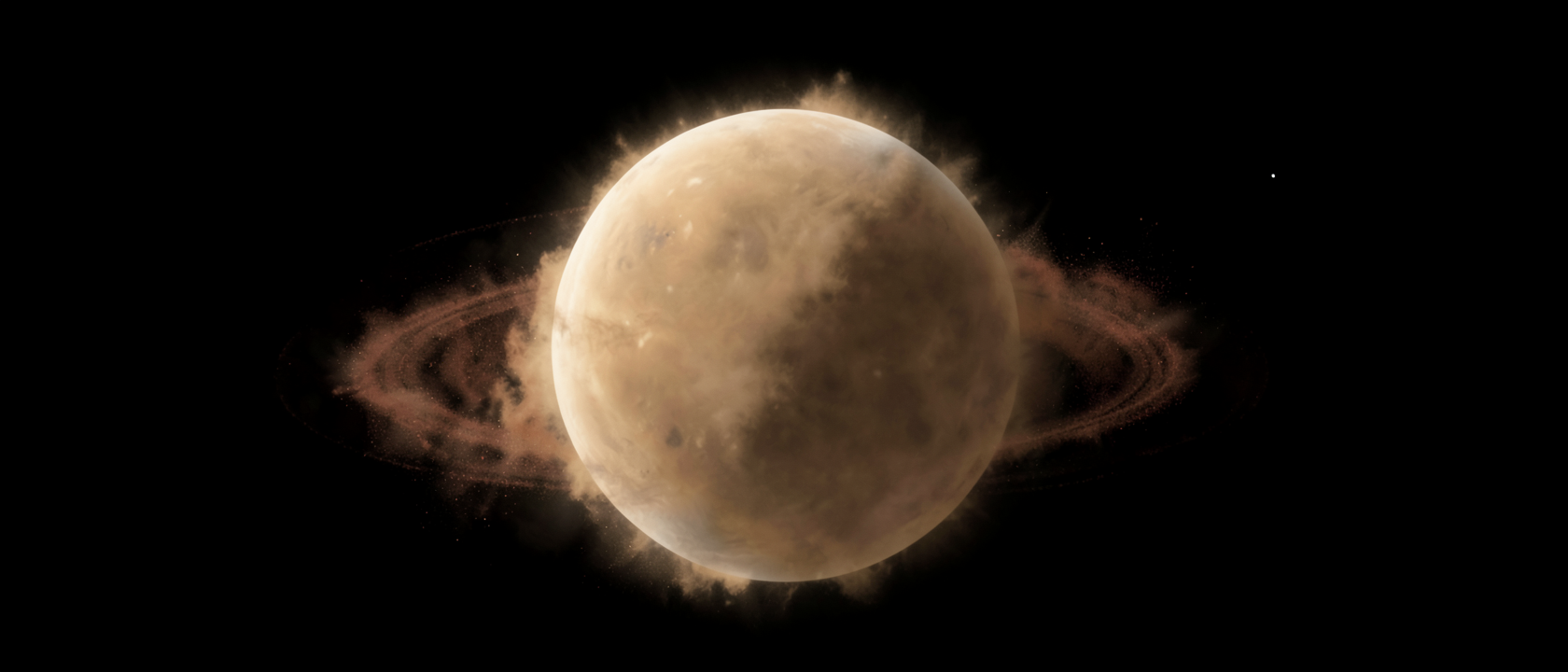
No camera has photographed the planet’s surface, that’s not possible yet for a world this far and this faint. What exists publicly is an artist’s impression from the European Southern Observatory, built from the disk imagery and the point-source brightness, not a photograph of anything solid.
Density itself was never read off an instrument. It’s built from two separately modeled numbers: a mass of about 1.613×10^28 kg (8.5 Jupiter masses, or about 2,701.5 times Earth’s mass) and a radius of about 306,500 miles (493,300 km, 77.4 times Earth’s radius), each estimated from the object’s brightness run through evolutionary models, theoretical tracks for how young, still-cooling planets should shine and shrink with age. Divide one estimate by the other and you get a third: an estimate stacked on estimates, which is why the range matters more than the decimal point.
Why the Number Feels Wrong
Mass over eight Jupiters should mean heavy, compact, dangerous to stand under. But density needs volume too, and volume is where this object cheats. Spread that same mass across a sphere 77 times Earth’s radius and it thins out so much that a genuinely enormous pile of matter ends up weighing almost nothing per cubic foot. It’s the planetary version of hammering a block of lead into a balloon the size of a house, heavy on a scale, nearly weightless by volume.
What’s Still Unsettled
Several things here are genuinely open. The brightness used to measure that huge radius may not be coming from the planet at all, researchers flag that it could be light from a circumplanetary disk, a ring of leftover dust and gas still wrapped around the planet, blended with the planet’s own glow. If that’s what’s inflating the radius, the real planet could be smaller and the real density higher than 2 lb/ft³ suggests. Independent studies also put the mass anywhere from roughly 1 to 25 Jupiter masses depending on the assumed age of the system, a spread of more than an order of magnitude. The NASA Exoplanet Archive lists HD 100546 b’s status in plain terms: “Confirmed Planet; Controversial.” Nobody has closed that file yet, and that’s the honest place to leave it.