
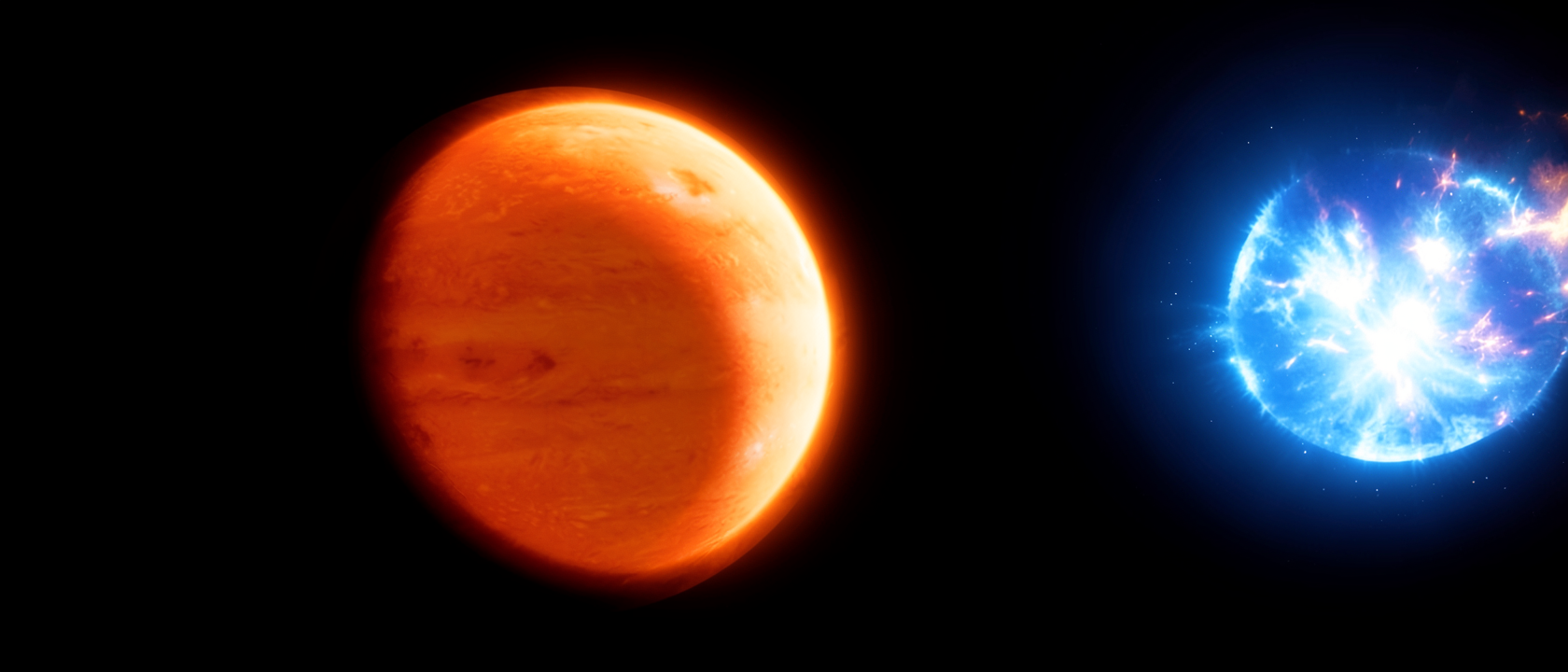
The Gas Giant Whose Dayside Nearly Melts Tungsten
Picture a planet the width of Jupiter, pulled so close to its star that its dayside runs at 3,353 K, a hair below the melting point of tungsten, the toughest-melting metal there is, and about 58% as hot as the Sun’s own surface. That’s WASP-189 b, and there’s no solid ground anywhere on it.
The measuring stick
The Sun’s visible surface sits at 5,772 K, the standard reference astronomers use for “how hot is a star.” WASP-189 b’s modeled dayside temperature, 3,353 K (with an uncertainty of +27/−34 K), works out to roughly 58% of that figure, more than half the brightness-heat of an actual star, coming off something still called a planet. Push the comparison toward something you could hold and it gets stranger: tungsten, the element with the highest melting point of any metal, turns liquid at 3,695 K. WASP-189 b’s dayside runs at about 91% of that. A block of tungsten sitting there would be most of the way to melting, with nothing but starlight doing the heating.
How we know
WASP-189 b was discovered in 2018, caught by the dip it causes in its star’s light every time it crosses in front, the transit method, which turns a few hours of dimming starlight into a measurement of a planet’s size and orbit. The temperature figure came later. In 2020, the European Space Agency’s CHEOPS spacecraft watched the planet pass behind its star across four separate occultations and measured how much the system’s total brightness dropped each time: just 87.9 parts per million, give or take 4.3 ppm. Fitting that dip to a model of a glowing, unreflective surface gave a brightness temperature of 3,435 K, plus or minus 27 K, a measured figure, tied directly to the observation. The 3,353 K number quoted everywhere else is one step removed: an equilibrium temperature, modeled from the same data under an assumption about how efficiently heat moves from the dayside to the night side. Same furnace, two different kinds of number, one measured, one calculated from it.
The host star doesn’t make this easier to picture as ordinary. WASP-189 is an A-type star, hotter than the Sun by class, with a measured surface temperature around 8,000 K, and it spins fast enough, about 93 kilometers per second at its equator, to distort its own shape. A planet orbiting that close to a star like that was always going to run hot.
A planet that won’t act like one
WASP-189 b carries 1.99 times Jupiter’s mass, 3.777 × 10^27 kilograms, measured from how hard it tugs on its star. Its radius comes in at 1.619 times Jupiter’s, or about 71,900 miles (115,700 kilometers), radius, not diameter. Divide one by the other and the density works out to roughly 582 kilograms per cubic meter, about 11% of Earth’s 5,514 kilograms per cubic meter and lighter than plain water. It orbits at just 0.05 AU, roughly a twentieth of the distance between Earth and the Sun, about 4.7 million miles (7.56 million kilometers) out, finishing a full year in 2.72 Earth days, on an orbit measured as circular. That much heat, that close, puffs a gas giant up instead of burning it down.
The picture that doesn’t exist
No camera has photographed WASP-189 b, and none will soon. CHEOPS and TESS measure brightness, a single number rising and falling, never an image. Any picture of this planet in circulation is an illustration, built from the measured size, orbit, and modeled temperature, not a photograph of anything real.
What’s still open
A 2026 study combining CHEOPS and TESS data mapped heat across the planet directly and came back with a lower dayside estimate, around 2,746 K, and a night side estimate of just 1,529 K, a figure the same study flags as likely too low, since the night side’s faint glow is hard to pin down. Whether that revises the 3,353 K figure, or simply measures something slightly different, isn’t settled. The same study checked for orbital precession, a wobble that fast-spinning, oblate stars can induce in a planet’s orbit, and found none large enough to measure. Nobody has stood close enough to this planet to take its temperature directly, every number here comes from watching starlight rise and fall, one dip at a time.