
One Lap, One Lifetime
Someone born the moment a particular point in Uranus’s orbit lines up with the Sun would be turning 84 by the time the planet swings back to that same spot. Not a metaphor, not rounded for effect: one full trip around the Sun, bookend to bookend, lasts about as long as a human life.
Uranus takes roughly 2.651 billion seconds (2.651×10⁹ s) to complete a single orbit, according to NASA’s NSSDC planetary fact sheet, which works out to 30,685.4 days. Put next to the one clock every reader has actually lived inside, Earth’s own year of 31.56 million seconds (365.256 days), and the comparison does the work: divide one by the other and you get about 84.0. Earth’s year isn’t picked because it’s tidy. It’s the only orbital period any of us has actually felt pass, birthday by birthday.
How We Know
Nobody clocked Uranus’s orbit with a stopwatch. The figure comes from centuries of patient bookkeeping: astronomers tracking where the planet sits against the background stars, year after year, since William Herschel first spotted it on March 13, 1781. That long positional record got its one direct correction in 1986, when NASA’s Voyager 2, the only spacecraft ever to fly past Uranus, sailed through the system on January 24 of that year and sharpened the orbital math that telescopes alone had been assembling for roughly two centuries. No probe has gone back since to check the arithmetic in person.
Not a Number With a Decimal Point
Treat 2.651 billion seconds as a rounded reference value, not a laboratory-grade measurement. Uranus’s path is very slightly egg-shaped: an eccentricity of about 0.047, compared with a perfect circle’s zero, so the exact length of one lap depends a little on where along that ellipse you start counting. The fact sheet is also explicit that this is the sidereal period, timed against the distant stars, not the synodic period, which is how long it takes Uranus to reappear at the same spot in Earth’s night sky, a much shorter 369.66 days. A second published compilation puts the ratio at 84.0205 rather than 84.0. Close enough to hang a sentence on. Not close enough to hang a decimal point on.
Don’t Mix Up the Clocks
Three Uranus numbers get tangled together, and they measure three different things. The orbit, 2.651 billion seconds, is how long the year lasts. The rotation is a separate, much shorter figure: about 62,064 seconds, roughly 17.2 hours, and it runs retrograde, spinning in the direction opposite to its orbit around the Sun. And the axial tilt, 97.77°, isn’t a duration at all. It’s the planet lying almost flat on its side as it travels, rolling around the Sun like a dropped ball instead of spinning upright the way Earth does. Put the tilt and the orbit together and each pole gets, on average, approximately 21 Earth years of unbroken daylight, then approximately 21 years of dark, inside that single 84-year lap, a season longer than most people’s working lives. That 21-year figure is a simple quarter-split of the 84-year orbit, a rough way to picture the swing, not a precise seasonal boundary measured at either pole.
What’s Still Open
Two things the primary NASA source doesn’t pin down: the precision NASA itself assigns to 2.651 billion seconds, and the exact convention behind the published figure, sidereal versus a close relative called the tropical period. Neither has a clean answer sitting in the public fact sheet. That’s not a reporting gap. It’s a gap in what’s been stated outright.
The One Photograph
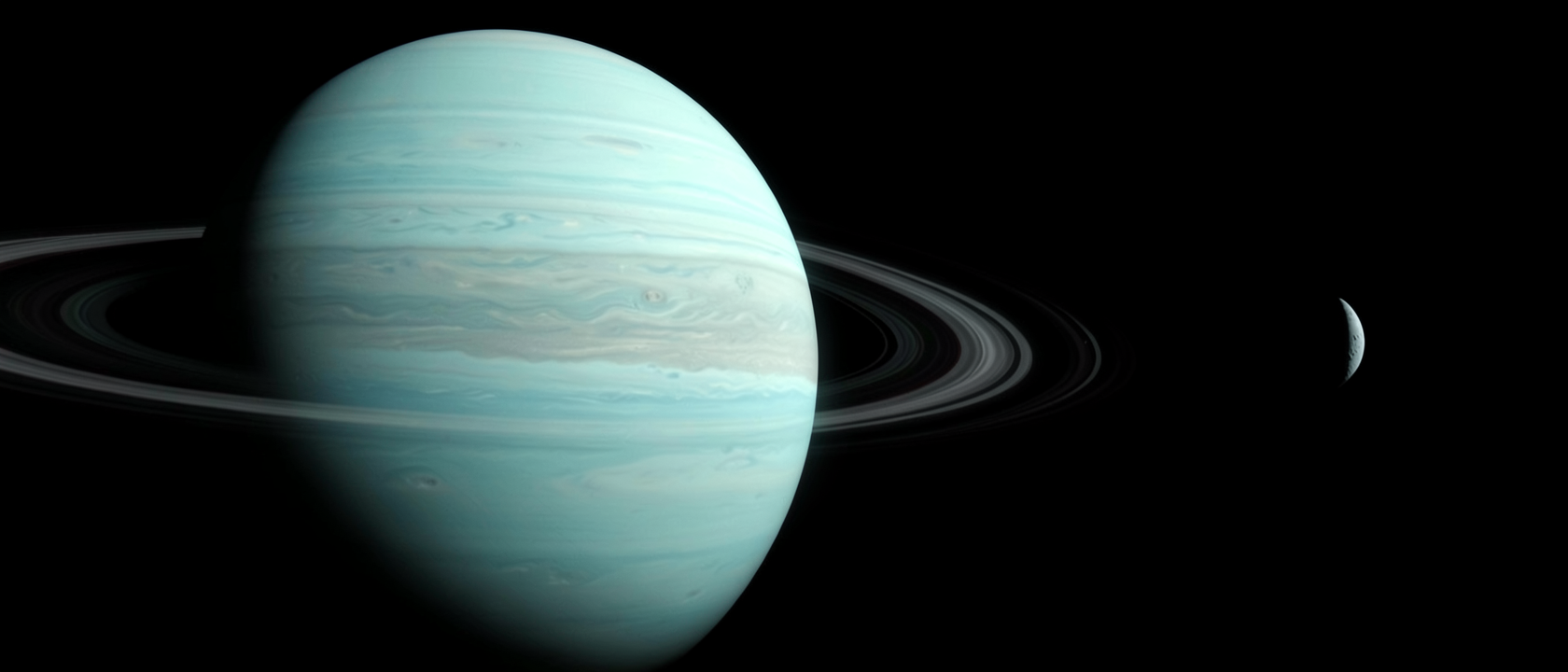
There is exactly one close-up photograph of Uranus, and it’s real: Voyager 2’s camera, on its single pass in January 1986, caught a smooth, nearly featureless blue-green disk, the color coming from methane in the atmosphere soaking up red light. The Hubble Space Telescope has photographed Uranus since, from Earth orbit, tracking seasonal changes across its disk and rings over the decades. But the only spacecraft to ever get close took its pictures and kept going. For a planet whose year outlasts most of a human attention span, that’s the whole photographic record: one flyby’s worth of images, set against an orbit that takes 84 years to close.