
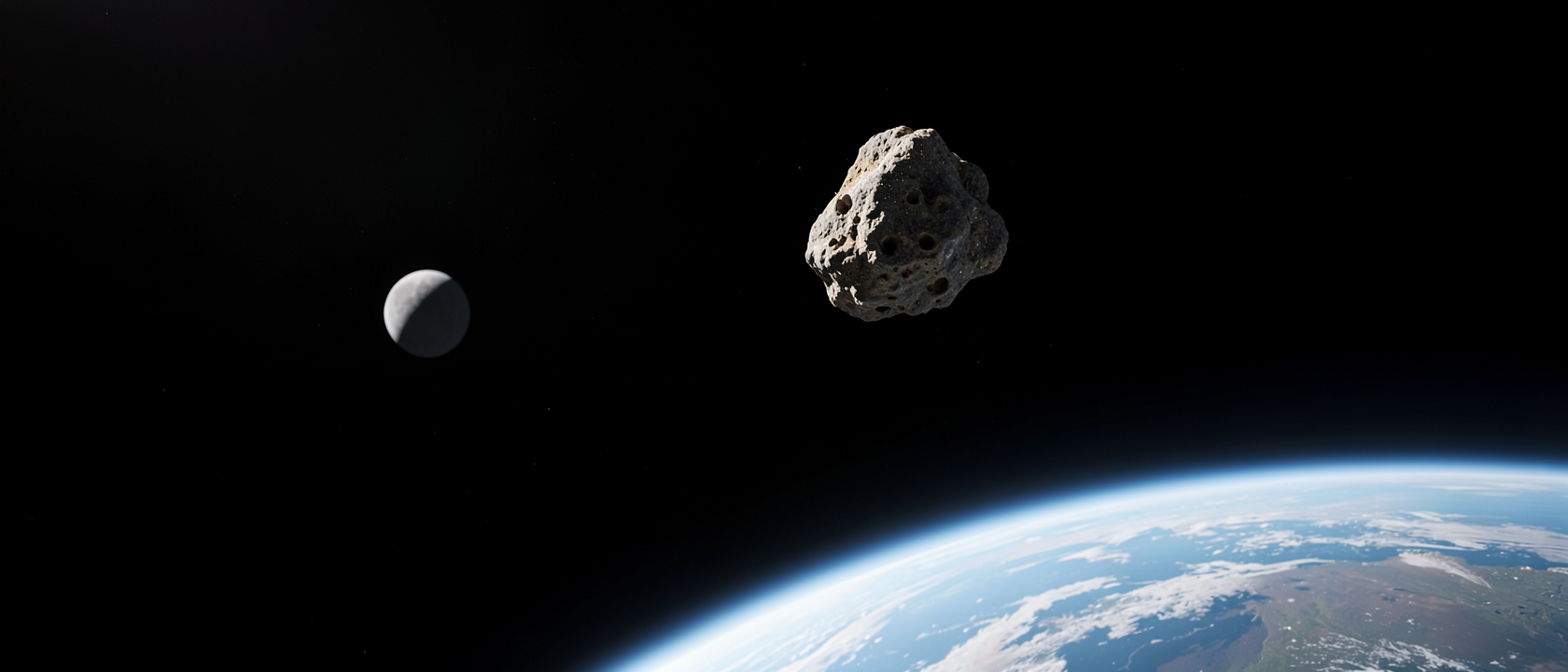
A rock passed inside the Moon’s orbit, and nobody blinked
A rock roughly the size of a house slid past Earth at about 58,900 miles (94,753 km), close enough that it cut inside the Moon’s own orbit, about four times nearer to us than the Moon ever gets. The pass happened on September 15, 2026, at 07:36 UTC. The object, cataloged as asteroid 2026 RG15, came, was tracked, and left. No alert, no “near miss” headline earned, because a near miss isn’t what this was. It was a clean pass, logged the way thousands of these passes are logged every year.
The Moon is the measuring stick most people already carry around: 238,855 miles (384,400 km), the number behind “that’s far, but not that far.” 2026 RG15 came in at roughly a quarter of that distance. You don’t need a new unit to feel it, just take the gap you already trust as close, and cut it to a quarter. Oddly, that makes it harder to picture, not easier. The Earth-Moon distance already reads as intimate in casual thinking, so dividing it by four tends to undersell the result rather than sharpen it. That gap between what the arithmetic says and what the gut expects is most of the story here.
How we know
The distance comes from NASA’s Jet Propulsion Laboratory, whose Center for Near-Earth Object Studies tracks and logs these encounters. The object was first picked up in Chile roughly three days before the pass, the exact survey and discovery time aren’t confirmed in the record used here, and then followed from Brazil as well. At Serra da Piedade, observers caught it on two separate nights, adding four more position measurements between 21:54 and 22:03 UTC on September 14, published in a Minor Planet Electronic Circular, the standard bulletin astronomers use to share new orbital data. By the time of closest approach, the rock had already dropped below the horizon as seen from Minas Gerais, tracked right up until the sky itself got in the way.
JPL rechecked the math on September 16 using 49 separate measurements, tightening the orbit solution. As the asteroid closed in, its brightness rose from magnitude 18 to near magnitude 15, still thousands of times fainter than the dimmest star you could ever see without a telescope. Nothing about this pass was visible to the naked eye, at any point, from anywhere.
How big, exactly? Nobody knows precisely
Nobody measured this rock with a ruler or bounced radar off it. What JPL recorded is its absolute magnitude, a brightness value, 26.16 with an uncertainty of 0.51, which describes how much sunlight the object reflects, not its size directly. Turning brightness into a size means guessing at albedo, how much of that sunlight the surface actually bounces back, somewhere between 0.05 for a soot-dark rock and 0.25 for a brighter one. Run the math across that range and you get an estimated diameter of about 53 to 115 feet (16 to 35 meters), a delivery truck on one end, a mid-size building on the other. The same light reaching the telescope could have come from two very different rocks.
What’s still open
The actual surface composition and reflectivity of 2026 RG15 were never measured, the whole diameter range rests on an assumed albedo, not an observed one. The exact date, time, and observatory that first spotted it in Chile aren’t pinned down in the record used for this piece, either; “roughly three days before the pass” is as specific as it gets here. Nothing is known about its rotation or shape. None of that is being withheld. It’s simply what you get from a faint, fast-moving point of light tracked for a handful of nights, rather than a spacecraft flying past with cameras running.
There’s no photograph of 2026 RG15, and there won’t be one. At 53 to 115 feet across and moving at roughly 20,400 mph (32,800 km/h) relative to Earth, it never showed up as more than a dot moving across a telescope frame, a point of light, not a shape. The only visual that honestly represents this event is a schematic orbit diagram from JPL, showing the trajectory crossing Earth’s neighborhood. That’s not a photograph standing in for the real thing. It’s the actual shape of what tracking an object like this looks like.