
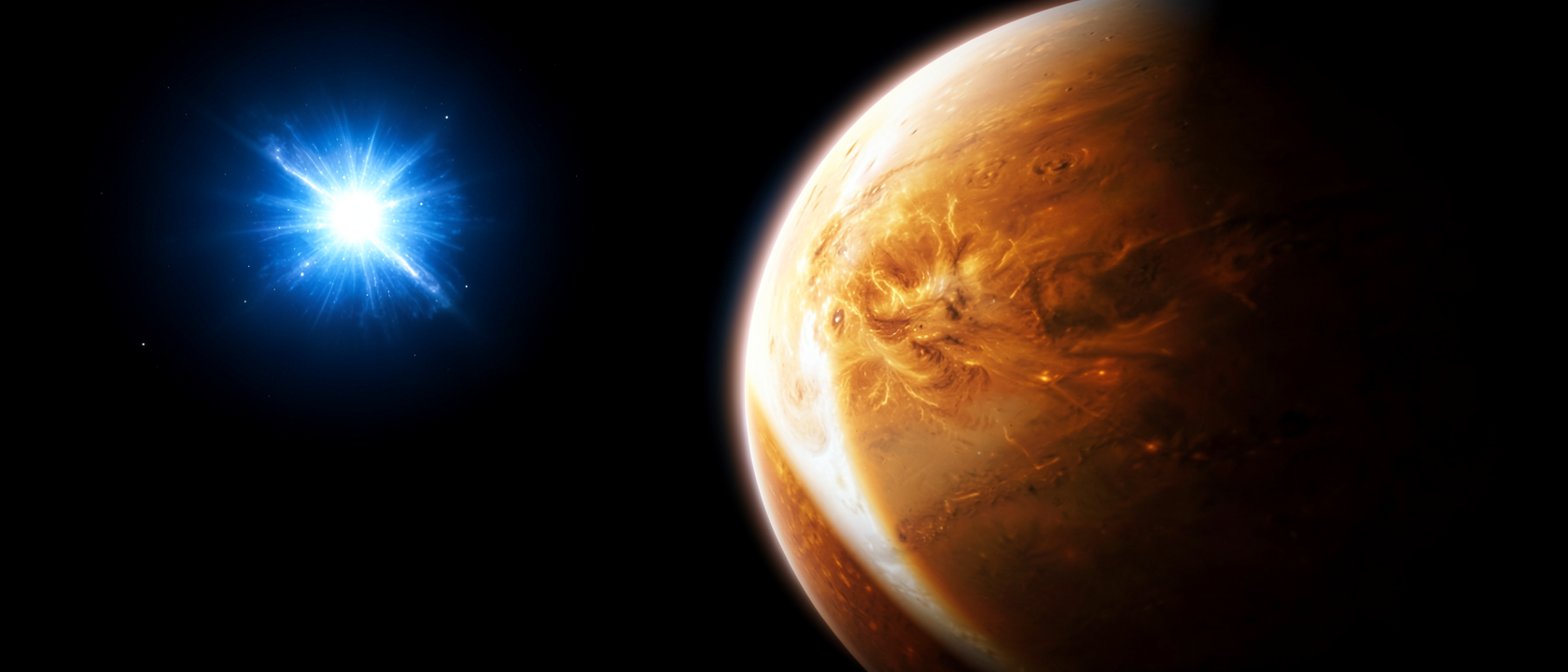
KELT-9 b: A Planet That Runs Hotter Than a Star’s Surface
Point a thermometer at the dayside of KELT-9 b and it would read about 4,600 kelvin (roughly 4,327 °C). That number belongs on a star’s spec sheet, not a planet’s. It’s close to four-fifths of the temperature of the Sun’s own visible surface, the photosphere, measured at 5,772 kelvin. A world running nearly as hot as the thing that’s supposed to be doing the heating.
It’s still cooler than its own sun, though. KELT-9, the star it orbits, has a blue-white surface temperature of 10,170 kelvin, nearly double the Sun’s. So KELT-9 b is less than half as hot as the star it circles, and close to four-fifths as hot as ours. A “hot” planet is always hot relative to something.
The picture that isn’t one
There’s no photograph of KELT-9 b. It was found the way most exoplanets are, by the transit method: watching a star for the tiny, regular dimming caused by a planet crossing in front of it, rather than seeing the planet directly. Roughly every 35.5 hours, KELT-9 b passes across its star and the light drops by a measurable sliver. That’s the entire signal: a rhythm in a brightness curve. Any glowing, tailed image you’ve seen is an artist’s concept built from the numbers, NASA/JPL-Caltech credits one such illustration to artist Robert Hurt. It stands in for something no camera will resolve directly; it isn’t a photograph mislabeled as one.
How we know the numbers
The find itself came from a survey with an almost comically precise name: the Kilodegree Extremely Little Telescope, or KELT, watching from Winer Observatory in Arizona. It flagged the dimming in 2016; the peer-reviewed confirmation, led by astronomer B. Scott Gaudi, appeared in Nature on June 5, 2017. The system sits somewhere between 650 and 670 light-years away, a range, not a fixed figure, that narrows slightly with each new distance measurement. The orbit that fell out of the data is unusually tidy: an eccentricity of zero, a true circle, where many hot Jupiters run lopsided.
The 4,600-kelvin dayside figure isn’t a direct readout, either. It comes from combining that transit data with a secondary eclipse, the brief window when the planet itself passes behind the star, letting astronomers catch the planet’s own glow just before it vanishes, folded into a model of how absorbed starlight balances against radiated heat. That’s what “equilibrium temperature” means: a calculated balance point, not a thermometer stuck in the atmosphere. A later analysis narrowed the dayside further, to 4,579 K plus or minus 120 K, and put the night side around 2,400 K, though that nightside estimate carries an uncertainty of +400/−300 K, wide enough to show how much less is pinned down about the planet’s dark half.
Why it runs this hot
KELT-9 b owes all of this to distance, not to any internal furnace. It orbits about 3.13 million miles (5.04 million kilometers) from its star, close enough to receive roughly 44,000 times the sunlight Earth gets from the Sun. Despite the heat, the planet itself is oddly light for its size: a bulk density of about 491 kilograms per cubic meter, under half the density of water. Its mass estimate has shifted with better data, from an early figure near 2.9 Jupiter masses down to about 2.2 Jupiter masses (± 0.58), or roughly 4.21 × 10^27 kilograms, in more recent work, and its radius is estimated at 1.8 to 1.9 Jupiter radii, with different papers still landing on slightly different numbers. None of that is weight; mass is what a scale would measure, and there’s no scale anywhere near KELT-9 b.
A story from the announcement
At the 2017 announcement, Gaudi described the dayside heat in a line that stuck: only about 1,000 °C cooler than the Sun’s own surface. His co-lead on the study, Keivan Stassun, added that the story doesn’t end well, KELT-9 is expected to swell into a red giant within a few hundred million years, at which point, as Stassun put it, the outlook for real estate on KELT-9 b gets considerably worse.
What’s still open
Two things remain unsettled. One is how efficiently the atmosphere moves heat from the blazing dayside to the darker night side; the models disagree by hundreds of kelvin, and the wide uncertainty on that nightside number is itself a sign of how little is nailed down. The other is the planet’s fate: its atmosphere is estimated to be stripped away at somewhere between 18 and 68 Earth masses per billion years. Whether that leaves behind a bare rocky core, surviving the way Mercury has near our own Sun, or erodes the planet down to nothing, is a question nobody can answer yet, and it is one worth sitting with, because it means the number on this page describes a planet mid-story, not a finished one.