
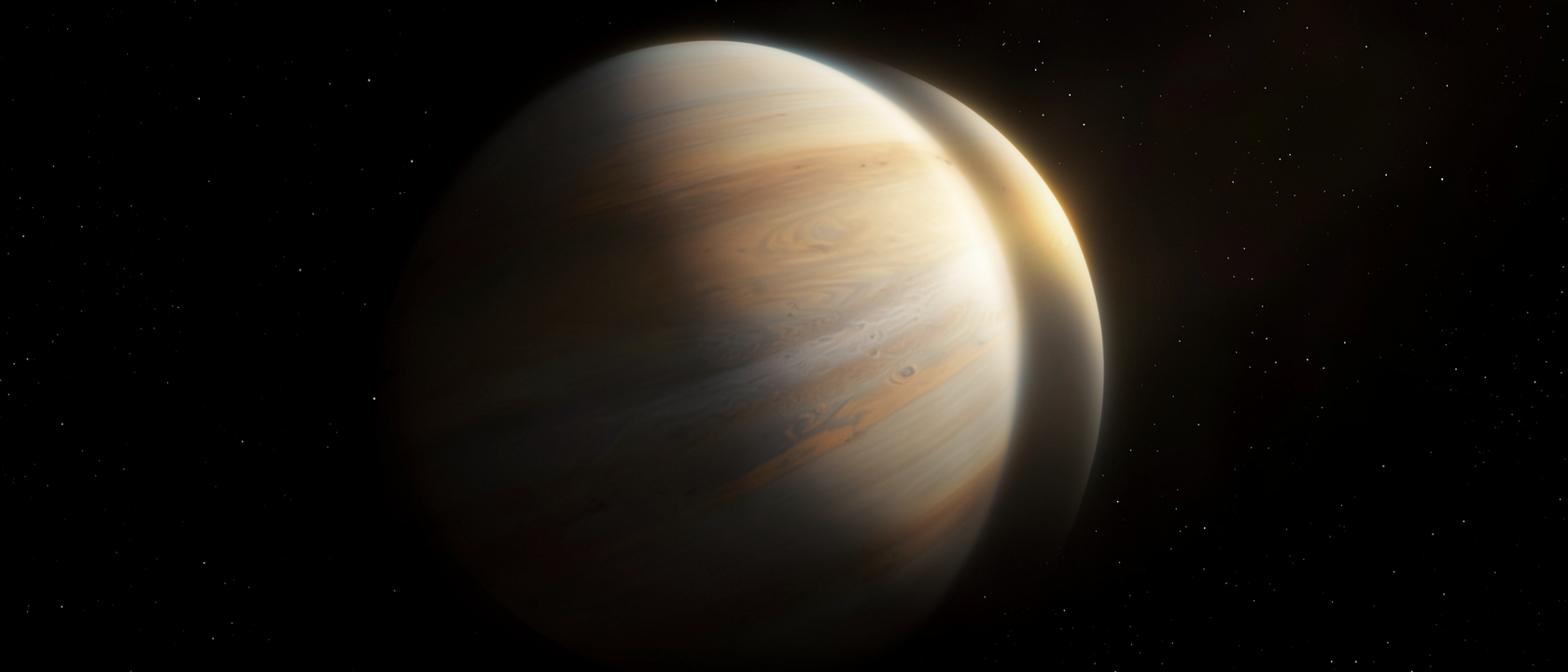
A Planet Light Enough to Float
Picture a chunk of packing foam the size of a planet, not lighter than it, just as light. That’s Kepler-51 b, a gas giant bigger than Neptune circling a young Sun-like star. Its bulk density works out to about 30 kilograms per cubic meter (0.030 grams per cubic centimeter), or roughly 1.9 pounds per cubic foot. Nobody reads that number off a dial. It’s built from two separate measurements, and getting there is most of the story.
The Measuring Stick: A Block of Packing Foam
Expanded polystyrene, the styrofoam wrapped around a new television, typically runs 10 to 35 kilograms per cubic meter (0.6 to 2.2 pounds per cubic foot), depending on how it’s manufactured. Kepler-51 b, at 30 kilograms per cubic meter, sits right inside that range, closer to the denser end than the light one. So the honest comparison isn’t “lighter than styrofoam”, it’s “about as packed as styrofoam already is.” Either way, a planet with more mass than Earth is, material for material, no denser than shipping padding.
Earth, for comparison, comes in at 5,514 kilograms per cubic meter (about 344 pounds per cubic foot). Divide it out and Kepler-51 b sits at roughly 0.006 times Earth’s density, about one one-hundred-seventieth. That’s worth keeping precise, because some quick summaries round it to a cleaner-sounding one percent, which overstates how much material is actually packed in there.
From Two Measurements to One Estimate
Nobody points a telescope at Kepler-51 b and reads its density off a screen. It’s assembled from two separately measured numbers. The planet’s mass comes out to about 2.1 times Earth’s, or 1.254×10²⁵ kilograms. Its radius comes out to about 7.10 times Earth’s radius, or roughly 28,100 miles (4.52×10⁷ meters), that’s the radius, not the diameter; pole to pole, the full width is about twice that.
Because volume scales with the cube of radius, a planet 7.10 times wider than Earth isn’t 7.10 times bigger inside, it’s 7.10³, or close to 358 times bigger by volume. So while Kepler-51 b only picked up about double Earth’s mass, it inflated to nearly 360 times Earth’s volume. Divide that mass by that volume and you land on the roughly 30 kilograms per cubic meter figure, an estimate, since both inputs carry their own margins of error in the catalog they come from.
How We Know
Kepler-51 b turned up in 2012, found by watching its host star dim by a tiny, repeating fraction each time the planet crossed in front of it, the transit method. That dimming and brightening, plotted as a light curve, a graph of the star’s brightness over time, is what gives the radius: block more starlight, and the disk doing the blocking has to be bigger. The mass came from a different technique: transit timing variations, meaning small shifts in exactly when each transit arrives, caused by the gravity of other planets in the system tugging on this one’s orbit. The system has three known planets, with orbital periods near 45, 85, and 130 days, locked close to simple resonances with each other, which is exactly the kind of gravitational nudging that makes timing variations measurable in the first place.
Radius from starlight, mass from timing, two separate measurements stitched together afterward to produce the density estimate above. These figures come from the catalogs currently maintained on Kepler-51 b, which get revised as new observations come in; a 2024 James Webb Space Telescope observation of a neighboring planet in the same system, timed two hours earlier than predicted, even led to the discovery of a fourth, still poorly characterized planet.
Why Your Gut Gets This Wrong
Every object anyone has ever picked up follows a rule that feels like physics but is really just chemistry: solid things get more massive as they get bigger. Kepler-51 b breaks that rule because it isn’t solid enough to obey it. Its mass grew only modestly past Earth’s while its volume ballooned by a factor of hundreds, so the instinct that scales a bowling ball up into a beach ball and expects more material inside falls apart once “ball” means “planet.” The material didn’t vanish, it’s spread thin across a shell of space wide enough to swallow Earth’s volume nearly 360 times over.
What’s Still Open
Astronomers call planets this puffed-up “super-puffs,” defined loosely as worlds with radii above roughly five Earth radii, masses under about ten Earth masses, and densities below a tenth of a gram per cubic centimeter. What actually holds up an atmosphere this wide and this thin isn’t settled. One model proposes a small rocky core wrapped in a hydrogen-helium envelope making up 20 to 40 percent of the planet’s mass. A competing model suggests the gas envelope is much thinner, more like a typical sub-Neptune, and that tidal heating from the star is what’s puffing the planet out instead.
Other researchers have proposed the planet isn’t really that fluffy at all, that it’s venting a dusty outflow, or wearing a tilted ring system that only mimics a puffy atmosphere from Earth’s viewing angle. After a 2019 Hubble study of the system, Penn State astronomer Jessica Libby-Roberts compared the three known planets to the pink spun-sugar treats sold at fairgrounds, saying picturing a Jupiter-sized ball of cotton candy gets you close to the actual density. That’s a vivid way of describing an unresolved problem, not a solved one.
Separate models put the planet’s equilibrium temperature, a modeled figure, not a thermometer reading, at 543 kelvin (270°C, about 518°F), with the planet absorbing roughly 10.12 times the sunlight Earth receives. Some estimates suggest that heat could be stripping gas away steadily enough that, over the next billion years, the planet might shrink toward something closer to a mini-Neptune. Whether that’s actually happening, and how fast, is still an open question, as is the true cause of the low density itself, which the scientific literature describes as unresolved despite several competing hypotheses.
The Picture That Doesn’t Exist
No camera has ever photographed Kepler-51 b, and none will anytime soon. Everything known about it comes from a graph of starlight dimming and brightening, not an image. Illustrations that circulate online, including one credited to NASA, ESA, and artists L. Hustak and J. Olmsted at the Space Telescope Science Institute, showing the system’s three known planets scaled against the solar system, are exactly that, illustrations, built from the measured and modeled numbers above, not photographs. If a crisp, cloud-swirled render of this planet turns up in a search, however convincing it looks, it’s art standing in for a picture that simply doesn’t exist yet.