
A Year That Fits Inside a Workday
Picture clocking in for an eight-hour shift. Before you clock out, a small planet spotted by NASA’s Kepler space telescope has already lived through almost two full years of its own. KOI-1843.03 completes one full circuit of its star in 15,282 seconds, 4.245 hours, timed down to the second. That isn’t a rounded estimate. It’s the whole orbit, start to finish, before most people finish lunch.
The Stick Everyone Already Owns
The fairest yardstick here is the year you’ve actually lived through: Earth’s own trip around the Sun, 365.25 days, or 31,557,600 seconds. Divide KOI-1843.03’s period into that and the ratio comes out to about 4.84×10⁻⁴, easier read the other way around. Earth’s year is roughly 2,065 times longer than this planet’s. Live through a single December-to-December stretch, and somewhere out there, that same small world has already started its “year” over more than two thousand times.
How We Know
Nobody caught this with a stopwatch pointed at a distant sky. Kepler was a space telescope that stared at one small patch of sky for years, watching for the faint dimming that happens when a planet crosses in front of its star, a technique called the transit method. Researchers Ofir and Dreizler first flagged a short, four-hour signal at a star cataloged as KOI-1843 (also known by its Kepler Input Catalog number, KIC 5080636) in 2013. That same year, MIT physicist Saul Rappaport and colleagues timed the repeated dips across twelve full observing quarters of Kepler’s long-cadence data and pinned the period at 4.245 hours, publishing the result in the Astrophysical Journal Letters. That number, the period, is measured, straight off the light curve. What comes next, the planet’s mass and makeup, is a separate, shakier layer built on top of it.
Close Enough to Almost Touch
A four-hour year comes from proximity, not size. KOI-1843.03’s semi-major axis, the measurement of an orbit’s average size, is about 464,800 miles (7.48×10⁸ meters), or 0.005 astronomical units. One astronomical unit (AU) is Earth’s own distance from the Sun, 92.96 million miles (149.6 million km), so this planet skims its star at roughly half a percent of that gap. The star itself is an M-dwarf, a small, cool class of star sometimes called a red dwarf, with a mass about 0.46 times the Sun’s. Tuck a planet in that close to a star that size, and hours replace months.
Dense Enough to Survive
Sitting that close raises a real problem: a star’s gravity can pull a loosely packed body apart before it ever finishes an orbit, at a boundary called the Roche limit. For KOI-1843.03 to hold together where it sits, Rappaport’s team calculated its bulk density has to be at least 7 grams per cubic centimeter. Modeling what could produce that, they estimated a composition that’s mostly iron, with at most 30% silicate rock by mass, later papers nicknamed it an “exo-Mercury.” NASA’s Exoplanet Archive lists the planet’s mass at roughly eight times Earth’s, packed into just 0.6 times Earth’s radius, but that mass figure comes from modeling the Roche-limit constraint, not a direct measurement, the host star is too faint for the radial-velocity technique that normally weighs a planet by its star’s wobble. “Just the fact that it’s able to survive there implies that it’s very dense,” co-author Josh Winn said when the result was published in August 2013. Whether anything could survive even denser and even closer in, he added, was still an open question.
What’s Still Open
Start with the name. “KOI” stands for Kepler Object of Interest, and the “.03” marks it as the third candidate signal found at that star, the standard label for “not yet confirmed.” Rappaport’s 2013 paper called it “very likely” a genuine planet, and NASA’s Exoplanet Archive was still listing it among newly updated entries as of 2025. It has survived years of scrutiny without formally crossing the line into a confirmed name of its own.
Two other numbers are worth naming by their absence. How far the KOI-1843 system actually sits from Earth, and how hot the planet’s starlit side really runs, are figures that different sources give differently, and not by a rounding error. Rather than print a number that might not survive the next data release, we’re leaving both blank. The period is measured to the second; the distance and temperature aren’t settled, and that gap is worth saying out loud.
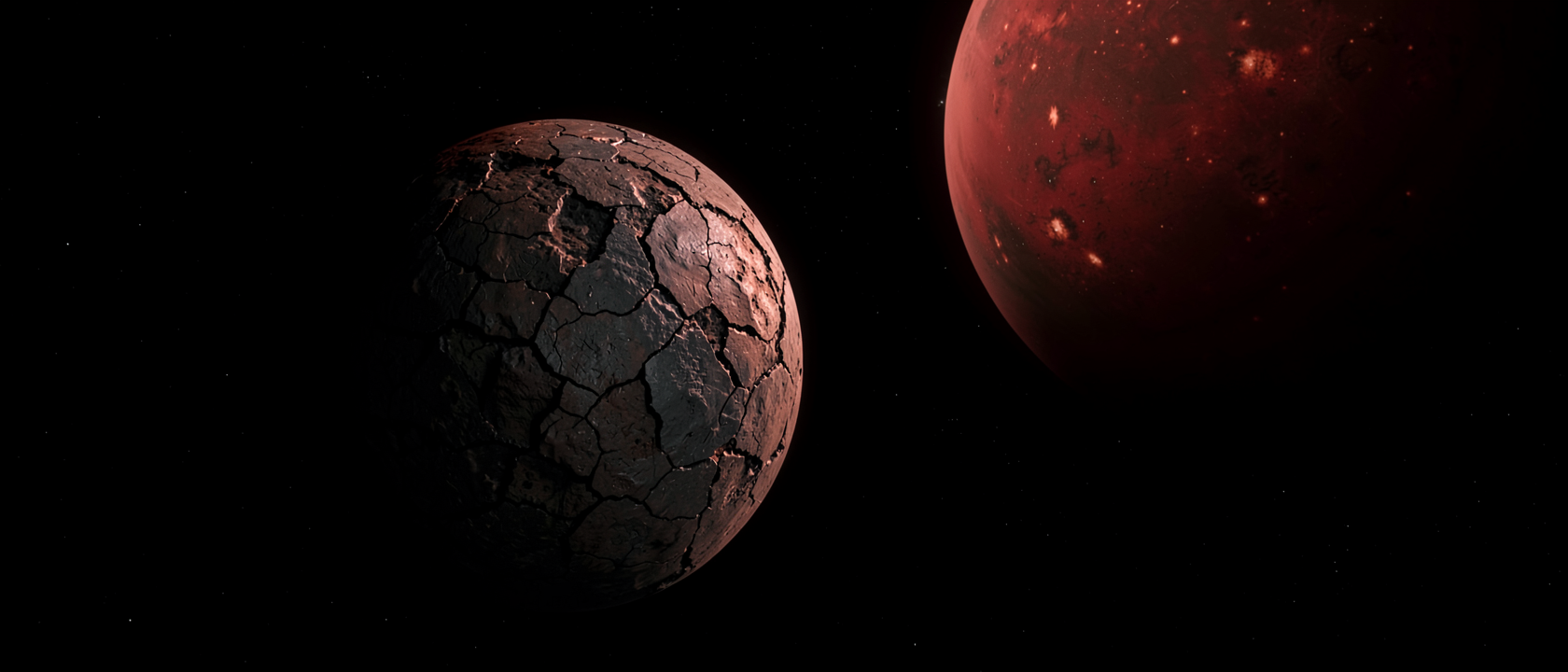
No photograph of KOI-1843.03 exists, and one may never come. Planets found this way don’t get their picture taken, they show up only as a dip in a graph of starlight, the transit’s signature and nothing more. In 2017, astronomers announced a planet called EPIC 228813918 b with a 4.3-hour orbit, just four minutes longer than KOI-1843.03’s. It made headlines as the second-shortest orbital period on record. KOI-1843.03 still holds first place. Any picture you see of a scorched, iron-heavy little world skimming its star is an artist’s illustration, built from the numbers above, not a photograph, because no camera has ever had anything to point at.