Ninety-Five Earths, One Number
Picture every Earth you’ve ever seen, this one, the blue marble, copied ninety-five times and crushed into a single ball. That’s not a stand-in for size, it’s mass: the actual amount of matter packed into Saturn, weighed against Earth’s own. NASA’s NSSDC Planetary Fact Sheet lists Saturn’s mass at 5.6832 × 10²⁶ kg, next to Earth’s 5.9722 × 10²⁴ kg. Divide one by the other and you get 95.16. No planet has ever actually been rolled up like dough to prove it, this is a number built for the mind, not a recipe anyone could follow.
Why mass beats every other ratio Saturn has
95.16 is the largest ratio on Saturn’s entire data sheet, and that’s the real surprise, because it beats even the planet’s own bulk. Saturn’s volumetric mean radius comes to 36,184 miles (58,232 km), against Earth’s 3,959 miles (6,371.0 km), a ratio of only 9.14. So the radius grows about ninefold while the mass grows almost a hundredfold. The reason is geometry: volume scales with the cube of the radius, so tripling the radius multiplies the volume by roughly twenty-seven, not three. Saturn is built mostly from hydrogen and helium gas rather than rock, but there is so much of it that the total mass still runs away from every other number in the file.
Heavier, and yet it would float
Spread that ninety-five-fold mass through Saturn’s enormous volume and the arithmetic flips. Saturn’s mean density works out to 687 kg/m³, only 0.125 times Earth’s 5,513 kg/m³. Plain water sits at 1,000 kg/m³, so bulk for bulk, Saturn is lighter than water, drop the whole planet into a large enough ocean and it would float. The same planet carries the biggest mass ratio on the sheet and one of the smallest density ratios, and both numbers are measured, both are true, and neither cancels the other out.
How a number gets built without a scale
Nobody has ever weighed Saturn, there’s no scale that size, and mass isn’t weight anyway; weight depends on local gravity, mass doesn’t. What spacecraft tracking actually hands astronomers is called GM: how hard a body’s gravity bends a nearby orbit. For Saturn, GM comes out to 37.931 × 10⁶ km³/s², against Earth’s 0.39860 × 10⁶ km³/s², the same 95.16 ratio, showing up a second time from a completely different measurement. Divide GM by G, the gravitational constant fixed by CODATA’s 2018 reference values, and you get the mass NASA’s NSSDC table publishes. It’s a calculation built up from years of tracking data, not a single reading, and the fact sheet reports the rounded result rather than claiming to hand down a final truth.
Your body wouldn’t feel it
If mass really ran ninety-five times higher, standing on Saturn might seem like carrying ninety-five copies of yourself. It doesn’t work that way. Saturn’s mean surface gravity is 11.19 m/s², against Earth’s 9.82 m/s², only 1.14 times as strong. Gravity depends on both mass and distance from the center, and Saturn spreads its huge mass across a radius 9.14 times Earth’s. Stretch a number that thin across a sphere that size and the pull at the cloud tops barely changes. Mass is the extreme in this story; the gravity your legs would feel stays almost ordinary.
The picture that exists, and the one that can’t
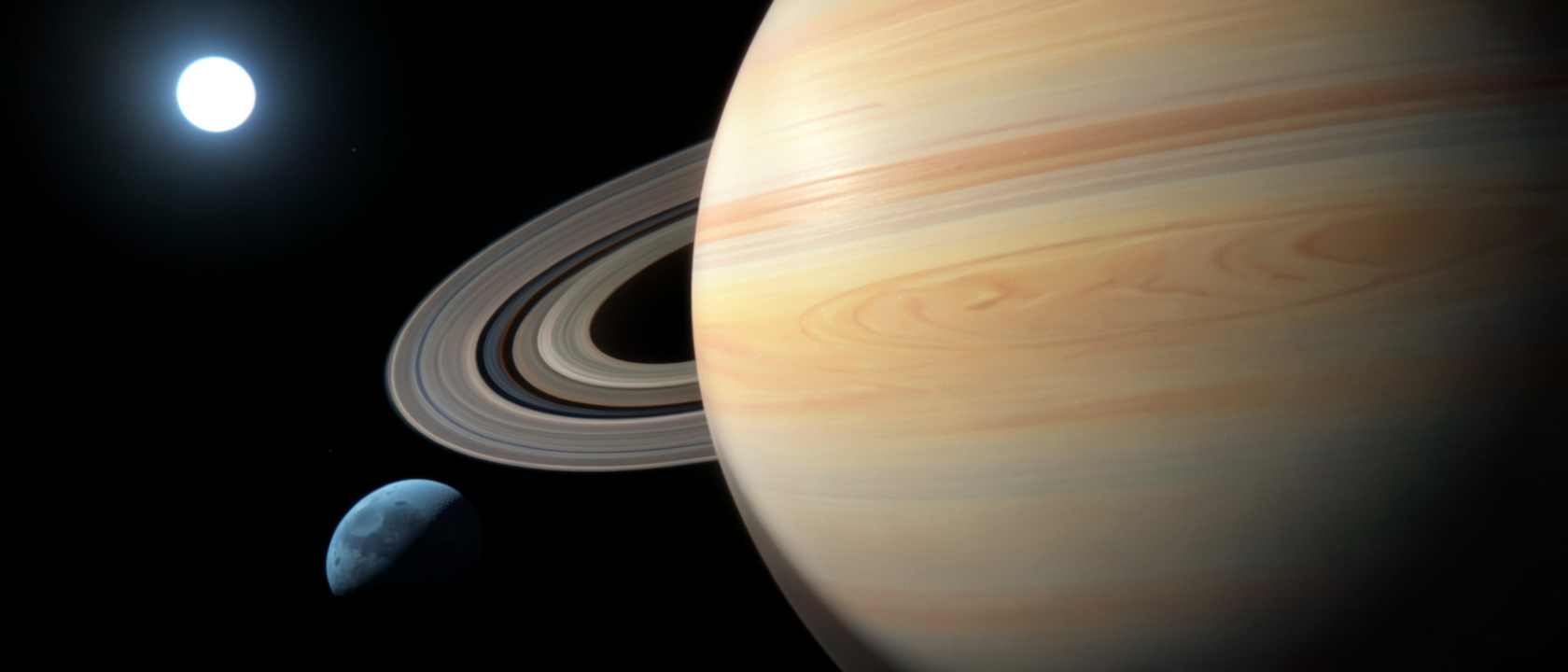
Cassini, Voyager, and the Hubble Space Telescope have all photographed Saturn, genuine NASA/JPL frames, public domain, showing the cloud bands and rings in true and false color. None of them show mass. Mass has no surface for a camera to catch; it isn’t a texture or a hue, it’s a quantity worked out from orbits, not from an exposure. Every Saturn photograph anyone has ever scrolled past is a picture of geometry, size and shape, while the 95.16 figure lives entirely in tracking data no lens has ever recorded.
What’s still open
Two threads stay loose. The 568.32 × 10²⁴ kg figure on NASA’s table is a rounded result; the exact spacecraft dataset and its margin of error aren’t spelled out on that page, so the extra decimal places deserve some caution. And Saturn’s moon count, 274, after 128 new satellites were logged in March 2025, is a snapshot, not a ceiling. Surveys keep turning up smaller, fainter moons around Saturn, so any total a reader sees elsewhere may already be out of date.