
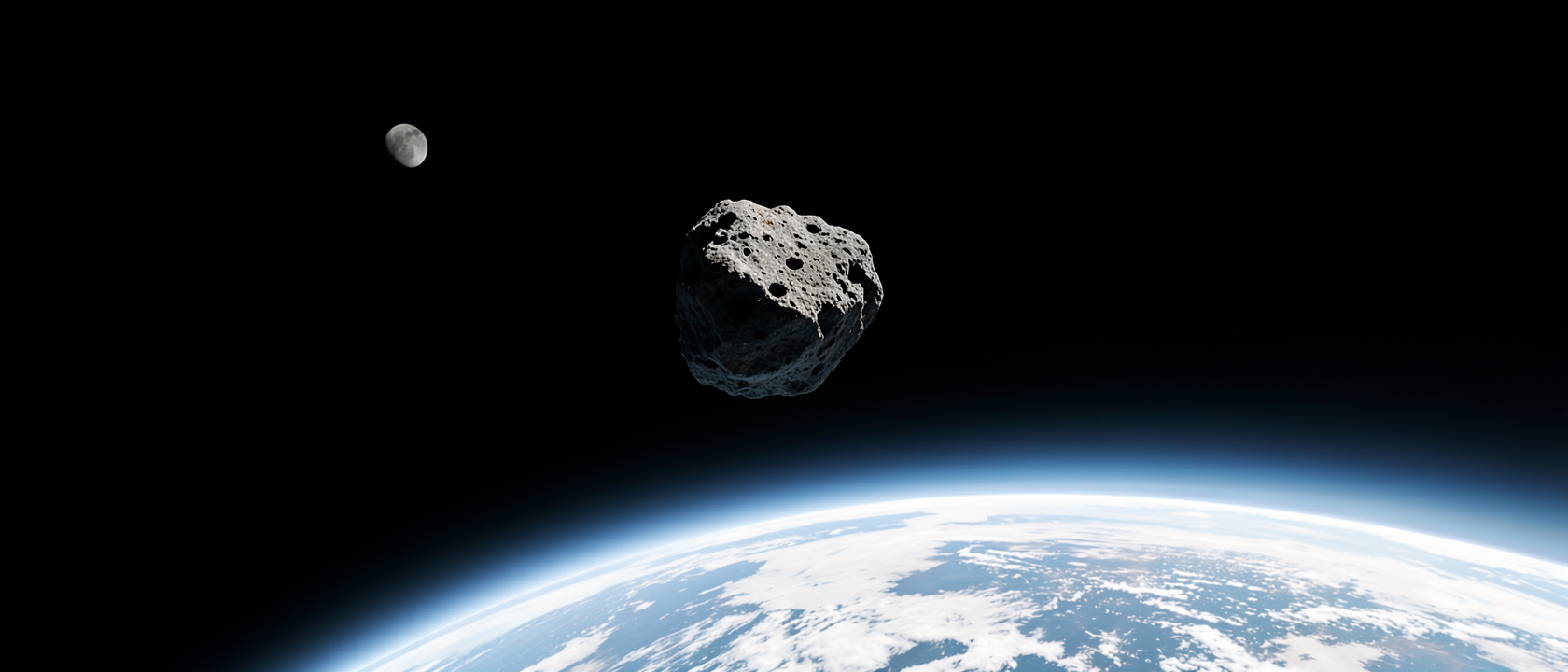
A Rock the Size of a Small House Slipped Inside the Moon’s Orbit
A rock somewhere between the size of a small house and a ten-story building slipped through the gap between Earth and the Moon, passing closer to us than the Moon itself does, by a factor of four. On September 15, 2026, asteroid 2026 RG15 made its closest approach at 07:36 UTC, moving relative to Earth at about 20,400 mph (32,800 km/h). Its path never crossed Earth’s own. But the distance is worth sitting with, because most people’s sense of how much empty room sits between here and “space” doesn’t leave room for something that close.
The Ruler Is the Moon
Tracking data from NASA’s Jet Propulsion Laboratory put the miss distance at about 58,880 miles (94,753 km), measured from the center of Earth to the asteroid. In astronomical units, the average Earth-Sun distance, the standard yardstick for solar-system distances, that comes to 0.000633 AU, a number that means nothing until you set it beside something familiar. The Moon does that job: it sits, on average, about 238,855 miles (384,400 km) from Earth. 2026 RG15 passed at roughly a quarter of that. Subtract Earth’s own radius and the gap down to the planet’s surface narrows to around 54,680 miles (88,000 km).
Two different numbers are doing two different jobs here, and they shouldn’t get merged. The 58,880 miles is how far the rock got, a distance. The 20,400 mph is how fast it was moving relative to Earth at that moment, a speed. A fast object can still pass at a huge distance, and a slow one can graze close. This particular flyby happened to combine a tight distance with real speed, but one number never substitutes for the other.
How We Know
The object first turned up as a faint point of light in images from the ATLAS survey’s telescope at Rio Hurtado, Chile, at 04:33 UTC on September 12, 2026, three days before the flyby. From there, observing stations across the Southern Hemisphere, including the SONEAR Wykrota-CEAMIG station on Serra da Piedade near Caeté, Brazil, measured its position over two more nights. Those measurements went to the Minor Planet Center, the International Astronomical Union’s clearinghouse for calculating orbits, and were published in circular MPEC 2026-R164, credited to five stations. A separate close-approach calculation, run independently using that same tracking record, landed within roughly 50 km of the JPL figure above, a small, reassuring sign of how consistent these orbit solutions get once enough nights of data feed into them.
The Estimate, Not the Rock
Nobody has measured 2026 RG15’s size directly, no radar echo, no thermal read. What exists is its absolute magnitude, a standardized brightness value of H=25.83, run through an assumed surface reflectivity, or albedo (the share of sunlight a surface bounces back rather than absorbs). Depending on whether the surface is dark and sooty or pale and reflective, that brightness fits an object anywhere from 59 to 135 feet (18 to 41 meters) across, a small house at one end, a ten-story building at the other. One source lists it provisionally as an Apollo-group asteroid, meaning an orbit that crosses Earth’s, but that classification isn’t independently confirmed here, so it stays a working estimate rather than a settled fact.
What’s Still Open
Where 2026 RG15 actually falls in that 59-to-135-foot range isn’t known, and won’t be without a radar campaign or a well-timed occultation. The precise margin of error on the 58,880-mile approach distance isn’t stated in the tracking data reviewed here either. And there’s no photograph of it, not from any telescope, not from any mission. What exists are tracking coordinates and orbit-solution plots: fine for drawing the path, useless as a picture of the object itself. Any image online claiming to show this asteroid up close is a render, and it should say so.
**Changes made:**, “Tracking data … puts” → “put” (data is plural, subject-verb agreement). “center of the Earth” → “center of Earth” (consistency with rest of article’s usage).