Neptune Outlives the People Who Found It
MEASURED: Neptune takes 5.200×10⁹ seconds to complete one trip around the Sun, 164.79 times as long as Earth’s own orbit, which runs 3.156×10⁷ seconds, or 365.256 days. Lay the two years side by side and Neptune’s swallows nearly 165 of ours, end to end.
Johann Gottfried Galle spotted Neptune on September 23, 1846, aiming his telescope at a position that mathematicians John Couch Adams and Urbain Leverrier had calculated from small irregularities in Uranus’s path. Neptune didn’t finish that first lap until 2011–165 years later, just about what the ratio above predicts. No one who was alive to hear the news in 1846 was still around in 2011 to see the planet cross its own starting line again. A single Neptune year outlasts a human life with room left over.
Why “a bit farther” doesn’t mean “a bit slower”
Neptune’s semimajor axis, the long radius of its orbit, and a fair stand-in for its average distance since the path is nearly circular (eccentricity of just 0.0097, where 0 would be a perfect circle), comes out to about 2.805 billion miles (4.515 billion kilometers). Earth’s is 92.96 million miles (149.598 million kilometers). That’s 30.178 times farther. Neptune’s radius, meanwhile, is only 3.865 times Earth’s: 15,299 miles (24,622 kilometers) against 3,959 miles (6,371 kilometers). Neither number looks dramatic by itself.
But orbital period doesn’t scale with distance in a straight line. Kepler’s third law scales it by distance raised to the power of 1.5. Run that 30-times-farther number through the exponent and it comes out the other side as a 165-times-slower orbit. A planet that’s merely “somewhat bigger and somewhat farther out” ends up needing a century and a half just to get back to where it started.
How anyone knows this at all
No spacecraft has ever ridden along for one complete Neptune year, that would take a probe launched sometime in the 19th century and still radioing home. None exists. The 164.79-year figure comes instead from decades of telescopes clocking Neptune’s exact position against the background stars, run through orbital-mechanics models and checked against radio-science data gathered during Voyager 2’s single flyby in 1989. NASA compiles the result and publishes it as a reference value on its National Space Science Data Center’s Planetary Fact Sheet.
The number even comes in two honest flavors. Measured against the fixed stars, Neptune’s year runs 60,189.018 days. Measured against the equinox instead, it’s 59,799.9 days. Same orbit, same planet, just two different ways of drawing the finish line.
The one photograph
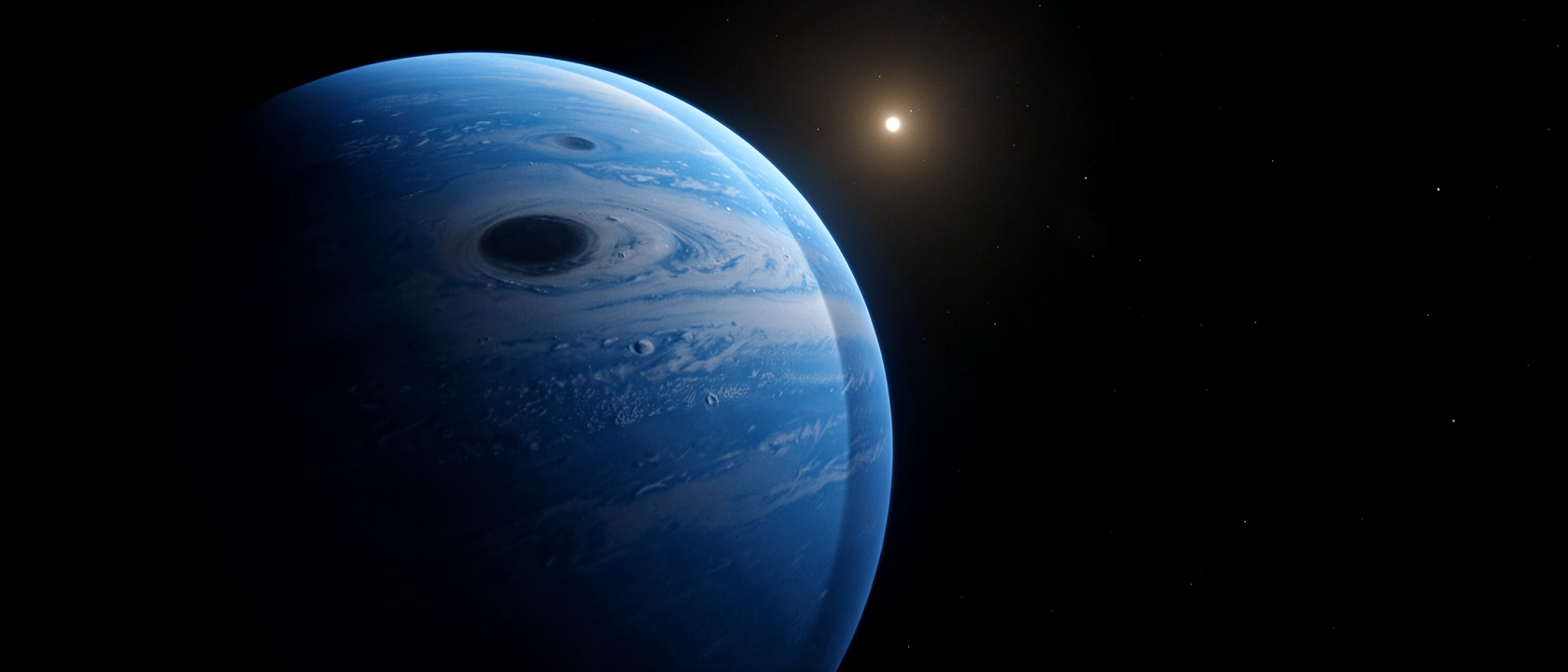
The deep blue Neptune most people picture came from that same 1989 pass. Voyager 2’s cameras shot it once, on the way out toward interstellar space, and NASA/JPL-Caltech released the result as a real photograph, not a render, not an illustration. No spacecraft has been back since.
OPEN: Britannica notes that with only one confirmed orbit logged since 1846, astronomers expect the exact size and shape of Neptune’s path to keep being refined well into the current century. Which digits in “164.79” are locked-down measurement and which are still being smoothed by that ongoing work isn’t spelled out anywhere public, and it won’t be until a good deal more of the next lap is in the books.