
A Planet That Orbits Like a Comet
Picture a world that swings in tight past its star, then flings itself back out into the dark, over and over, on a fixed clock. That’s not a comet’s path. It belongs to a gas giant carrying something like four times Jupiter’s mass, and its orbit is stretched so thin that calling it an ellipse barely covers what’s happening.
The planet is HD 28254 b, and the number behind that stretch is its orbital eccentricity: 0.95, a measured value from a 2010 study by Naef and colleagues. Eccentricity is a simple ratio with no unit of its own, 0 means a perfect circle, and the closer the number climbs toward 1, the more a closed loop collapses toward a straight line flung out and back.
The Measuring Stick
Earth’s own orbit has an eccentricity of 0.0167, close enough to a circle that nobody ever notices the difference between our closest approach to the Sun and our farthest. HD 28254 b’s orbit is about 57 times more eccentric than that. In distance rather than ratios: the planet swings from 0.12 AU at its closest point, an astronomical unit (AU) is the average distance between Earth and the Sun, out to 4.78 AU at its farthest. That’s close to a fortyfold change in distance within a single lap, on a planet, not a chunk of ice and rock.
How We Know
Nobody has ever seen this planet. It was found by watching its star instead. A planet’s gravity tugs its star back and forth as it orbits, and that motion stretches and compresses the star’s light, the same Doppler effect that changes the pitch of a passing siren. Using the HARPS spectrograph at La Silla Observatory in Chile, astronomers collected 32 such velocity readings between October 28, 2003, and April 9, 2009. Over that stretch, the star wobbled at up to 83 miles per hour (37.3 meters per second), a respectable highway speed, moving in a sharp, lopsided pattern rather than a smooth wave. A circular orbit produces a smooth wave; an eccentric one produces a spike followed by a slow crawl. From that shape, the 2010 paper derived both the 0.95 eccentricity and a minimum mass of 3.8 Jupiter masses, or about 7.213 × 10^27 kilograms, at the time, one of the most eccentric substellar orbits ever pulled out of radial-velocity data.
A follow-up study in 2023, by Philipot and colleagues, combined the same HARPS measurements with precise position tracking of the star from the Hipparcos and Gaia satellites, and found an even higher eccentricity than the original fit. That analysis narrowed, but didn’t settle, two things: the planet’s true mass and the tilt of its orbit relative to our line of sight. Both remain open, with the mass estimated somewhere between 1.6 and 6.8 times Jupiter’s.
Numbers Nobody Has Measured Directly
Because HD 28254 b was found through the wobble it causes rather than by blocking its star’s light, several of its basic numbers are modeled, not measured. Its radius, an estimated 1.16 Jupiter radii, and its equilibrium temperature, estimated at 207 kelvin (about −87°F) with an uncertainty running from +13 to −40 kelvin, both come from models built on its mass and orbit, not from a telescope reading the planet itself. Its estimated density, about 3,020 kilograms per cubic meter, roughly three times that of water, is plausible for a large, gas-rich planet, but it’s calculated, not weighed. And with an orbit swinging between 0.12 AU and 4.78 AU, one average temperature figure hides more than it reveals: this planet isn’t getting anything like a steady dose of starlight over the course of a single year.
The Picture That Doesn’t Exist
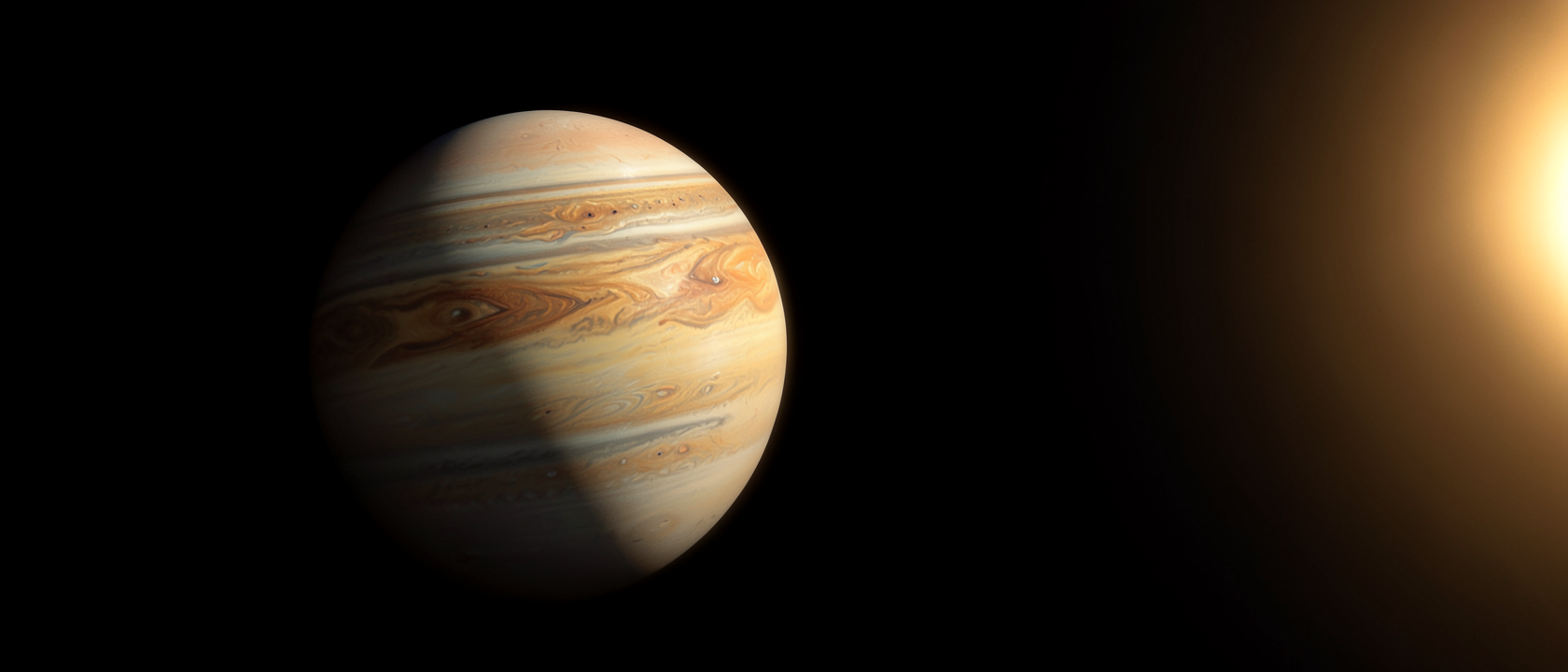
There’s no photograph of HD 28254 b, and the method that found it, reading shifts in starlight, not gathering light from the planet, means there won’t be one from this technique. What exists is the data itself: a velocity curve plotting the star’s spectral shifts against time, and diagrams showing the shape of that stretched-out path. Any image that shows the planet itself is an artist’s illustration built from these numbers, not a photograph of anything a telescope has actually seen.
What’s Still Open
HD 28254, the host star, isn’t alone. It has a bound companion, HD 28254 B, a likely red dwarf carrying roughly 48% of the Sun’s mass, orbiting at a projected separation of 235 AU. Whether that second star had anything to do with stretching the planet’s orbit into its current shape is an open question. So is the planet’s makeup: astronomers call it a gas giant based on its mass alone, since no spectroscopic or transit data exist to confirm what it’s actually made of. On both counts, the honest answer is the same one: nobody knows yet.
**Summary of changes made:**
1. Lowercased “MEASURED” to “measured” (inconsistent capitalization, not a proper noun).
2. Added missing article “a” before “respectable highway speed.”
3. No relative-to-today date issues were found, all dates are already absolute (e.g. “October 28, 2003,” “2010 study,” “2023”).
4. No subject–verb agreement, homophone, tense, or punctuation errors were found beyond the above.