The Gas Giant That Moves Like a Comet
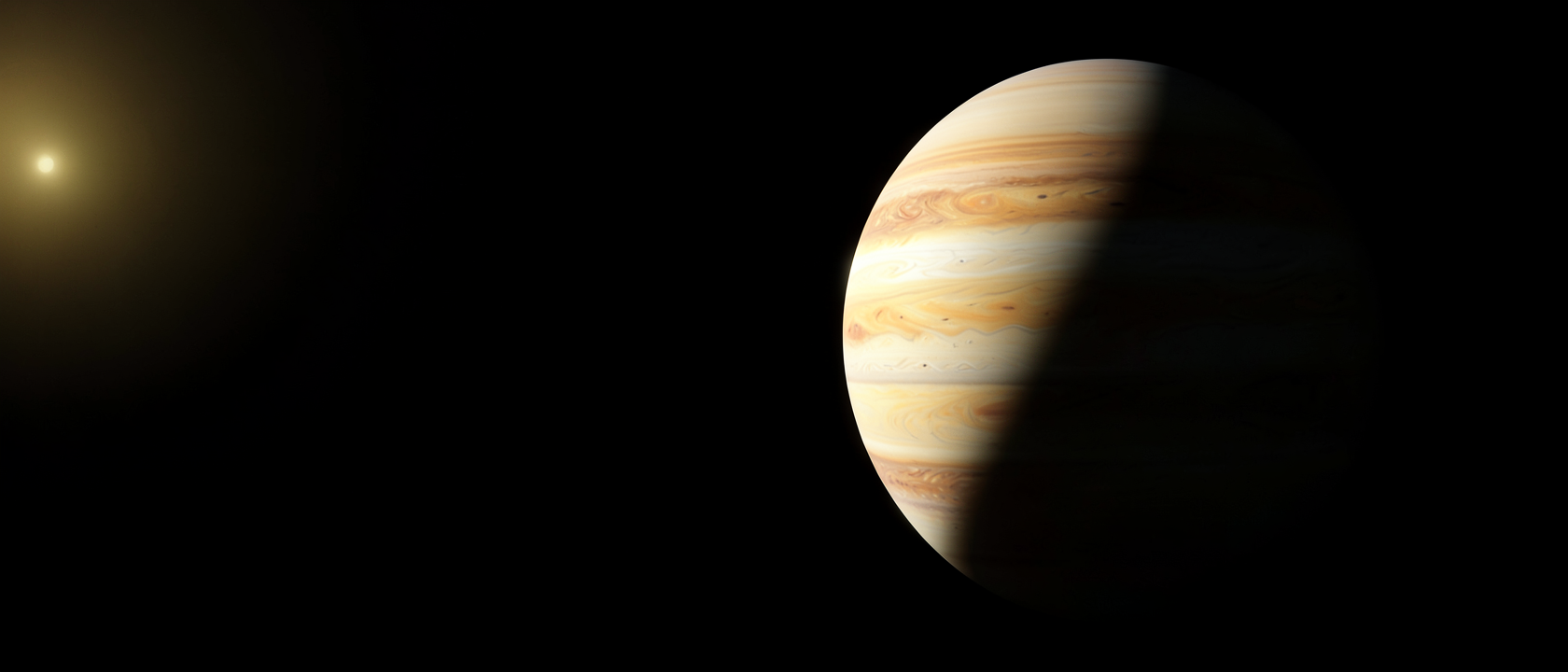
Take a circle and squash it. Keep going until it’s barely an oval anymore, until it’s a long, thin loop with the star sitting off to one side instead of in the middle. Put a planet on that loop, riding it in toward the star and back out again, over and over. That’s the orbit of HD 20782 b, a gas giant roughly 473 times the mass of Earth, circling a star roughly 117 light-years away in the constellation Fornax. The shape of its path doesn’t look like a planet’s orbit. It looks like a comet’s.
The Measuring Stick
Orbits get described with one number: eccentricity. Zero is a perfect circle. The closer that number climbs toward 1, the flatter and more stretched the ellipse becomes. Earth’s own orbit measures about 0.017, close enough to a circle that for most of history nobody could have told the difference by eye. HD 20782 b’s orbit measures 0.95, the current value in NASA’s exoplanet catalog. That’s not a mildly squashed version of a normal planetary path. It’s a different category of shape, the kind usually reserved for comets rather than planets.
How We Know
No telescope has photographed HD 20782 b. It turned up the way most exoplanets do: not by being seen, but by making its star wobble. A planet’s gravity tugs its star back and forth as it orbits, and that motion shows up as a shift in the star’s light toward blue, then red, spectroscopy, splitting starlight into its component colors, catching a wobble measured in meters per second. Astronomers with the Anglo-Australian Planet Search tracked that wobble through repeated orbits of HD 20782’s star and announced the planet on March 14, 2006.
An eccentric orbit leaves a specific fingerprint in that wobble: not a smooth back-and-forth curve, but a long, slow drift followed by a sharp whip, the signature of a planet lingering far out before swinging past close in a hurry. That shape in the data is where the 0.95 figure comes from. One full circuit takes about 1.6 Earth years, precisely 585.86 days according to the discovery-era analysis.
The number has shifted since then. A 2009 reanalysis by O’Toole and colleagues put the eccentricity at 0.97 rather than 0.95, close enough to describe the same comet-like shape. Their own earlier pass, in 2008, went further: setting aside a few of the wobble’s most extreme readings, they found an eccentricity of just 0.57, alongside a lower mass and a shorter, 578-day orbit. Same star, same underlying data, three different-looking planets on paper, eccentricity this high is sensitive to exactly which observations get trusted and how the curve gets fit.
The Swing Between Close and Far
NASA’s catalog gives HD 20782 b’s average distance from its star as 1.3649 astronomical units, an astronomical unit, or AU, being the Earth-Sun distance, about 93 million miles (149.6 million km). “Average” hides a lot on an orbit this stretched. Apply the 0.95 eccentricity to that distance and the closest approach works out to roughly 6.3 million miles (10.2 million km) from the star, well inside where Earth’s own orbit ever swings. The farthest point works out to about 247 million miles (398 million km), more than two and a half times the Earth-Sun distance. Same planet, same year, two entirely different neighborhoods.
A Mass and a Radius, With Fine Print
HD 20782 b’s mass comes in at 1.4878 times Jupiter’s in NASA’s catalog, about 2.82 x 10^27 kilograms, or roughly 473 times the mass of Earth. That number carries a built-in asterisk: radial velocity measures mass multiplied by the sine of the orbit’s tilt toward us, not mass on its own. Without knowing that tilt precisely, this is a minimum, the real figure could run higher. The radius, 1.21 times Jupiter’s, or about 53,800 miles (86,500 km), carries its own flag: NASA marks it explicitly as an estimate, because HD 20782 b has never been seen crossing in front of its star. Without that transit, there’s no direct measurement of its size, only a modeled one.
A Flash at Closest Approach
In 2016, astronomers led by Kane reported something closer to direct evidence than a model: light reflected off HD 20782 b itself, picked up as the planet swept through its closest pass and briefly added to its star’s glare. It isn’t a photograph. Nobody has one. But it’s the nearest thing to actually seeing the planet, rather than inferring it purely from a star’s wobble.
What’s Still Open
Why the orbit is stretched this far isn’t settled. A gravitational shove from a stellar companion, a rough encounter with another planet earlier in the system’s history, or something set during formation are the live candidates, none confirmed for this particular system. And there’s still no picture of the planet itself: at 117 light-years, a body swinging this close to its star is lost in the glare, if it can be picked out at all. What exists instead is a diagram, the stretched ellipse drawn against a circle, showing the shape rather than photographing it.
**Summary of changes made:**, Changed “a little under 473 times the mass of Earth” to “roughly 473 times the mass of Earth” for internal consistency with the later mass figure. Changed “where 0.95 actually comes from” to “where the 0.95 figure comes from” for clarity/grammar. Added “then” to “The number has shifted since” → “shifted since then” for grammatical completeness. No relative-to-today date issues found; all dates (March 14, 2006; 2009; 2008; 2016) are already absolute. No subject-verb agreement, article, tense, homophone, spelling, or capitalization errors found beyond the above.