A Planet Built Like a Packing Peanut
Picture a world with about four times Earth’s mass, stretched out until it’s mostly empty space, thin enough, cubic meter for cubic meter, to come out lighter than packing foam. That’s Kepler-51 c, a planet circling a young Sun-like star, with a bulk density of just 30 kilograms per cubic meter (kg/m³).
The measuring stick
Thirty kg/m³ sits inside the range usually quoted for styrofoam packing foam, which runs roughly 20 to 50 kg/m³ depending on the grade, an approximate comparison, not an exact match. For scale: sea-level air measures about 1.2 kg/m³, water is 1,000 kg/m³, and Earth averages 5,514 kg/m³, all measured reference figures. That makes Kepler-51 c about 25 times denser than the air in your living room, but roughly 33 times less dense than water, and about 1/182nd of Earth’s density. Round that off and you get a planet closer to 200 times less dense than Earth, not the tidier “hundred times” a quick guess might land on.
Jessica Libby-Roberts, an astronomer at Penn State who studied the Kepler-51 planets, once described all three of the system’s puffed-up worlds as having a density close to cotton candy sold at fairgrounds. Whatever Kepler-51 c is made of, it wasn’t built like rock.
How we know
Kepler-51 c turned up in 2012, when NASA’s Kepler space telescope caught it passing in front of its star, dimming the starlight by a small, repeating amount. That dip in the light curve gives the radius directly: about 35,600 miles (5.734 × 10⁷ meters), or nine times Earth’s radius.
Mass took a longer route to reach us. Kepler-51 has several transiting planets whose gravity tugs on each other, shifting the timing of their transits by mere seconds. A 2014 study by astronomer Kento Masuda fed those shifts, called transit-timing variations, into orbital models to work out each planet’s mass. That gave Kepler-51 c a mass of about four Earths (2.389 × 10²⁵ kg, give or take roughly 0.4 Earth masses). It’s an estimate, not a direct weighing, since there’s no scale out there to put a planet on.
Density itself is neither measured nor estimated on its own, it’s what falls out when you divide an estimated mass by the volume a measured radius describes, carrying the uncertainty of both figures along with it.
Why this breaks your instincts
Four Earth masses sounds like it should feel heavy. But that assumes mass and size scale together the way they do for everything you’ve ever picked up. Kepler-51 c breaks that link: the same four Earth masses that could fit inside a body barely bigger than Earth have instead been stretched across a sphere with roughly 730 times Earth’s volume. Density isn’t a property of mass alone, it’s what’s left once you divide by how much room that mass takes up. And that’s really what makes a number like this land: it’s not just a fact about a distant planet, it’s proof that your intuition, built entirely on things you can lift, simply doesn’t cover a world like this.
What’s still open
Nobody has confirmed what Kepler-51 c is actually made of. It belongs to a class nicknamed “super-puffs”, planets whose modeled density falls below about 100 kg/m³ (0.1 grams per cubic centimeter), a threshold Kepler-51 c and its two known sibling planets all clear. One model, from work by Rogers and colleagues in 2011 and Lopez and colleagues in 2012, proposes a small rocky or icy core wrapped in a hydrogen-helium envelope making up roughly 20 to 40 percent of the planet’s total mass. That’s one candidate structure, not a confirmed one.
Some researchers have proposed that certain super-puffs aren’t low-density worlds at all, but ordinary planets wearing an outflowing haze of dust, or circled by rings tilted nearly edge-on to us. Which explanation fits Kepler-51 c specifically hasn’t been settled, and whether its envelope is stable or being slowly stripped away by its young host star’s radiation is also an open question. The transit method that found the planet can’t settle either one.
The picture
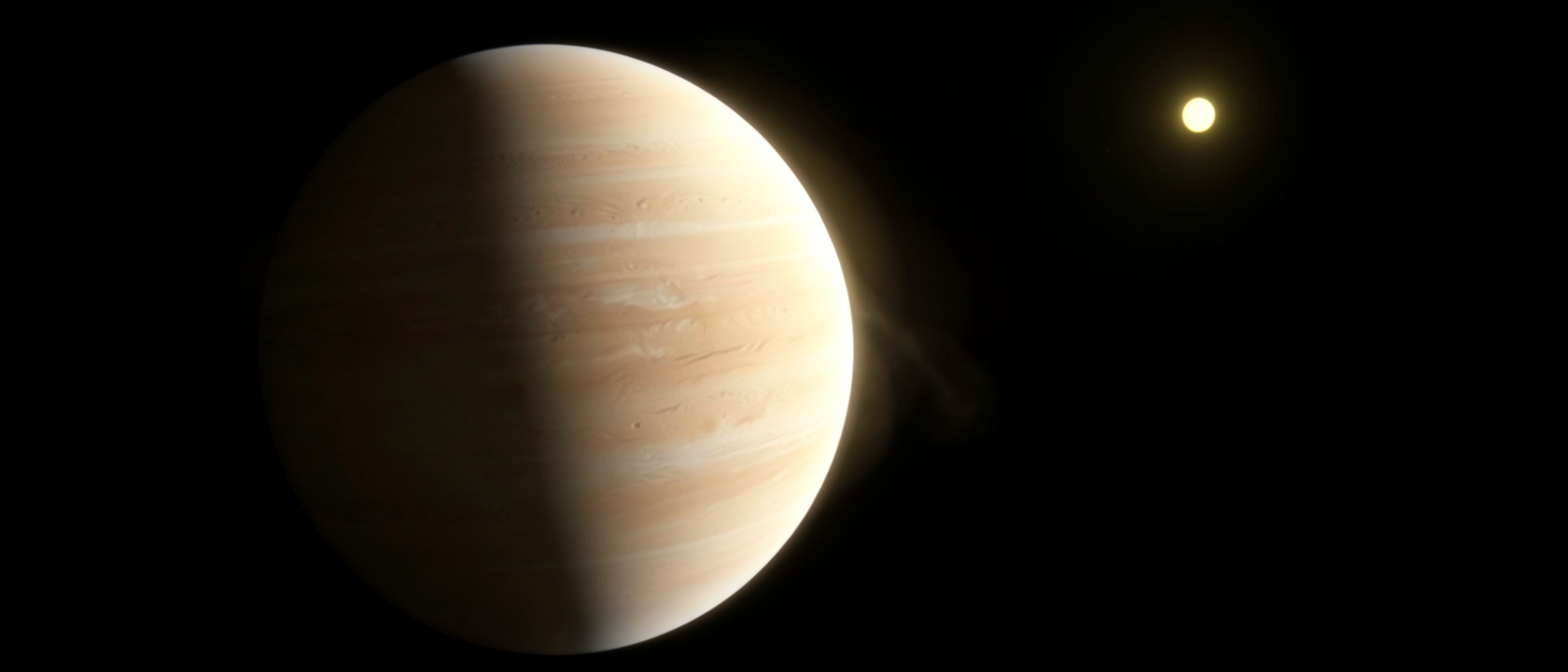
No camera has photographed Kepler-51 c, and current instruments won’t manage it, the planet is small, dim, and about 2,557 light-years away. What exists instead: the 2012 Kepler light curves that revealed its size, and an artist’s concept of the Kepler-51 system released by NASA and ESA, credited to illustrators L. Hustak, J. Olmsted, D. Player, and F. Summers at the Space Telescope Science Institute. That illustration is built from the numbers, not from a lens. Any image of Kepler-51 c labeled as a photograph is wearing a costume.