
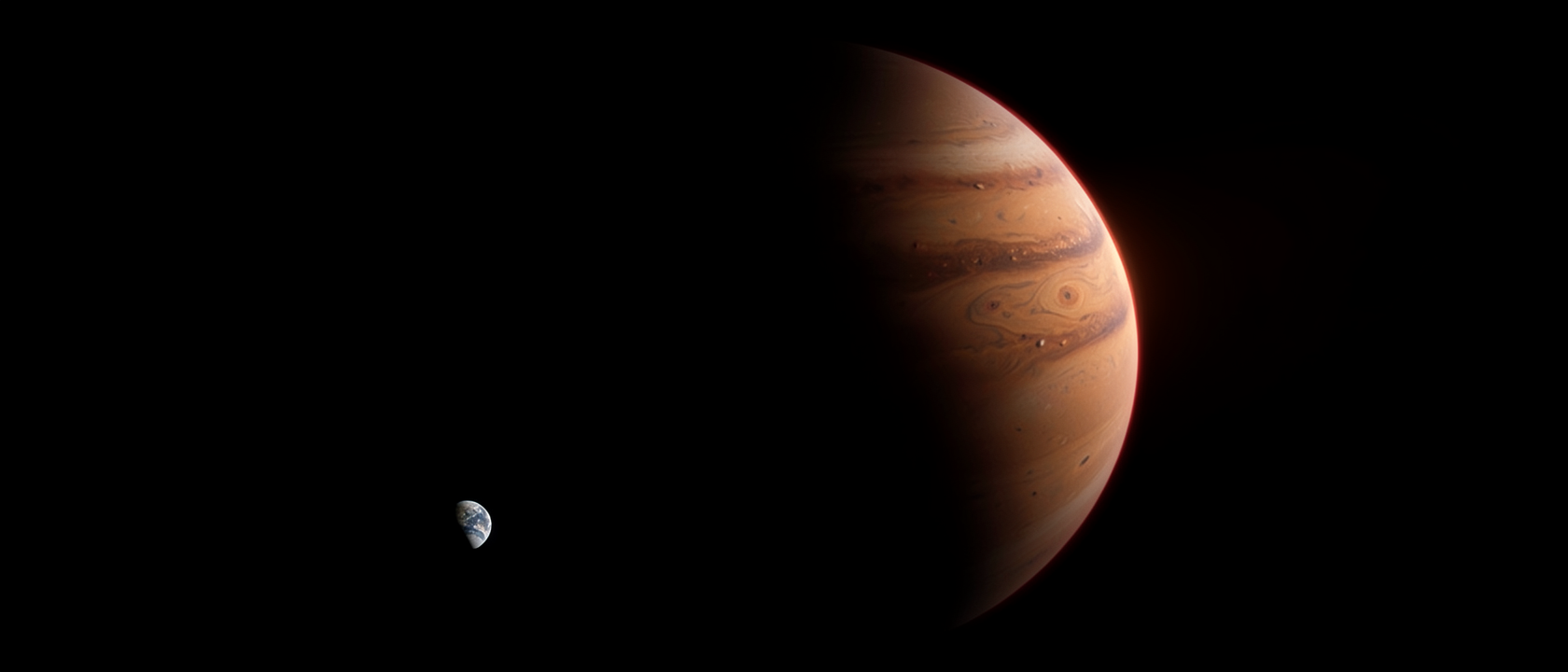
CT Cha b Is Bigger Than Jupiter, and Nobody’s Sure What to Call It
Picture Jupiter. Not the number, the actual planet, the one with the storm band you can find in a backyard telescope, the biggest thing in the solar system by a wide margin. Now stretch that picture until it’s roughly 2.2 times wider across. That’s CT Cha b, a companion object circling the young star CT Cha, about 620 light-years away. A light-year is a distance, not a stretch of time, about 5.88 trillion miles, the distance light covers in one year.
The stick that works
The catalog radius for CT Cha b is 157,282 kilometers (about 97,700 miles). Jupiter’s own equatorial radius is 71,492 kilometers (about 44,400 miles). Divide one into the other and you land on roughly 2.2, CT Cha b’s radius is about 2.2 times Jupiter’s. The same object is also listed as 24.7 times Earth’s radius (Earth’s mean radius is 6,371 kilometers, or 3,959 miles), which is the correct number and also the one nobody can hold in their head. “Bigger than Jupiter” is a stick you already own. Twenty-five Earths stacked edge to edge is a fact you have to rebuild from scratch every time someone says it.
That radius comes with real wobble room. The team that derived it in 2008 put the value at 2.20 Jupiter radii, but their own range runs from about 1.60 up to 3.01 Jupiter radii, call it “at least Jupiter-and-a-half, maybe triple,” not a fixed line.
How we know
Nobody caught CT Cha b crossing in front of its star, and nobody clocked a stellar wobble from its gravity. It was found by direct imaging: the European Southern Observatory’s Very Large Telescope, using its NACO adaptive-optics camera, picked out a faint second point of light beside CT Cha in February 2006 and again in March 2007. The two objects were moving together across the sky rather than just happening to line up, and the discovery was published in Astronomy & Astrophysics in 2008.
Direct imaging is exactly why the radius is a model output rather than a tape-measure reading. There’s no light curve to read a size from. Instead, astronomers measured the object’s temperature, around 2,600 K, or about 4,220°F, give or take roughly 250 K (450°F), using spectroscopy from the VLT’s SINFONI instrument, combined that with its brightness, and ran both through models of how young, still-cooling bodies evolve. The radius above, and a widely cited mass of 17 Jupiter masses (about 3.227×10²⁸ kilograms, some 5,403 times Earth’s mass), both came out of that same modeling. It’s the models’ best answer, not a direct measurement.
A density that shouldn’t work
Take that mass and that radius and divide: the result is a density of roughly 1,980 kilograms per cubic meter. Earth averages about 5,500 kilograms per cubic meter. An object carrying more than 5,000 times Earth’s mass is, cubic meter for cubic meter, less than half as dense as the ground under your feet. That isn’t a mistake, hydrogen-rich bodies puff outward instead of packing down, but it drops CT Cha b into an awkward gap on the chart between “large planet” and “dim brown dwarf,” an object that forms the way a star does but never gets hot enough at its core to fuse hydrogen.
The mass figure itself hasn’t stayed still. The 2008 estimate of 17 (± 6) Jupiter masses assumed the CT Cha system was 2 to 3 million years old. Newer age work puts the system younger, closer to 1.3 to 1.8 million years, and feeding that into the same models pulls the mass down toward roughly 10 Jupiter masses, squarely planetary. A separate 2015 estimate put it anywhere from 14 to 24 Jupiter masses. Same object, three different numbers, depending on which age goes into the model.
What’s still open
By the current catalog value, CT Cha b sits about 440 astronomical units from its star (one astronomical unit is the average Earth-Sun distance, roughly 93 million miles); the imaging data separately measured a projected separation of about 511 astronomical units. At that range, starlight reaching CT Cha b is thin enough that the catalog simply rounds it to zero, some light does arrive, just not enough to register. Its glow is almost certainly leftover heat from its own formation, radiating away as it slowly contracts and cools, which is exactly the phase direct imaging is good at catching.
Nobody has measured a full orbit. At this distance, one lap around the star would take far longer than telescopes have been watching, so there’s no period, no eccentricity, only repeat images confirming the two objects are drifting through space together. And the larger question hasn’t closed either: whether something this size, at this mass, glowing for this reason, is a planet at all, or belongs to a category the word “planet” was never built for. The 2006–2007 images that found it show a single point of light next to its star. Nobody has photographed CT Cha b’s actual surface or disk; everything past that point of light is a model, and the field hasn’t finished deciding what to call the answer.
—
**Notes on what was checked (no changes needed):**, Subject–verb agreement: correct throughout. Articles: correct throughout. Verb tense: consistent (present tense for facts/state of knowledge, past tense for discovery events). Pronouns/homophones: “it’s” vs “its” used correctly throughout; no errors found. Spelling: American English used consistently (e.g. “kilometers,” “catalog”). Punctuation: em-dashes, quotation marks, and possessives are correctly and consistently used. Capitalization: proper nouns (CT Cha, Very Large Telescope, NACO, SINFONI, Astronomy & Astrophysics) correctly capitalized; sentence case maintained elsewhere. Date references: all instances (February 2006, March 2007, 2008, 2015, “2 to 3 million years,” “1.3 to 1.8 million years”) are absolute or year-based and require no adjustment relative to the generation date.