HEADLINE:
TOI-2431 b completes a full year in just 5.4 hours
ARTICLE:
TOI-2431 b: A Year You Could Lose on a Long-Haul Flight
Board a flight from New York to London, about seven to eight hours in the air, and you will have outlasted an entire year on this planet before the drink cart even finishes its second pass. That year, one full lap around its star, belongs to the exoplanet TOI-2431 b, and it takes just 5 hours and 22 minutes, or 19,371.7 seconds, to complete. The planet orbits a cool, orange K-type dwarf star roughly 117 light-years away, a light-year being a distance, the span light covers in a year, not a span of time itself.
It helps to remember that a “year” isn’t a fixed unit like a second or a mile. It’s just the time it takes a planet to go once around its star. Earth’s version happens to run 365.25 days, or 31,557,600 seconds. TOI-2431 b’s runs about 1,632 times faster, Earth completes a single orbit in roughly the time this planet laps its star 1,632 times over.
How We Know
The period comes from NASA’s TESS spacecraft, which watches stars for the tiny, repeating dimming that happens when a planet crosses in front of them, the transit method. Catch that dip often enough, and the gap between dips gives you the orbital period down to a fraction of a second, no travel required. A team led by Kaya Han Taş at the University of Amsterdam confirmed the signal with follow-up data from the NEID and HPF spectrographs, which track the star’s faint wobble, plus speckle imaging from the NESSI instrument, a technique that sharpens ground-based images enough to rule out a background star faking the dip. The paper went up on the preprint server arXiv on July 11, 2025.
Why Size Lies to You
TOI-2431 b isn’t a scaled-down Earth. Its radius measures about 6,081 miles (9,786 kilometers), 1.54 times Earth’s. Its mass runs 6.2 times Earth’s, which works out to roughly 3.7 × 10²⁵ kilograms, a measure of mass, not weight. Pack that much material into a sphere barely bigger than Earth’s and you get a world nearly twice as dense, about 9,400 kilograms per cubic meter against Earth’s roughly 5,500.
A bigger, denser planet sounds like it should take its time. It does the opposite, because orbital period has almost nothing to do with a planet’s size, it comes down to distance. TOI-2431 b sits just 584,000 miles (940,000 kilometers) from its star, about 1/159th of an astronomical unit, the average Earth-Sun distance, itself 93 million miles (149.6 million kilometers). Tie a planet that close to the post and it doesn’t matter how heavy it is, it still whips around fast.
That closeness cooks the planet. Modeled, not measured directly, its equilibrium temperature, the theoretical balance between starlight absorbed and heat radiated back out, runs around 2,063 kelvin (1,790°C), consistent with standing molten rock rather than solid ground. The same modeling suggests tidal stretching leaves the planet’s shortest axis about 10% shorter than its longest, and puts it on a roughly 31-million-year path toward spiraling into its star, since its current orbit already sits only about 30% wider than the point where tidal forces would start tearing it apart.
What’s Still Open
Whether TOI-2431 b holds any atmosphere, or is simply bare, scorched rock, isn’t settled. A 2026 follow-up using Hubble’s WFC3 instrument caught the planet’s secondary eclipse, the moment it passes behind its star, the first time Hubble has recorded that signal from a rocky exoplanet. Detailed results on what, if anything, the atmosphere contains weren’t available at the time of writing. The orbit is logged as perfectly circular, an eccentricity of zero, but that value is fixed in the model fit rather than measured stretch by stretch, it may be a genuine circle, or it may just be the model’s way of saying the data couldn’t detect any ellipse.
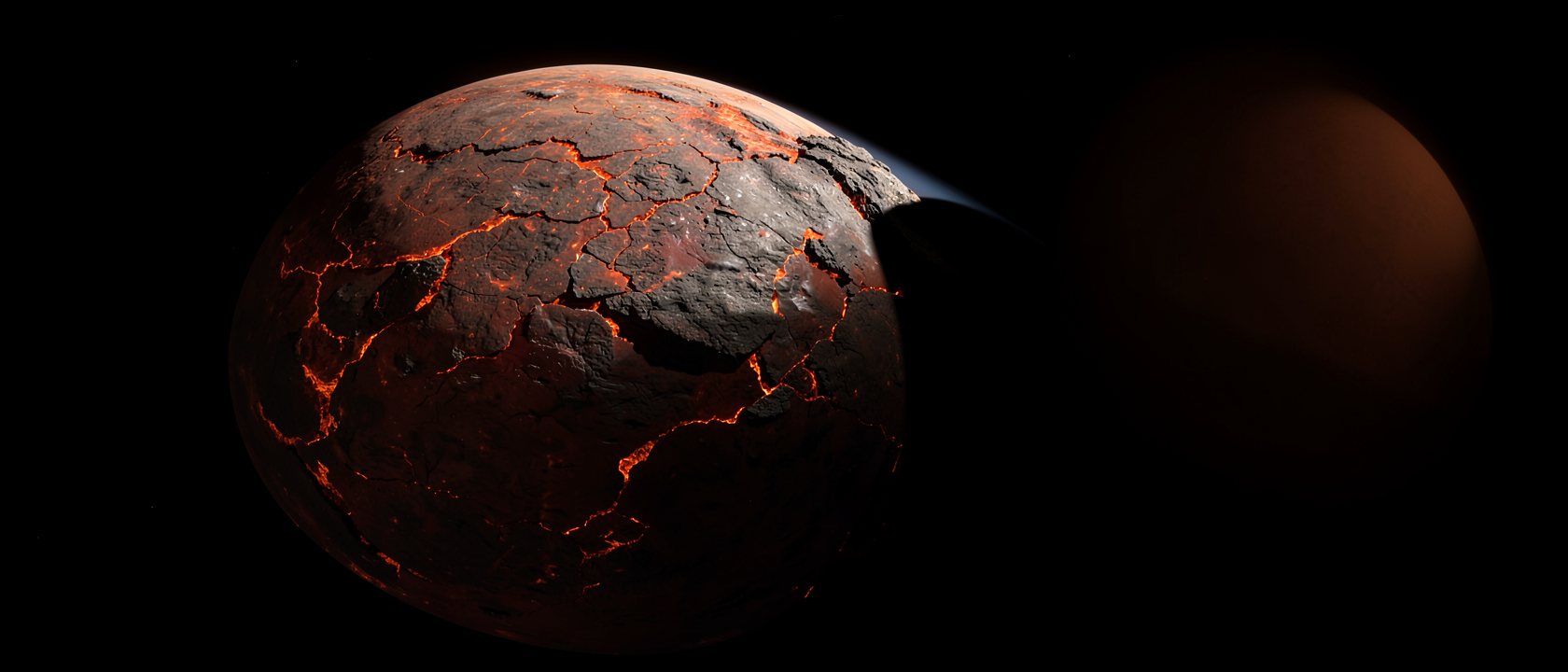
No telescope has photographed TOI-2431 b, and none on any current drawing board could, at 117 light-years, resolving a planet this small this close to its star is beyond what direct imaging can do. Every glowing, lava-streaked illustration you see of it is exactly that: a rendering built from the measured mass, radius, and orbital distance, not a captured frame. NASA’s own coverage uses a generic artist’s impression, credited to NASA Ames/SETI Institute/JPL-Caltech, for exactly that reason, label the picture honestly, or don’t publish it.
—
**Summary of corrections made:**, No subject–verb agreement errors found. No article errors found. No verb tense inconsistencies found. No pronoun/homophone errors found. No spelling inconsistencies found (American spelling used consistently: “kilometers,” “meter,” etc.). No punctuation errors found; em-dashes used correctly and sparingly. No capitalization errors found. No relative-to-today date references found (“July 11, 2025” and “2026 follow-up” are already absolute dates, correctly used).
The article was already clean; no changes were necessary.