
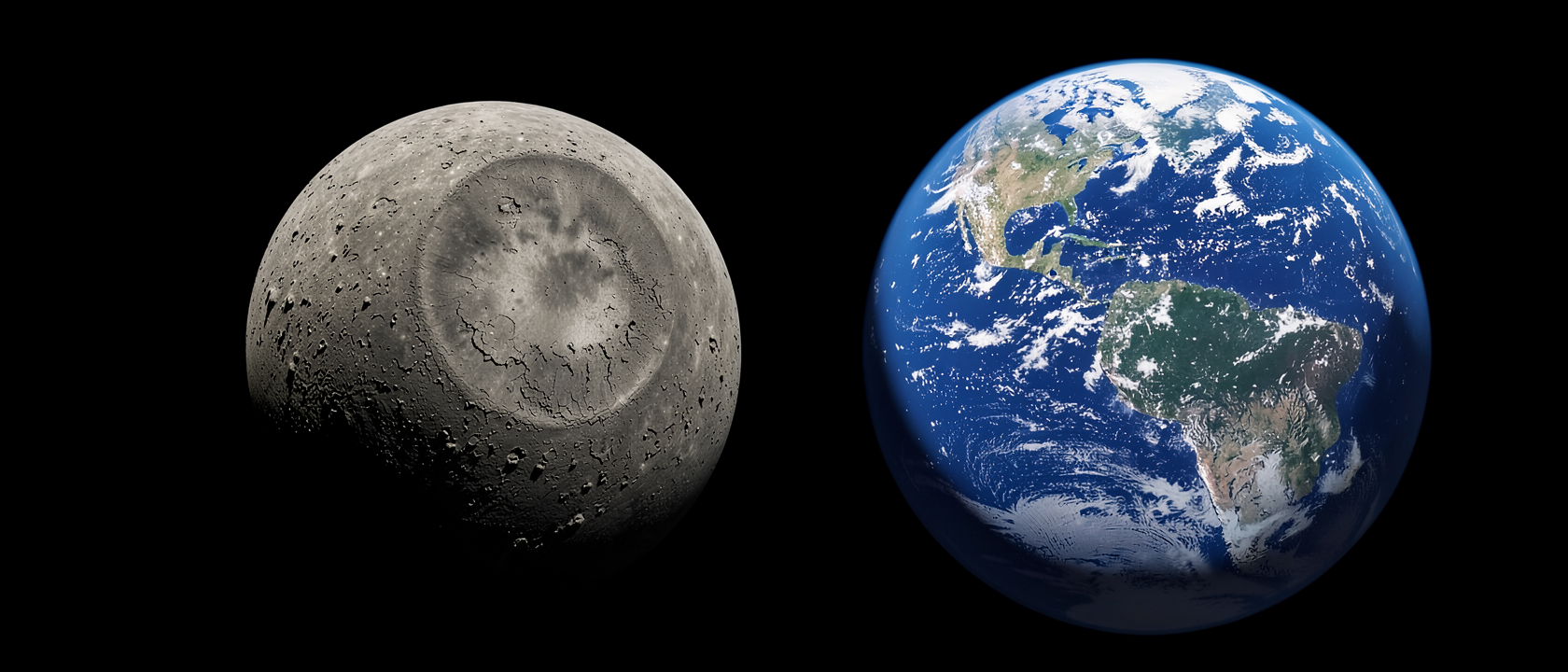
Put eighteen Mercurys on one side of a scale and a single Earth on the other, and the two sides balance. Eighteen isn’t a number you’d guess by eye, Mercury looks like a modest, cratered little planet in any photograph, nothing about its size hints at how light it actually is. That gap only shows up once you stop measuring across the planet and start weighing it.
Mercury’s mass is 3.3010×10²³ kilograms, the measured value in NASA’s NSSDC Planetary Fact Sheet, the agency’s standard reference table for planetary data. Earth’s, from the same table, is 5.9722×10²⁴ kilograms. Divide one into the other and Earth comes out about 18.1 times more massive, not heavier, more massive. Mass is the amount of material a planet is actually built from; weight is just how hard gravity pulls on that material, and it changes from world to world even when the material doesn’t.
The Number That Breaks the Pattern
On paper, Mercury looks like a scaled-down Earth in almost every other way. Its equatorial radius is 1,516 miles (2,440.5 kilometers) against Earth’s 3,963 miles (6,378.1 kilometers), a ratio of about 0.38. Its surface gravity is 3.70 meters per second squared versus Earth’s 9.82, also a ratio of roughly 0.38, a 150-pound person stepping onto Mercury would weigh about 57 pounds. Even its escape velocity, the speed something needs to reach to leave the planet for good, comes in at about 9,620 miles per hour (4.3 kilometers per second) against Earth’s roughly 25,050 miles per hour (11.2 kilometers per second): the same 0.38-ish ratio again.
Mass refuses to follow along. At 0.0553, Mercury carrying about 5.5% of Earth’s mass, it sits far below where radius, gravity, and escape velocity all cluster. Of every property measured on this planet, mass is the one that strays furthest from Earth’s number.
How We Know
You can’t put a planet on a scale, so you watch how hard it pulls on something that’s already moving. A spacecraft near Mercury sends back a steady radio signal; gravity bends its path and shifts that signal’s frequency by a tiny, precisely measurable amount. From the size of that shift, engineers work backward to exactly how much mass is doing the pulling.
Mariner 10 did that work first, flying past Mercury in 1974 and 1975, the earliest spacecraft ever to reach the planet. MESSENGER followed much later, operating at Mercury from 2008 to 2015, including time spent in orbit rather than just passing through, which sharpened the mass figure well beyond what the flybys alone could give. Results from both missions sit behind the number in NASA’s NSSDC Planetary Fact Sheet, the reference table the 3.3010×10²³-kilogram figure comes from. It’s a measured value, built on tracked spacecraft trajectories, not a model and not a guess.
Running the Math
Here’s a sanity check worth doing by hand. If Mercury were simply a shrunken copy of Earth, same density, same mix of rock and metal, its mass should shrink along with its volume, and volume scales with the cube of radius. Mercury’s radius ratio is 0.383; cube that and you get about 0.056, or 5.6% of Earth’s mass.
Mercury’s actual density, 5,429 kilograms per cubic meter against Earth’s 5,513, is nearly a match, a ratio of 0.985. So that back-of-the-envelope guess should hold up, and it very nearly does: the measured figure is 5.53%, which is the same 18.1-times gap read the other way round. The surprise isn’t that the estimate misses. It’s how little room there was for it to miss. A modest-looking difference in radius compounds fast once it’s cubed, even between two planets made of almost identical material. This is an estimate used as a check, the measured mass above is the real number.
What’s Still Open
Two things the fact sheet doesn’t spell out. The 3.3010×10²³-kilogram figure carries no stated margin of error, which is odd for a number given to five digits, tracking down exactly how tight that margin is means going back to the original Mariner 10 and MESSENGER results rather than the compiled table.
Second, and more interesting: Mercury’s density nearly matches Earth’s despite being a much smaller, cooler, more slowly formed planet. One leading idea points to an unusually large iron core, but why Mercury kept so much metal while apparently losing so much of its outer rock isn’t settled. That part stays open.