
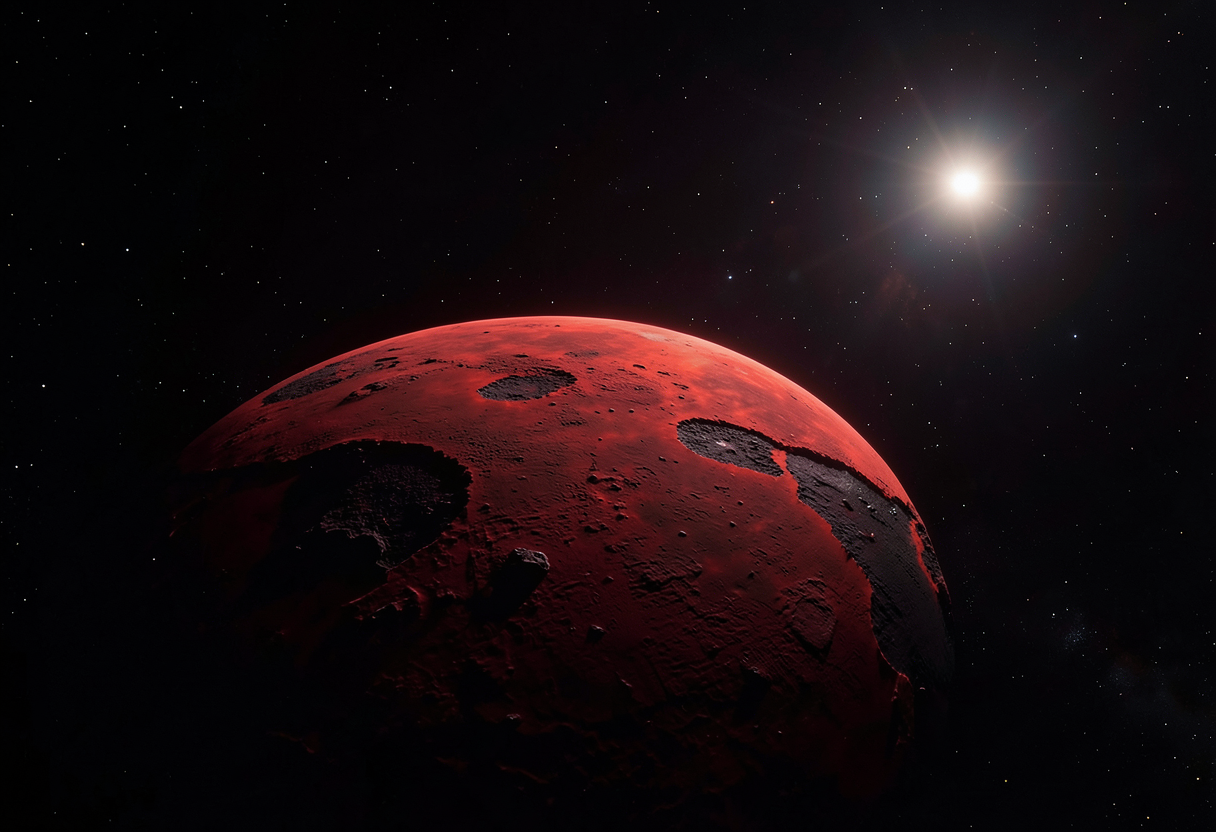
TOI-6729 b is a confirmed super-Earth exoplanet orbiting a star 607.88 light-years away. Its equilibrium temperature of 1,479 K (1,206 °C) and an orbital period of just 3.9 days place it among the class of intensely irradiated planets that challenge models of atmospheric survival and interior structure alike. TOI-6729 b was confirmed in 2026 via the transit method — one of 70 planets confirmed in a single week that pushed the TESS mission past 1,000 confirmed exoplanets.
Key facts
- Mass: 3.22 Earth masses (3.22× Earth)
- Body type: exoplanet
- Host star: TOI-6729
- Radius: 10,269 km (1.61× Earth)
- Density: 4,240 kg/m³ (0.77× Earth)
- Temperature: 1,479 K (1,206 °C)
- Orbital period: 3.9 days
- Orbital eccentricity: 0
- Distance: 607.88 light-years
- Insolation: 1,082,938 W/m²
- Discovered: 2026
- Discovery method: Transit
Physical characteristics
A lower-than-Earth density at a size near the top of the rocky-planet range suggests the planet may incorporate a modest fraction of low-density material — ice, water, or a thin volatile envelope — though it remains ambiguous whether it sits just below or just above the true compositional divide.
The planet’s equilibrium temperature is 1,479 K (1,206 °C). That temperature exceeds the melting point of most silicate rock. Theoretical models of hot rocky super-Earths with radii around 1.5 Earth radii and dayside temperatures above roughly 1,700 K predict partially to fully molten silicate interiors, forming deep magma oceans on the permanently illuminated hemisphere. TOI-6729 b’s temperature falls just below that particular threshold, so whether its dayside hosts a true magma ocean remains an open question.
The orbital eccentricity is fixed at 0.0, indicating an effectively circular orbit. This is a common feature among close-in super-Earths and is thought to be the result of tidal interactions between the planet and its host star, which circularise orbits over geological timescales. The planet orbits its star far closer than Mercury is to the Sun.
Where it sits in the radius valley
The exoplanet size distribution shows a pronounced gap — the radius valley — with peaks in planet occurrence near approximately 1.5 Earth radii and 2.4 Earth radii. Planets smaller than about 1.6 Earth radii tend to have higher bulk densities consistent with rocky compositions, while those larger than this threshold show much lower densities consistent with large hydrogen-helium atmospheres or significant volatile fractions. At 1.61 Earth radii, TOI-6729 b sits right at this boundary, making its true composition genuinely uncertain from radius alone.
Two physical mechanisms are currently debated as the primary driver that carves this valley. One is photoevaporation, in which high-energy stellar radiation strips hydrogen-helium envelopes from close-in planets. The other is core-powered mass loss, in which heat retained in the planet’s interior drives atmospheric escape over longer timescales. Recent analyses using precise planetary radii and stellar parameters give results more consistent with a dominant role for core-powered mass loss, though the question is not settled. The location of the valley also shows sensitivity to stellar refractory element ratios such as magnesium-to-silicon, while correlations with carbon-to-oxygen ratios are weaker — an indication that planetary interior composition is itself a factor.
Statistical studies constrain a population-level one-sigma upper limit on total water mass fraction for super-Earths of no more than approximately 3%, suggesting that most super-Earths are predominantly rocky rather than water-world bodies. Interior structure models further indicate that for a planet of roughly 4 Earth masses with sufficient volatiles, a basal magma ocean could in principle sequester around 130 times the water mass of Earth’s present-day oceans and around 1,000 times the carbon in Earth’s surface and crust — numbers that illustrate why the boundary between ‘rocky’ and ‘volatile-rich’ is not sharp in practice.
Atmosphere and surface environment
No atmosphere has been directly detected or characterised for TOI-6729 b. However, the temperature regime and size class it belongs to inform several predictions. For hot rocky super-Earths, theoretical models predict that any silicate atmosphere outgassed from a magma surface would be composed primarily of sodium (Na), molecular oxygen (O₂), atomic oxygen (O), and silicon monoxide (SiO). Whether such an atmosphere could persist against stellar irradiation, or whether a secondary volatile-rich atmosphere analogous to what has been inferred from JWST observations of 55 Cancri e — probably rich in CO₂ or CO — could survive, is a question that observations at TOI-6729 b have not yet addressed.
JWST observations of 55 Cancri e demonstrated that hot rocky super-Earths can retain volatile-rich secondary atmospheres even at extreme temperatures, ruling out the scenario in which that planet is simply a bare lava world shrouded only by tenuous vaporised rock. That result shows the category is more varied than simple thermal stripping models predict, and TOI-6729 b’s position near the top of the rocky-planet radius range makes it a plausible target for similar characterisation work.
The TOI-6729 system
TOI-6729 b is not alone. The system contains at least one confirmed companion: TOI-6729 c, a Neptune-like exoplanet with a mass of 9.32 Earth masses and an orbital period of 7.8 days. TOI-6729 c has a radius of 0.26853468 Jupiter radii and an orbital eccentricity also fixed at 0.0. The two orbital periods — 3.9 days and 7.8 days — form a precise 2:1 ratio, a near-resonance configuration. Mean-motion resonance capture is thought to result from convergent migration of planets within the protoplanetary gas disk, in which differential migration of two planets due to planet-disk interaction drives them toward a resonant configuration. Whether the TOI-6729 pair is in true mean-motion resonance or merely near it requires additional radial-velocity and dynamical analysis that had not been published as of October 2026.
Discovery and the TESS mission
TOI-6729 b was detected using the transit method, in which periodic dips in a star’s measured brightness — recorded as the planet passes in front of it — are used to derive the planet’s radius and orbital period. The detection was made by TESS, the Transiting Exoplanet Survey Satellite, which launched in April 2018. TESS is a NASA Astrophysics Explorer-class mission led and operated by the Massachusetts Institute of Technology in Cambridge, Massachusetts, and managed by NASA’s Goddard Space Flight Center in Greenbelt, Maryland. George Ricker of MIT’s Kavli Institute for Astrophysics and Space Research serves as the mission’s principal investigator.
TESS surveys the sky by monitoring large swaths for nearly a month at a time, measuring small stellar brightness dips caused by transiting planets. The satellite flies a unique highly elliptical, lunar-resonant orbit with a perigee of approximately 108,000 km and an apogee of approximately 373,000 km, completing one orbit every 13.7 days — exactly half the Moon’s orbital period. This 2:1 lunar resonance keeps the orbit gravitationally stable for decades without requiring station-keeping manoeuvres. No other spacecraft has flown this particular orbit configuration.
The confirmation of TOI-6729 b was announced on October 8, 2026, as part of a batch of 70 newly confirmed planets that pushed the total count of TESS-confirmed exoplanets past 1,000. That same milestone batch also brought the NASA Exoplanet Archive’s total confirmed planet count across all missions to 6,445. TESS planet designations assign suffixes ordered first by validation time and then by orbital period after a candidate, called a TESS Object of Interest (TOI), has been confirmed and entered in the NASA Exoplanet Archive. As of September 2026, the spacecraft was fully operational, having delivered more than five times its planned primary mission length. NASA’s FY25 senior review approved TESS operations through 2028.
By September 2025 — the end of TESS’s second extended mission — the satellite had discovered 679 confirmed exoplanets and 5,165 planet candidates. As of October 2026, nearly 5,000 additional TESS candidate planets remained in the ExoFOP discovery database, awaiting the follow-up radial-velocity and spectroscopic observations needed to confirm them. The scale of that pipeline gives context for why individual confirmations like TOI-6729 b arrive in batches rather than one at a time.
Significance within the super-Earth population
Super-Earths are broadly defined as exoplanets with masses greater than Earth’s but below those of ice giants like Neptune, and they represent the most common class of planet discovered in the galaxy to date. Results from NASA’s Kepler mission established this: the most abundant planet type found around other stars falls into the super-Earth and sub-Neptune size range, a category entirely absent from our own solar system. Estimates suggest that approximately 30 to 50 percent of Sun-like stars host a planet of roughly 1 to 4 Earth radii within orbital periods shorter than around 300 days.
TOI-6729 b exemplifies this common but poorly understood class.
Did you know
- Despite being classified as a super-Earth, TOI-6729 b completes one full orbit — one local ‘year’ — in just 3.9 Earth days. A resident would accumulate more than 93 of these years in the time it takes Earth to complete a single orbit of the Sun. (science.nasa.gov)
- The TOI-6729 system hosts two planets with orbital periods in a near 2:1 ratio: TOI-6729 b at 3.9 days and TOI-6729 c at 7.8 days. That arrangement may hint at a past orbital resonance or convergent migration during the system’s formation. (science.nasa.gov)
- TOI-6729 b’s orbital period of 3.9 days and TOI-6729 c’s period of 7.8 days form a precise 2:1 ratio — a near-resonance configuration that likely hints at convergent migration during the system’s early formation. As of October 2026, both planets were among the 70 confirmed in a single week that pushed TESS past 1,000 confirmed exoplanets. (exoplanetarchive.ipac.caltech.edu)
- TESS flies the only spacecraft orbit of its kind: a 13.7-day lunar-resonant ellipse that swings between 108,000 km and 373,000 km from Earth. The orbit was chosen because it requires no station-keeping to remain stable; no other spacecraft has ever flown this trajectory. (orbitalradar.com)
Data sources
- NASA Exoplanet Archive
- science.nasa.gov
- exoplanetarchive.ipac.caltech.edu
- eoportal.org
- iopscience.iop.org
- arxiv.org
- bohrium.com
- ipac.caltech.edu
- nasa.gov
- orbitalradar.com
- caltech.edu
- nature.com
Data updated: 2026-10-26