
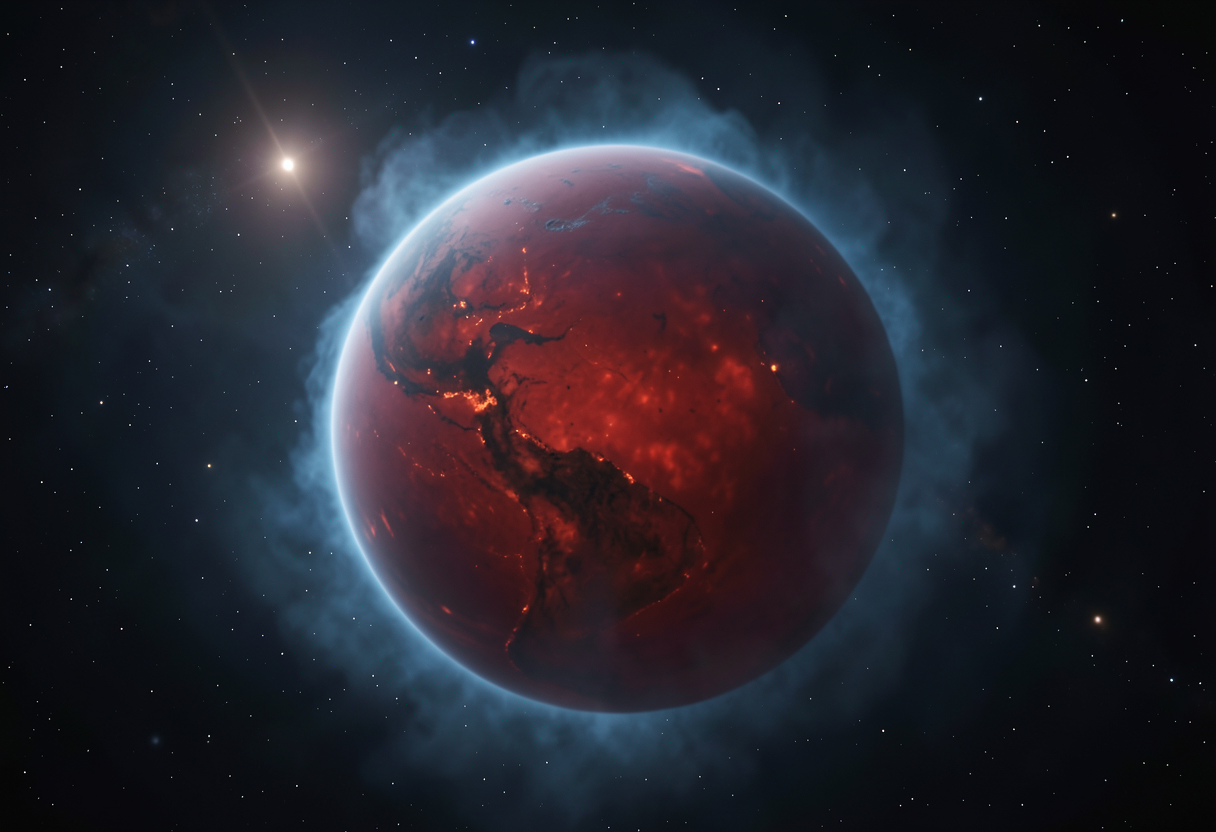
TOI-6647 b is a confirmed exoplanet orbiting a star 568.81 light-years from Earth, classified by NASA as a Neptune-like world — intermediate-sized, gaseous, and too low in density to be rocky. With a radius of 25,321 km (3.97 times Earth’s radius) and a mass 14.9 times that of Earth, its mean bulk density works out to 1,310 kg/m³, barely a quarter of Earth’s.
Key facts
- Mass: 14.9 Earth masses (14.9× Earth)
- Body type: exoplanet
- Host star: TOI-6647
- Radius: 25,321 km (3.97× Earth)
- Density: 1,310 kg/m³ (0.24× Earth)
- Temperature: 1,451 K (1,178 °C)
- Orbital period: 4 days
- Orbital eccentricity: 0
- Distance: 568.81 light-years
- Insolation: 1,002,726 W/m²
- Discovered: 2026
- Discovery method: Transit
Physical characteristics
Its mass of 14.9 Earth masses combined with that volume yields a mean bulk density of 1,310 kg/m³. That density — 0.24 times Earth’s — rules out a predominantly rocky interior and points toward a substantial gaseous envelope of hydrogen and helium overlying a denser core.
The equilibrium temperature reported for TOI-6647 b is 1,451 K (1,178 °C). The insolation — the power per unit area delivered by the host star at the planet’s orbital distance — is measured at 1,002,726 W/m².
Models of Neptune-class exoplanets generally describe a heavy-element rocky core surrounded by a gaseous envelope dominated by hydrogen and helium. The precise split between core and envelope is not determined by bulk density alone; a range of core masses and envelope mass fractions can reproduce the same mean density. Whether TOI-6647 b is a true ice giant — with a significant fraction of water-ice and other volatile ices making up much of its mass — or whether it is more accurately described as a rock-and-iron core with an accreted gas layer depends on where in its protoplanetary disk it originally formed relative to the ice line, an open question as of 2026.
Orbital dynamics
Mercury, the innermost planet of the Solar System, orbits at a distance several times greater from the Sun than TOI-6647 b is from its host star. At this separation, the planet completes a full circuit every 4 days. The orbital eccentricity is measured at 0.0, meaning the orbit shows no detectable elongation; the planet travels in a circle, with the star–planet separation staying essentially constant throughout its year.
A circular orbit at this proximity has a particular implication: because the separation never changes, neither does the stellar irradiation. There are no seasons driven by orbital geometry. The equilibrium temperature of 1,451 K (1,178 °C) is therefore a stable value rather than an annual average, subject only to variations driven by stellar activity.
The Neptunian desert
TOI-6647 b lies within — or at least adjacent to — a statistical scarcity in exoplanet surveys known as the Neptunian desert: a region of parameter space defined roughly by orbital periods of 2 to 4 days and planetary radii of 2 to 6 Earth radii, first identified as a concept in 2016. The desert is notable precisely because it is empty: surveys of many thousands of stars accumulate very few planets of Neptune-like radius at ultra-short periods, whereas smaller rocky planets and larger hot Jupiters are comparatively abundant.
The leading explanation for the desert’s existence involves photoevaporation. At orbital distances this close to a star, a Neptune-mass planet is subjected to intense X-ray and extreme-ultraviolet (XUV) radiation. That flux drives a hydrodynamic outflow in which hydrogen and helium escape the planet’s gravitational well faster than they can be replenished, gradually stripping the gaseous envelope. The expected outcome is that most Neptune-class planets that migrate or form at such short periods lose enough mass to shrink below the Neptune-radius range, swelling the population of close-in rocky worlds instead.
The upper boundary of the desert — where hot Jupiters reside — has a different physical explanation. Massive gas giants undergoing high-eccentricity migration can overflow their Roche lobe at closest approach to the star and be tidally disrupted before atmospheric stripping becomes the dominant loss mechanism. The desert is therefore bounded above by a tidal disruption limit and below by photoevaporation, making it a product of two distinct physical processes operating on different mass regimes.
A 2026 demographic analysis of close-in exoplanets detected by TESS identified a localized enhancement in occurrence rate at periods of approximately 3 to 6 days for planets in the 6-to-8 Earth-radius range — dubbed the Neptunian ridge — consistent with an earlier 2024 identification by Castro-González and collaborators. The ridge sits at the boundary between the desert and the broader planet population, and TOI-6647 b’s 4-day period and 3.97 Earth-radius size place it in a position to inform where exactly the desert edge lies for its host star type. A 2026 study of TOI-672 b using NIRPS and HARPS found that the inner boundary of the desert shifts with host star type: it sits at 3.3 ± 1.4 days for FGK stars and at 2.2 ± 1.0 days for M dwarfs, indicating that the desert’s geography in period–radius space is not universal.
Discovery and confirmation
TOI-6647 b was confirmed in 2026 via the transit method: the planet passes in front of its host star as seen from Earth, producing a periodic dip in the star’s measured brightness. TESS detected those dips. TESS is a NASA Astrophysics Explorer mission led and operated by the Massachusetts Institute of Technology, with partners including NASA’s Goddard Space Flight Center, MIT Lincoln Laboratory, NASA’s Ames Research Center, the Harvard-Smithsonian Center for Astrophysics, and the Space Telescope Science Institute.
TESS surveys the sky by dividing it into 26 sectors, each spanning 24 by 96 degrees. The spacecraft’s four wide-angle cameras — optimized for red-band photometry — cover that field of view simultaneously, monitoring the brightest stars at a two-minute photometric cadence for at least 27 days per sector before the pointing shifts by approximately 24 degrees along the ecliptic plane. Together the four cameras cover roughly 5.5 percent of the celestial sphere at any one time.
When a host star’s light curve shows a sequence of periodic brightness dips that passes tests for statistical significance and reliability, the source is designated a TESS Object of Interest — a TOI — and the planetary candidate enters follow-up observation programs for formal confirmation. The suffix ‘b’ assigned to TOI-6647 b follows the project’s naming convention: suffixes are assigned after a TOI is confirmed and appears on the NASA Exoplanet Archive, first in order of validation and then by orbital period.
TOI-6647 b was among 10 planets named explicitly in the NASA Exoplanet Archive’s milestone news entry dated October 8, 2026 — titled ‘(More Than) One Thousand TESS Planets!’ — as part of a 70-planet batch that collectively pushed TESS’s confirmed-planet tally past 1,000. As of October 9, 2026, 4,823 additional TESS Project Candidates remained awaiting confirmation, with data for more than 8,000 candidates uploaded to the Exoplanet Follow-up Observing Program (ExoFOP).
The host star TOI-6647 had not been assigned a published spectral classification in the confirmed-planet parameter set as of 2026; its spectral type is listed as unknown in the NASA Science exoplanet catalog.
The TESS spacecraft
TESS launched in 2018 and reached its science orbit through an unconventional trajectory. The spacecraft performed six thruster-burn maneuvers, then used a gravitational-assist flyby of the Moon on May 17, 2018, before a final period-adjust maneuver lowered the apogee to approximately 59 Earth radii. The resulting orbit is a highly elliptical, P/2 lunar-resonant path with a period of 13.7 days — a 2:1 resonance with the Moon that no science mission had used before TESS.
The primary design goal of the TESS mission is to find small planets transiting bright, nearby host stars so that follow-up facilities can characterize their atmospheres in detail. The James Webb Space Telescope is one such facility. TOI-6647 b’s host star lies 568.81 light-years away.
Atmospheric follow-up context
One instrument broadening the toolkit for atmospheric studies of TESS planets is Pandora, a NASA Astrophysics Pioneers SmallSat mission. Pandora launched on January 11, 2026, aboard a SpaceX Falcon 9 rideshare from Vandenberg Space Force Base into a Sun-synchronous low Earth orbit. The spacecraft carries an all-aluminum telescope approximately 45 centimeters in diameter and is designed to simultaneously perform visible photometry and near-infrared spectroscopy, separating chemical fingerprints in a planet’s atmosphere from signals produced by the host star itself. The mission plans to characterize the atmospheric composition of at least 20 exoplanets.
For Neptune-class planets at short periods, atmospheric characterization carries particular stakes. Photoevaporation models predict that such planets are in the process of losing — or have already lost — significant fractions of their hydrogen-helium envelopes. Measuring the current atmospheric composition and mass-loss rate for a planet like TOI-6647 b would test whether the observed bulk density of 1,310 kg/m³ is consistent with an envelope still largely intact or one already substantially depleted. Neptune itself, for comparison, has a mean density of 1,638 kg/m³ and an atmosphere composed primarily of 80 percent molecular hydrogen and 19 percent helium by volume.
Did you know
- TOI-6647 b is one of 10 planets listed by name in the NASA Exoplanet Archive’s news entry for October 8, 2026 — the entry titled “(More Than) One Thousand TESS Planets!” — meaning it is part of the specific 70-planet batch whose confirmation collectively pushed TESS’s total past the 1,000-planet mark. (exoplanetarchive.ipac.caltech.edu)
Data sources
- NASA Exoplanet Archive
- science.nasa.gov
- arxiv.org
- nasa.gov
- iac.es
- iopscience.iop.org
- astrobiology.com
- eoportal.org
- spaceupclose.com
- nssdc.gsfc.nasa.gov
- pmc.ncbi.nlm.nih.gov
- exoplanetarchive.ipac.caltech.edu
- ll.mit.edu
Data updated: 2026-10-26