
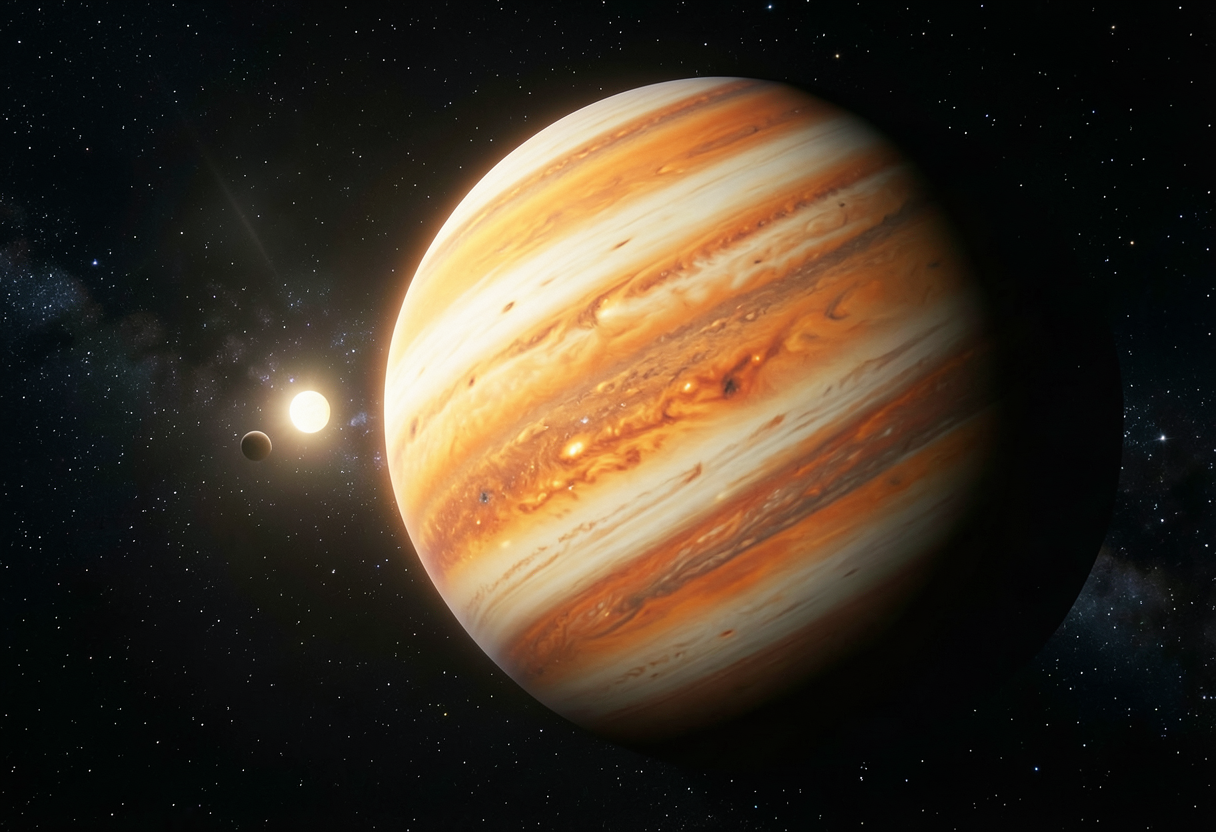
TOI-6450 b is a gas giant exoplanet orbiting a star roughly 967.32 light-years from Earth. With a radius of 46,943 km (7.37 times Earth’s radius, or 0.65661635 times Jupiter’s radius) and a mass of 42.5 Earth masses (0.134 Jupiter masses), it occupies a sparsely populated zone in the landscape of known planets, sitting just above the upper boundary of what planetary scientists call the Neptunian desert. Its discovery was announced in 2026 and confirmed through transit photometry by the TESS space telescope, placing it among the first thousand planets ever confirmed using TESS data.
Key facts
- Mass: 42.5 Earth masses (42.5× Earth)
- Body type: exoplanet
- Host star: TOI-6450
- Radius: 46,943 km (7.37× Earth)
- Density: 586 kg/m³ (0.11× Earth)
- Temperature: 981 K (708 °C)
- Orbital period: 3.6 days
- Orbital eccentricity: 0
- Distance: 967.32 light-years
- Insolation: 209,391 W/m²
- Discovered: 2026
- Discovery method: Transit
Physical characteristics
TOI-6450 b has a radius of 46,943 km — 7.37 times Earth’s radius — and a mass of 42.5 Earth masses, or 0.134 Jupiter masses. That combination places the planet in the sub-Saturn class: larger than Neptune-sized worlds but considerably less massive than Jupiter itself.
The planet’s bulk density is 586 kg/m³ (0.11 times Earth’s density), a low figure characteristic of a hydrogen- and helium-dominated interior, consistent with its gas giant classification. Its equilibrium temperature is estimated at 981 K (708 °C), a direct consequence of how close the planet sits to its host star.
The insolation at TOI-6450 b’s orbital distance reaches 209,391 W/m². The orbital eccentricity is measured at 0.0, meaning the orbit is effectively circular — the planet traces a near-perfect ring around its host star with no detectable variation in distance across its year.
Orbital dynamics and the Neptunian desert
TOI-6450 b completes one orbit around TOI-6450 every 3.6 days. A 3.6-day period places TOI-6450 b firmly within the class of close-in gas giants, sometimes called hot Jupiters or, in this lower-mass range, hot sub-Saturns.
Planets with radii between 4 and 8 Earth radii and orbital periods shorter than approximately 10 days exist in a region of parameter space where they are statistically rare — the Neptunian desert. The lower boundary of this desert is shaped primarily by photoevaporation: X-ray and extreme ultraviolet (XUV) radiation from the host star strips the atmospheric envelope from planets that are not massive enough to retain it. Smaller objects lose their atmospheres and are reduced to rocky cores, which is why sub-Neptune-sized planets are nearly absent at these short periods.
TOI-6450 b sits above the desert’s upper boundary, where massive close-in gas giants become progressively more common. That upper boundary is thought to result from high-eccentricity migration: gravitational interactions with other bodies — possibly other planets or a stellar companion — can kick a planet into an elongated orbit. Over time, tidal forces from the host star then circularise the orbit at a small radius. The zero eccentricity of TOI-6450 b is consistent with this pathway having already run to completion.
The sub-Saturn class — planets in roughly the 4–8 Earth radii range — has no analogue in the Solar System. That gap makes objects like TOI-6450 b particularly useful for testing models of how planetary formation and atmospheric retention operate across the mass–radius spectrum.
Discovery and validation
TOI-6450 b was detected by TESS — the Transiting Exoplanet Survey Satellite — using the transit method, in which the brightness of the host star dips briefly and periodically as the planet crosses in front of it. TESS carries four wide-angle cameras whose associated CCD detectors each image a 24° × 96° strip of sky, enabling a near-all-sky photometric survey. The depth and regularity of the brightness dip encode the planet’s radius and orbital period.
The raw photometric data were processed by the TESS SPOC (Science Processing Operations Centre) pipeline, which calibrates pixel values, assigns coordinate information, performs simple aperture photometry, and delivers pre-search data conditioning light curves. Those light curves were then passed to the RAVEN pipeline — a machine-learning transit search system developed at the University of Warwick and led on the technical side by Andreas Hadjigeorghiou, with Dr. Marina Lafarga Magro as first author of the corresponding MNRAS paper (Lafarga et al., MNRAS, 2026).
RAVEN ran against a magnitude-limited stellar sample, excluding any star with a TESS magnitude fainter than 13.5 or a Gaia magnitude fainter than 14, to ensure the photometric precision needed for reliable classification. The pipeline operates two families of machine-learning classifiers in parallel — a Gradient Boosted Decision Tree (implemented with XGBoost) and a Gaussian Process classifier — with one of each trained against each of eight distinct categories of astrophysical false positive, for 16 classifiers in total. The first version of RAVEN was built exclusively for TESS SPOC light curves; compatibility with the alternative QLP (Quick Look Pipeline) light curves was not included in that release.
The confirmation of TOI-6450 b as a planet was announced as part of two separate batch events in 2026. It was listed again among the 70 new planets added on October 8, 2026, the batch that pushed the total count of TESS-confirmed planets past 1,000 for the first time. The overall tally in the NASA Exoplanet Archive stood at 6,445 confirmed exoplanets as of that October 8, 2026 milestone. The RAVEN pipeline code is publicly hosted on GitHub and is also available as a cloud-hosted application on Hugging Face, accessible without additional setup.
Hot Jupiter occurrence rates and population context
TOI-6450 b sits at the lower-mass fringe of the hot Jupiter population, and its confirmation contributes to demographic studies of how often such planets form around different types of stars. The K-type measurement was identified as the first of its kind.
As of October 2026, the NASA Exoplanet Archive catalog page for TOI-6450 b records no spectral type for the host star TOI-6450, leaving open which of the F, G, or K categories the demographic rates above would apply to. That gap underlines one of the standard challenges in large-scale photometric surveys: stellar characterisation often lags behind planet detection, and bulk properties of the planet — such as its equilibrium temperature and insolation — carry uncertainties that propagate from incomplete knowledge of the host.
Did you know
- The RAVEN pipeline that validated TOI-6450 b runs 16 separate machine-learning classifiers in parallel — one Gradient Boosted Decision Tree and one Gaussian Process classifier for each of the eight categories of astrophysical false positive it is trained to reject. (arxiv.org)
- TESS’s full-frame image cadence shortened substantially across its mission phases: 30 minutes in the prime mission, 10 minutes in the first extended mission, and 200 seconds in the second extended mission and beyond — each step improving sensitivity to the brief dips produced by smaller or more distant planets. (arxiv.org)
- As of October 8, 2026, the NASA Exoplanet Archive listed 4,823 unconfirmed TESS Project Candidates still awaiting follow-up confirmation, pointing to a vast reservoir of potential planets yet to be vetted. (exoplanetarchive.ipac.caltech.edu)
Data sources
- NASA Exoplanet Archive
- science.nasa.gov
- exoplanetarchive.ipac.caltech.edu
- astrobiology.com
- arxiv.org
- github.com
- sciencedaily.com
Data updated: 2026-10-26