
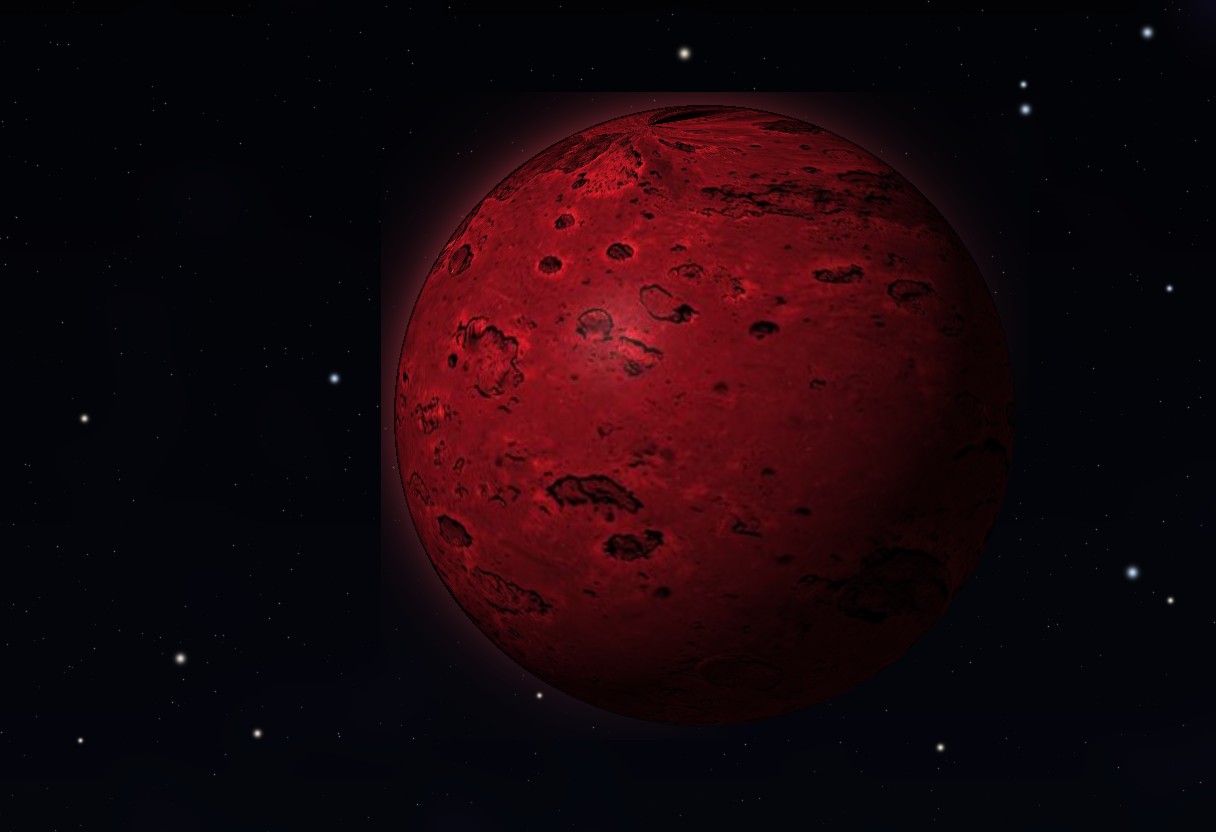
TOI-2260 b is a super-Earth exoplanet that completes a full orbit around its host star in just 8.5 hours, placing it so close to the star that its equilibrium temperature reaches 2,609 K (2,336 °C). At 1.62 times Earth’s radius (10,333 km) and an estimated 3.26 times Earth’s mass, it sits in the category of rocky or partially rocky worlds rather than gas-dominated ones, yet its extreme heat makes it unlike any body in the Solar System. Validated in 2022 from photometric data gathered by the Transiting Exoplanet Survey Satellite, the planet stands out not only for its temperature but for its remarkably young host star and for the scientific questions its interior structure and orbital history still leave open.
Key facts
- Mass: 3.26 Earth masses (3.26× Earth)
- Body type: exoplanet
- Host star: TOI-2260
- Radius: 10,333 km (1.62× Earth)
- Density: 4,210 kg/m³ (0.76× Earth)
- Temperature: 2,609 K (2,336 °C)
- Orbital period: 8.5 h
- Semi-major axis: 1,451,099 km
- Distance: 330.24 light-years
- Insolation: 2,511,018 W/m²
- Discovered: 2022
- Discovery method: Transit
Physical characteristics
TOI-2260 b has a radius of 10,333 km — 1.62 times Earth’s radius — and a bulk density of 4,210 kg/m³, which is 0.76 times Earth’s mean density. That combination places it below the density of a pure-rock body, suggesting either a volatile-rich interior, an iron-poor composition, or both, though no direct spectroscopic measurement of its interior has been published.
The equilibrium temperature of 2,609 ± 86 K (2,336 °C) is the planet’s single most striking physical property. At the time of its announcement in January 2022, TOI-2260 b ranked as the fourth hottest known planet with a radius smaller than 2 Earth radii, exceeded only by KOI-55 b at roughly 8,000 K, TOI-55 c at roughly 7,000 K, and Kepler-1340 b at roughly 2,860 K. That heat drives an insolation flux of 2,511,018 W/m².
Host star
TOI-2260 is a G-type main-sequence star (spectral class G V) with an effective temperature of 5,534 ± 100 K, a mass of 0.99 ± 0.04 solar masses, and a radius of 0.94 ± 0.05 solar radii — close enough to the Sun’s parameters that the two stars would sit nearly on top of each other on a Hertzsprung–Russell diagram. Its surface gravity is log g = 4.62 ± 0.10 (in units of log₁₀ cm/s²), consistent with a dwarf rather than a subgiant.
Two properties set TOI-2260 apart from the average Sun-like star. Its stellar metallicity is [Fe/H] = +0.22 ± 0.06 dex, placing it among the most metal-rich stars known to host an ultra-short-period planet. Its estimated age is only 321 ± 96 Myr, derived in part from its stellar rotation period of 8.45 ± 0.03 days: young stars spin faster, and gyrochronology translates that spin rate into an age estimate. At the time of the 2022 discovery paper, this made TOI-2260 b one of the youngest known transiting planets.
TOI-2260 lies 330.24 light-years from the Solar System, confirmed by a measured parallax of 9.8476 ± 0.0274 milliarcseconds. Its total proper motion across the sky is 66.4 milliarcseconds per year.
Discovery and validation
TESS detected TOI-2260 b by recording the tiny dimming of the host star each time the planet passed in front of it. The satellite observed the star across three consecutive observing sectors — sectors 23, 24, and 25 — collecting enough transit events to establish the 8.5-hour orbital period with confidence. Because TESS’s pixel scale is coarse, a background eclipsing binary blended into the same pixel could mimic a planetary transit signal; ruling out that possibility required additional work.
Validation, rather than mass measurement via radial velocity, was the path taken by the discovery team. The team applied two independent vetting tools — DAVE and TRICERATOPS — to assess the statistical probability that the signal was a genuine planet rather than a false positive, and combined those results with follow-up observations coordinated through the TESS Follow-up Observing Program (TFOP). High-resolution imaging played a central role: on March 23, 2021 (UT), the AstraLux lucky-imaging instrument on the 2.2 m telescope at Calar Alto Observatory in Almería, Spain, recorded 166,860 individual frames of TOI-2260, each with an exposure time of 10 milliseconds. The lucky-imaging technique selects only the sharpest frames, effectively beating atmospheric seeing to resolve the immediate neighbourhood of the star and confirm that no contaminating source was lurking nearby.
The discovery was announced on January 28, 2022, in a paper titled “Validation of 13 Hot and Potentially Terrestrial TESS Planets” published in The Astronomical Journal, Volume 163, Number 2 (DOI 10.3847/1538-3881/ac4334). The lead author was Steven Giacalone; the co-author list included Courtney D. Dressing, Christina Hedges, Veselin B. Kostov, and more than 110 collaborators in total. A paper of that scale reflects the operational reality of modern transit surveys, where a single planet candidate routinely draws on telescope networks, software pipelines, and expertise spread across dozens of institutions.
Ongoing and planned research
Because the planet’s mass was not measured directly, its bulk composition remains poorly constrained. Radial-velocity follow-up with a spectrograph capable of reaching a precision well below 3 m/s would be required to resolve the uncertainty range of (+2.5/−1.3) Earth masses and determine whether the interior is predominantly rocky or carries a significant volatile layer. That measurement had not been reported as of the 2022 discovery paper.
Did you know
- TOI-2260, the host star, has an estimated age of only 321 million years — placing it in roughly the same era, in geological terms, as Earth’s Carboniferous period. At that age it is one of the youngest G-type stars known to host a confirmed transiting exoplanet. (iopscience.iop.org)
- The January 2022 paper that validated TOI-2260 b, led by Steven Giacalone, listed more than 110 co-authors. The figure reflects how large a collaborative network — spanning telescope operators, pipeline developers, and statistical validators — a single modern planet validation can require. (arxiv.org)
- To confirm that no background star was contaminating the TESS signal, the AstraLux instrument at Calar Alto Observatory captured 166,860 separate frames of TOI-2260, each just 10 milliseconds long. The lucky-imaging technique then selected only the sharpest frames, combining them to produce a resolution that conventional long-exposure imaging through the same atmosphere could not match. (iopscience.iop.org)
Data sources
- NASA Exoplanet Archive
- science.nasa.gov
- iopscience.iop.org
- arxiv.org
- exoplanetarchive.ipac.caltech.edu
Data updated: 2026-10-29