
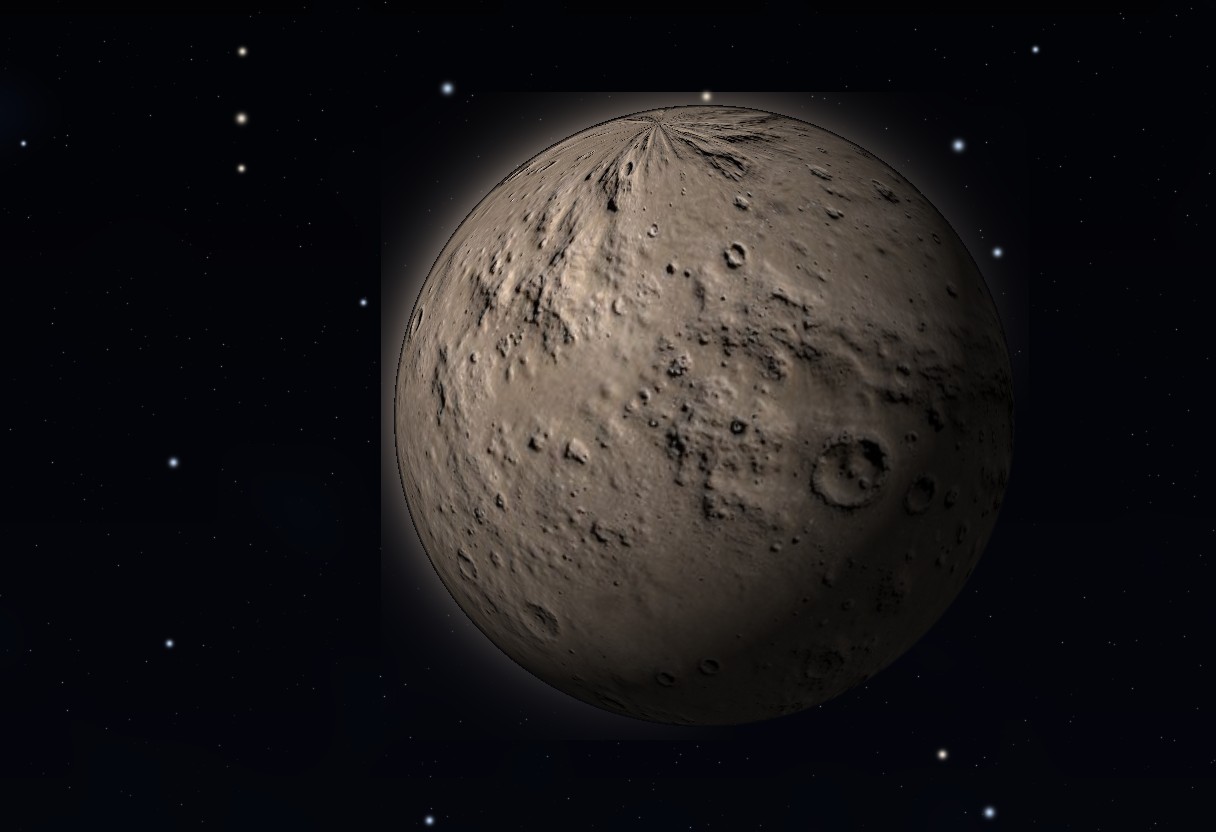
Roughly 1,473.47 light-years from Earth, a planet slightly larger than our own completes a full orbit in just 8.5 hours — less time than a standard working day. EPIC 206042996 c is a validated super-Earth exoplanet circling a K-type orange-dwarf star, with a radius of 7,654 km (1.2 times Earth’s), a mass of 1.87 Earth masses, and a bulk density of 5,950 kg/m³ that comes in at 1.08 times Earth’s own — figures that point firmly toward a rocky, metal-and-silicate interior rather than a world swaddled in gas. It belongs to the class of ultra-short-period planets: objects so close to their host stars that they occupy some of the most extreme orbital environments known to planetary science.
Key facts
- Mass: 1.87 Earth masses (1.87× Earth)
- Body type: exoplanet
- Host star: EPIC 206042996
- Radius: 7,654 km (1.2× Earth)
- Density: 5,950 kg/m³ (1.08× Earth)
- Orbital period: 8.5 h
- Distance: 1,473.47 light-years
- Discovered: 2021
- Discovery method: Transit
Physical characteristics
EPIC 206042996 c has a radius of 7,654 km — 1.2 times Earth’s — and a mass of 1.87 Earth masses. Together these two figures yield a mean density of 5,950 kg/m³, which is 1.08 times Earth’s mean density. That near-Earth density is significant: it matches what you would expect from a body built predominantly of silicate rock and iron, with little or no thick gaseous envelope to dilute the bulk.
The planet’s radius of 1.2 Earth radii places it just below the approximate 1.6 Earth-radii boundary that planetary scientists use when thinking about atmospheric stripping. Small ultra-short-period planets below that threshold are thought to be the rocky cores of formerly larger worlds whose hydrogen-and-helium envelopes were eroded away by the intense radiation received at such close orbital distances. The density of EPIC 206042996 c is consistent with that picture: what remains is a dense, solid body broadly Earth-like in composition.
Orbit and environment
EPIC 206042996 c completes one orbit in 8.5 hours, placing it in the ultra-short-period regime. The extreme proximity to its host star subjects the planet to intense irradiation.
Tidal interactions are expected to be dominant at this orbital distance. Planets in ultra-short-period orbits are widely considered to be tidally locked, meaning their rotation period has been synchronized with their orbital period so that one hemisphere permanently faces the star while the other faces permanently away — much as the Moon always shows the same face to Earth. Whether EPIC 206042996 c has in fact reached this locked state has not been directly measured, but the physics of tidal dissipation at 8.5-hour orbital periods makes it the strongly favored outcome.
Ultra-short-period planets cannot have formed at the distances where they are found. The prevailing view, supported by the high fraction of USP planets discovered in multi-planet systems, is that they assembled farther out in their protoplanetary disks and then migrated inward. The mechanism most consistent with the observed data involves gravitational interactions with companion planets raising the orbital eccentricity of the inner body, followed by tidal dissipation gradually shrinking and circularizing the orbit until the planet settles at its present extreme position.
Planetary system
EPIC 206042996 c is not the only planet in its system. The existence of this companion is consistent with the theoretical expectation that USP planets are commonly found alongside outer planetary neighbors: the Adams et al. (2021) K2 survey identified thirteen new multi-planet systems in the same study that validated EPIC 206042996 c, reinforcing the statistical link between ultra-short-period planets and companion bodies.
Among the broader USP population studied in that survey, the median validated candidate had a radius of 1.1 Earth radii, with the full sample spanning 0.4 to 2.4 Earth radii and orbital periods ranging from 0.18 to 0.96 days. At 1.2 Earth radii, EPIC 206042996 c sits near the larger end of that radius distribution while its 8.5-hour period keeps it well within the ultra-short-period range.
Discovery
EPIC 206042996 c was identified using data from the K2 mission, the extended operational phase of the Kepler Space Telescope following the failure of two of its four reaction wheels. In K2 mode, the telescope observed approximately 100 square degrees of sky for around 80 days per pointing, cycling through 20 different fields along the ecliptic plane.
The transit method was used to detect the planet: as EPIC 206042996 c passed in front of its host star from the spacecraft’s line of sight, it blocked a measurable fraction of the star’s light, producing a periodic dip in brightness. The EVEREST photometry pipeline was applied to the K2 data to extract and vet these signals; the Adams et al. (2021) study used this pipeline to identify 74 ultra-short-period planet candidates across the first half of the K2 dataset.
The planet’s validation as a confirmed USP was announced in the study ‘Ultra-short-period Planets in K2. III. Neighbors are Common with 13 New Multiplanet Systems and 10 Newly Validated Planets in Campaigns 0–8 and 10,’ published in The Planetary Science Journal on August 6, 2021, with Elisabeth R. Adams as lead author. In that paper the planet carried the internal designation EPIC 206042996 p1. It was formally added to the NASA Exoplanet Archive on October 28, 2021, as part of a batch of thirteen new planets, under the alternative designation K2-301 c.
Data sources
- NASA Exoplanet Archive
- science.nasa.gov
- iopscience.iop.org
- exoplanetarchive.ipac.caltech.edu
- archive.stsci.edu
- experts.boisestate.edu
- facultyshowcase.sfasu.edu
Data updated: 2026-10-29