
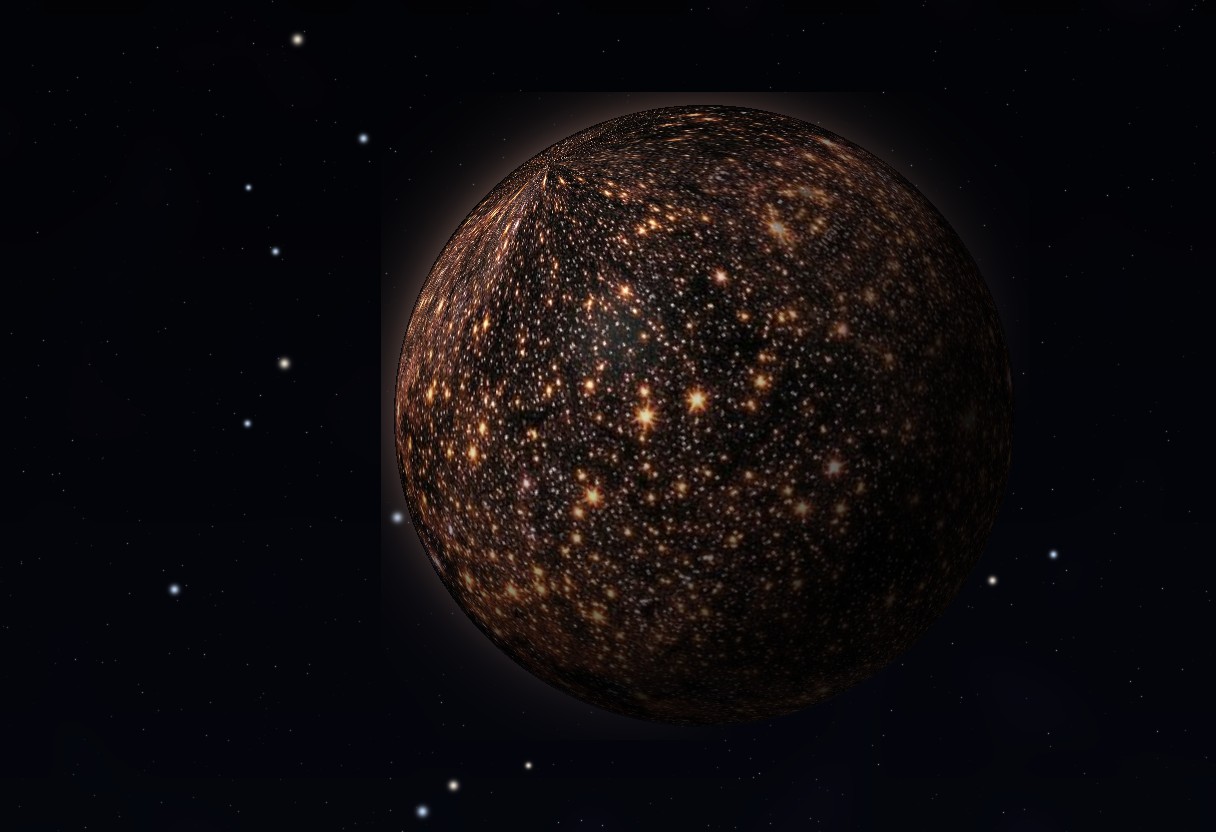
TOI-2260 is a G-type main-sequence star sitting 330.4 light-years away in the constellation Hercules. The star itself is close to solar in size and mass, which makes the contrast with its roasting companion all the sharper.
Key facts
- Mass: 1,037.35 Jupiter masses
- Body type: high proper-motion star; near-infrared source
- Radius: 0.94 solar radius
- Distance: 330.4 light-years
The star
TOI-2260 is classified as a G V star — the same broad category as the Sun — with an effective temperature of 5,534 ± 100 K and a mass of 0.99 ± 0.04 solar masses. Its radius, measured at 0.94 solar radii, is about 6 percent smaller across than the Sun. A surface gravity of log g = 4.62 ± 0.10 (in CGS units) places it on the main sequence, consistent with a star that has not yet begun to expand off it.
Where TOI-2260 departs from a plain solar analog is in its iron content. Its metallicity, [Fe/H] = 0.22 ± 0.06 dex, means it is substantially richer in iron relative to hydrogen than the Sun. That figure put it, at the time of its 2022 validation announcement, among the most metal-rich stars known to host an ultra-short-period planet.
At a visual apparent magnitude of 10.474 ± 0.006 in the V band, TOI-2260 falls just below naked-eye visibility; a small backyard telescope can reach it. The Gaia mission measured its parallax at 9.8476110 ± 0.0274353 milliarcseconds, placing it at 101.251 parsecs. TOI-2260 sits well above the Galactic plane, at a Galactic latitude of 42.88825 degrees, which means interstellar dust causes relatively little reddening of its light — a practical advantage for precise photometry.
Position and motion
The star’s equatorial coordinates are right ascension 16 h 30 m 40.08 s and declination +49° 02′ 48.44″ (J2000 epoch), placing it in the northern part of Hercules, at Galactic longitude 75.95588 degrees and Galactic latitude 42.88825 degrees. It is catalogued as a high proper-motion star: Gaia measured a total proper motion of 66.4006040 ± 0.0618395 milliarcseconds per year, broken into −25.2997 ± 0.047 mas/yr in right ascension and +61.3919 ± 0.064 mas/yr in declination. This angular drift, though slow on a human timescale, is large enough by stellar standards to earn TOI-2260 the formal designation of a high proper-motion object.
The planet: TOI-2260 b
TOI-2260 b is an ultra-short-period planet, a class defined by orbital periods shorter than one Earth day. Its 8.5-hour year means it completes a full orbit well within a single Earth day. Mercury, the innermost planet of the Solar System, takes 88 days to lap the Sun — far longer. At that proximity, the planet’s equilibrium temperature reaches 2,609 ± 86 K, an environment that has earned this class of object the informal label ‘lava planet.’
The planet’s transit impact parameter is 0.77 ± 0.04, measured on a scale where 0 means the planet crosses directly through the center of the stellar disk. A value of 0.77 is consistent with a near-grazing geometry, which affects how well the planet’s radius can be pinned down from photometry alone and adds uncertainty to atmospheric characterization.
At the time of its validation announcement in January 2022, TOI-2260 b was the fourth hottest known planet with a radius below 2 Earth radii — a specific and narrow distinction, since larger hot planets (hot Jupiters) were already well catalogued. Its radius of 1.62 Earth radii places it in a size range where the boundary between rocky and volatile-rich interiors is not straightforwardly determined from radius alone.
Discovery
The planet’s validation was announced on January 28, 2022, in a paper by Steven Giacalone and colleagues published in The Astronomical Journal, Volume 163, Number 2 (DOI: 10.3847/1538-3881/ac4334). The study validated seven ultra-short-period planets in total — TOI-206 b, TOI-500 b, TOI-1075 b, TOI-1442 b, TOI-2260 b, TOI-2411 b, and TOI-2445 b — all drawn from transit signals identified by TESS. The coordinated validation of a batch of planets from a single photometric survey is a relatively efficient use of follow-up resources, since each candidate requires ground-based or archival checks to rule out background eclipsing binaries.
Ongoing and planned observations
TOI-2260 b is one of five targets in JWST Cycle 4 General Observer Program 8864, informally called ‘Hell of a Survey.’ The program, led by principal investigator L. Dang, uses the Mid-Infrared Instrument’s Low Resolution Spectroscopy mode (MIRI-LRS) to observe secondary eclipses — the moments when the planet passes behind the star — in order to characterize thermal emission and constrain whether the planet retains any atmosphere. At an equilibrium temperature of 2,609 ± 86 K, the key open question is whether any mineral vapor atmosphere persists, and if so, what composition it carries. MIRI-LRS eclipse photometry is the most direct method currently available to probe that question for a planet of this size at this temperature.
Did you know
- TOI-2260 b completes one full orbit — equivalent to a ‘year’ — in just 8.5 hours, shorter than a standard workday and far shorter than Mercury’s 88-day year around the Sun. (the-exoplanets.space)
- At the time of its validation announcement in January 2022, TOI-2260 b held the distinction of being the fourth hottest known planet with a radius less than 2 Earth radii, despite having a radius of only 1.62 times Earth’s. (iopscience.iop.org)
Data sources
Data updated: 2026-10-29