
A Year Before the Credits Roll
A planet completes one full lap around its host, a complete year, start to finish, in 2.177 hours. Buy a large popcorn, sit through a feature film, and its year would be over before the credits roll.
The measured orbital period, extracted from radio telescope data, is 7,837.024 seconds. Divide by 3,600 and you get 2.177 hours; “2.2 hours” is the rounded figure that tends to travel. Earth’s orbital period is 365.256 days, or 31,558,118 seconds. While Earth completes a single trip around the Sun, this planet completes roughly 4,027 of its own years.
The film comparison was not chosen for flair. It was chosen because two hours is a duration most people have sat through. Astronomical intuition is hard to build from scratch, but the memory of a long third act is already there. Both sides of a measuring stick have to be real.
How the Period Was Measured
No spacecraft has visited this system. No telescope has photographed the planet. The 7,837.024-second figure was pulled entirely from the behavior of a radio signal.
The host is a millisecond pulsar: a collapsed stellar remnant with a mass of roughly 1.44 times the Sun’s, compressed into an object with a radius of about 12 miles (19 kilometers), spinning at around 173 rotations per second. That spin sweeps a tight beam of radio emission around like a lighthouse on an extreme motor, producing pulses so regular they rival an atomic clock in stability.
When a companion object orbits a pulsar, it tugs the pulsar gently back and forth along our line of sight. As the pulsar moves toward us, its pulses arrive fractionally early; as it swings away, they arrive fractionally late. These Doppler shifts, tiny compressions and stretches in pulse arrival time, measured in milliseconds, accumulate over weeks and months of observation. Fit a mathematical model to that pattern and you recover the orbital period, the geometry of the orbit, and a lower bound on the companion’s mass. No camera required. Just a clock and a long run of data.
The discovery used the 210-foot (64-meter) Parkes Radio Telescope in New South Wales, Australia, with follow-up timing at the Lovell Telescope at Jodrell Bank in the United Kingdom and the Keck 10-meter telescope in Hawaii. The paper, “Transformation of a Star into a Planet in a Millisecond Pulsar Binary,” led by Matthew Bailes of Swinburne University of Technology, was published in Science on August 25, 2011. Parkes did not see the planet. It heard the pulsar flinch.
An Orbit Inside the Sun
The semi-major axis of this orbit is approximately 600,000 kilometers (373,000 miles). The Sun’s radius is roughly 696,000 kilometers (432,000 miles). The entire orbital path of this planet fits inside a volume comparable to the Sun itself. Hollow out the Sun, place the pulsar at the center, and the planet would complete its full yearly circuit without once grazing the solar surface.
The companion’s minimum mass, the lower bound derived from the timing solution, assuming the orbital plane is seen edge-on, is at least 1.2 times the mass of Jupiter. The true mass is unknown; without measuring the orbital inclination, the timing method yields a floor, not a ceiling.
The Density Estimate, and What It Might Mean
Here the fact sheet changes register, from measured to estimated, and the distinction matters.
Any object orbiting a pulsar must fit within its Roche lobe, the gravitational boundary inside which tidal forces would pull the companion apart. Knowing the orbital period and the minimum companion mass, astronomers can calculate the minimum size that Roche lobe can be, and therefore the minimum density the companion must have to survive intact. That calculation, published by Bailes et al. in 2011, yields a minimum mean density of at least 23 grams per cubic centimeter. Diamond has a density of about 3.5 grams per cubic centimeter. This planet’s minimum density is at least 6.6 times that.
That figure, combined with the system’s probable evolutionary history, supports a specific hypothesis: the companion was once a white dwarf in a close orbit with what is now the pulsar. Over a very long time, the pulsar drew mass off the white dwarf, spinning itself up to its current rotation rate, a process astronomers call recycling. The white dwarf, progressively stripped, left behind a dense, carbon-rich remnant that models suggest may be largely crystalline. Popular science has taken to calling it the “diamond planet.” That label captures the theoretical interior state, not the appearance, and it carries more uncertainty than the name implies. The composition is inferred from a minimum density that is itself derived from a radius nobody has directly measured. The result is a physically motivated hypothesis, consistent with the data. It is not a confirmed finding.
What Remains Open
The planet’s radius has not been measured. No transit has been detected, and without a measured radius, the density carries cascading uncertainty.
The planet’s distance from Earth is disputed at the model level. The discovery paper placed it at approximately 3,900 light-years; a more recent dispersion-measure model gives around 1,100 light-years. Pulsar distances are estimated from how much the radio signal is smeared by intervening interstellar gas, a measurement that requires a model of the galaxy’s electron density, not a direct parallax reading.
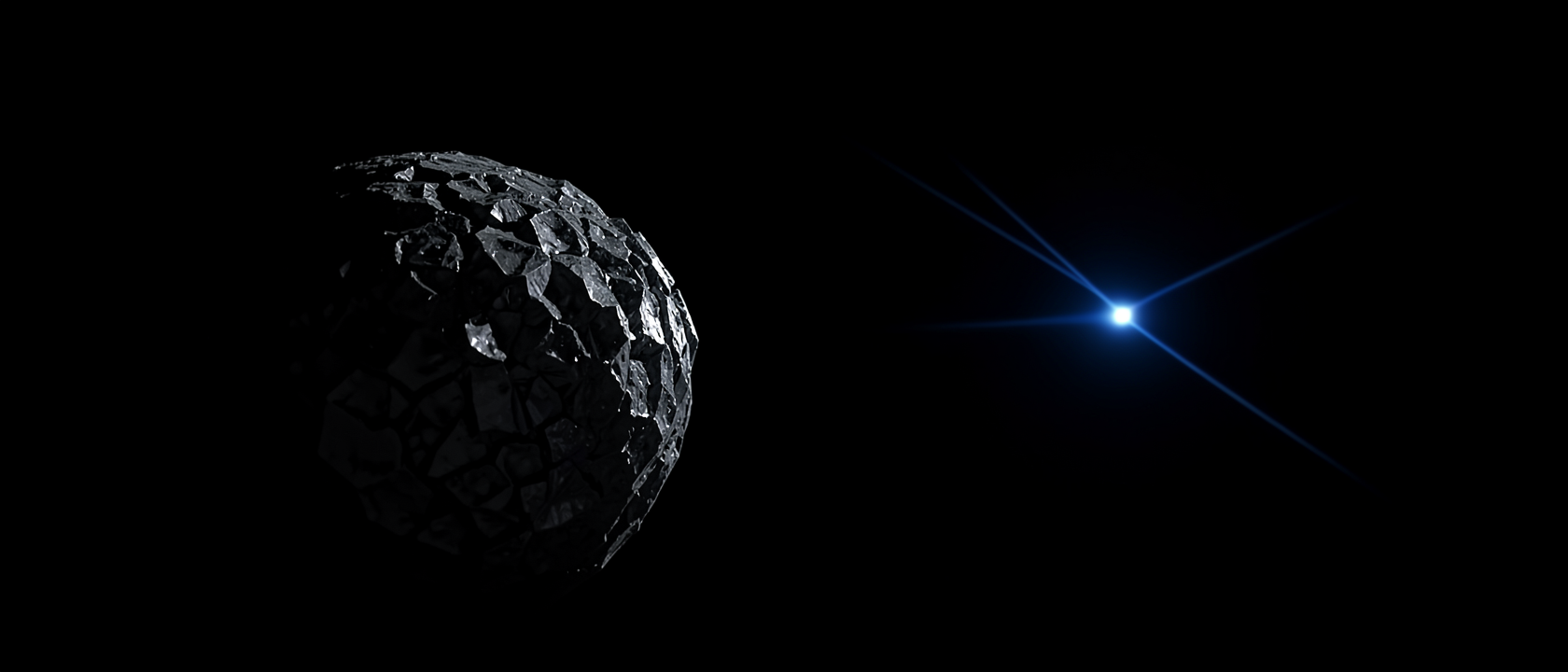
And there is no image of this planet. Searches at the Keck 10-meter telescope found nothing at the expected position. Every visual representation in circulation is an artist’s impression, not an observation. That distinction is not cosmetic. It is the difference between what the data contain and what we have drawn to help ourselves think.
The planet was found in a table of pulse arrival times. That spreadsheet is the closest thing to a photograph this system has.