
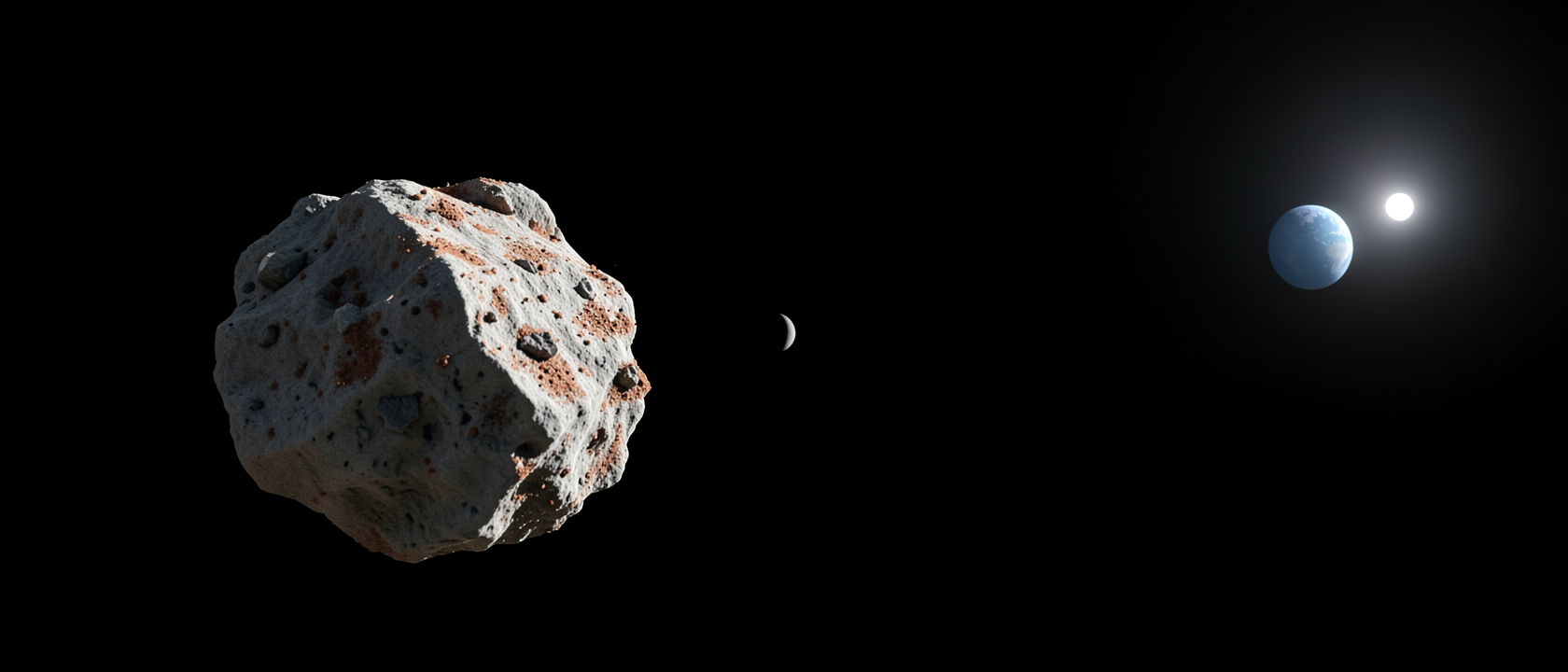
Thirteen and a Half Steps
Thirteen and a half Moon-distances sounds threatening. It isn’t, it is roughly 5.235 million km of open space between Earth’s surface and a fast-moving rock, and the rock had been on the books for four years before it got there. Asteroid 2022 RK passed Earth on September 6, 2026, at 17:47 UTC, at a computed miss distance of 0.03499 AU, that same 13.62 lunar distances, according to NASA’s Jet Propulsion Laboratory Center for Near Earth Object Studies (CNEOS), which derives these figures from fitted orbital solutions built on ground-based astrometric observations.
The Unit and What It Costs You
One lunar distance is 384,399 km, not the Moon’s actual position on any given night, which swings between roughly 356,500 km and 406,700 km because the orbit is an ellipse. CNEOS fixes the value at 384,399 km so that every row in its close-approach table uses the same ruler. Multiply that fixed ruler by 13.62 and you get the gap on September 6, 2026: approximately 5.235 million km. The miss distance was roughly 411 Earth-diameters, and approximately 124 times the distance from Earth’s center to a geostationary satellite, well above everything humanity has ever placed in space. The CNEOS close-approach tables routinely contain objects at 10 to 30 lunar distances. They are there because the surveys are working, not because the solar system is unusually crowded.
How the Miss Distance Was Computed
The name “2022 RK” is a timestamp. The object was first detected in September 2022, roughly four years before the September 6, 2026 closest approach. Survey telescopes recorded it as a moving point of light against background stars; enough precise positional measurements constrain an orbit, which is then propagated forward to calculate closest-approach distances and epochs. The miss distance of 0.03499 AU and the Earth-relative speed at closest approach of approximately 8.6 km/s are products of that calculation, not guesses, but the best reconstruction from real instrument data. (Both figures come from the CNEOS close-approach record; readers should verify against the live table, as orbital solutions are refined with each new observation.)
Size: An Estimate, Not a Measurement
CNEOS lists an absolute magnitude of H = 25.89 for 2022 RK. Brightness depends on both size and reflectivity, and reflectivity (albedo, the fraction of incoming sunlight an object’s surface bounces back) has never been directly measured for 2022 RK. Using the standard asteroid-diameter formula developed by planetary scientists Pravec and Harris, published in 2007, and plugging in the plausible albedo range for rocky near-Earth objects gives an estimated diameter somewhere between about 59 and 128 feet (18 to 39 meters). The lower bound assumes a bright, silicate-rich surface (albedo 0.25); the upper bound assumes a dark, carbonaceous one (albedo 0.05). That is a factor of roughly 2.2 in diameter from albedo uncertainty alone, an honest bracket, not a precise measurement.
That bracket places 2022 RK in the same size class as the Chelyabinsk impactor, which entered Earth’s atmosphere on February 15, 2013, at an estimated diameter of roughly 66 feet (20 meters) and produced a powerful regional airburst that shattered windows across a wide area of Russia. An object in this size class, if it struck the atmosphere, would be a regional event. At 13.62 lunar distances, 2022 RK did not enter the atmosphere. Potential and trajectory are different statements.
What Remains Open
The size is the most practically significant unknown. The 59-to-128-foot estimate narrows only with radar imaging or thermal infrared observations. NASA’s Goldstone antenna in California, a dish 230 feet (70 meters) across, is capable of producing delay-Doppler radar images at roughly 33 to 66 feet (10 to 20 meters) resolution during a close approach at this distance. Whether radar time was scheduled around September 6, 2026, is unconfirmed in the available data. Composition is also unknown; whether 2022 RK is a solid rocky body, a metallic fragment, or a loosely bound rubble pile cannot be determined from optical astrometry alone. None of these open questions change what happened on September 6, 2026. They are the ordinary residue of tracking a small, fast-moving object with a ground-based astrometric network rather than a dedicated spacecraft.
No close-up photograph of asteroid 2022 RK exists in any public archive. The object has been observed only as a point of light against background stars in astrometric survey frames, the same class of image that produced the orbital solution described above. Any depiction of the asteroid’s shape or surface is an illustration, not a photograph.