
The Rock That Passed Earth at 2.36 Moon-Distances
An asteroid about the size of an apartment building slipped past Earth on October 18, 2026, missing by a gap that sounds generous until you measure it the way astronomers do. Near-Earth asteroid 2026 TS came within about 564,000 miles (907,600 km) of Earth at its closest point, according to NASA’s Jet Propulsion Laboratory Center for Near-Earth Object Studies (CNEOS). That works out to roughly 0.0061 astronomical units, an astronomical unit (AU) being the average Earth–Sun distance, about 93 million miles (149.6 million km). Set against the one distance most of us already carry around in our heads, the Moon, it comes out to about 2.36 lunar distances. That’s 2.36 times farther from Earth than the Moon itself is.
The Ruler Astronomers Reach For
Picture the Moon as a streetlamp at the far end of your block, sitting about 238,855 miles (384,399 km) away, that’s the standard “lunar distance” used across the field. 2026 TS passed by at roughly two and a third of those streetlamps out: well past your driveway, but still on your street. CNEOS reports close approaches this way by default, because lunar distances land instantly for most readers in a way astronomical units never quite do.
How We Know
The 564,000-mile figure isn’t a rough guess dressed up as precision. It comes from CNEOS’s continuous orbit-tracking, which recalculates an asteroid’s path every time a new position reading comes in from the survey telescopes watching for moving objects in the sky. That refinement is what let JPL’s own Asteroid Watch dashboard publish the October 18, 2026, approach distance with the confidence it has. Two other numbers tied to this flyby, the exact minute of closest approach and the asteroid’s closing speed, aren’t available from a primary close-approach table solid enough to print here, so they’re left out rather than stated as fact.
How Big It Actually Is: An Estimate, Not a Measurement
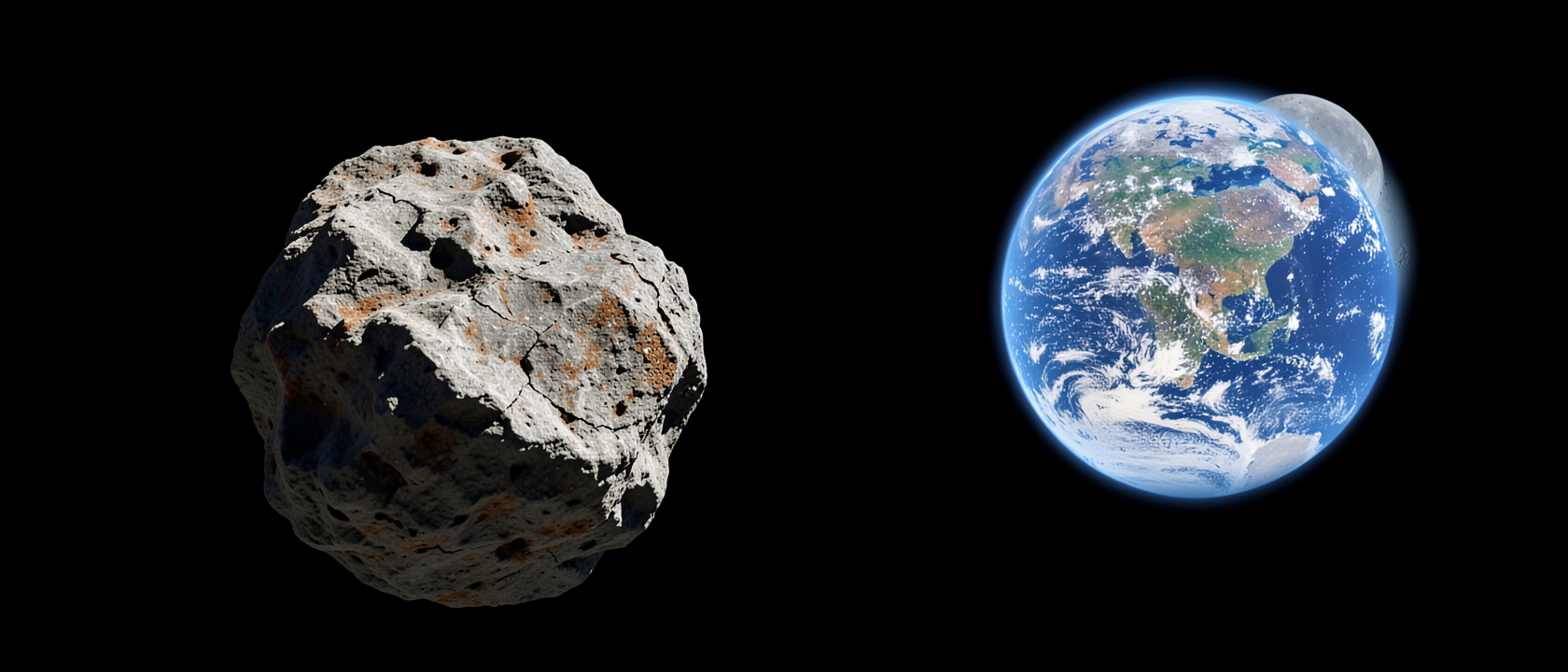
Nobody has photographed 2026 TS closely enough to size it up directly. No probe has flown past it, no radar has pinged it back. What exists is its brightness, how much sunlight it bounces back to survey telescopes, and that brightness only becomes a size once you assume how reflective its surface is, a property astronomers call albedo. JPL’s Asteroid Watch dashboard runs that math assuming a reflectivity somewhere between 5% and 25%, the typical range for near-Earth asteroids, and comes out with a single best estimate: about 170 feet (52 m) across, roughly the height of a 15-story building. A darker, duller rock would need to be bigger to shine this bright; a paler one could be smaller and still match. So 170 feet is a working number, not a tape-measure result. There’s no photograph of 2026 TS to show for any of this, it’s far too small and faint for anything but a point of light in a telescope’s frame. Any image showing its path past Earth and the Moon is a diagram, not a photo, and should be labeled that way.
Why “Twice as Far as the Moon” Still Counts as Close
Two and a third lunar distances reads like plenty of breathing room, and on paper it is: 2026 TS was never on a path toward Earth, and this was a routine, catalogued flyby rather than a near miss in any dramatic sense. But measured against the scale astronomers actually work at, a solar system that spans roughly 93 million miles just to reach the Sun, a pass this close gets logged, tracked, and handed its own designation instead of dissolving into background noise. Most small asteroids pass at distances that never make anyone’s list. That this one did says less about danger and more about how differently “far” gets calibrated once the counting is done in millions of miles instead of city blocks.
Not Traveling Alone
2026 TS wasn’t the only small asteroid JPL’s Asteroid Watch dashboard flagged for October 18, 2026. Two others, 2026 TC94 and 2026 UF, were listed with approach dates the same day. The three aren’t related to each other in any way; they simply happened to pass through the same short stretch of orbital traffic, a reminder that flybys tracked closely enough to earn a name like this one are a steady hum in the background of most weeks, not a singular event.
What’s Still Open
2026 TS’s true diameter depends on an albedo nobody has actually measured, so the 170-foot estimate could run smaller or larger once better data comes in. Its composition, its shape, and whether it tumbles chaotically or spins on a steady axis are all unknown. The precise time of closest approach and its exact closing speed haven’t been confirmed against a primary CNEOS table and are left out of this piece for that reason. Even which survey telescope first picked it out of the sky isn’t part of the public record available here. All of it waits on the same thing every open question in this field waits on: more light collected, or a sharper instrument eventually pointed at the right patch of sky.