
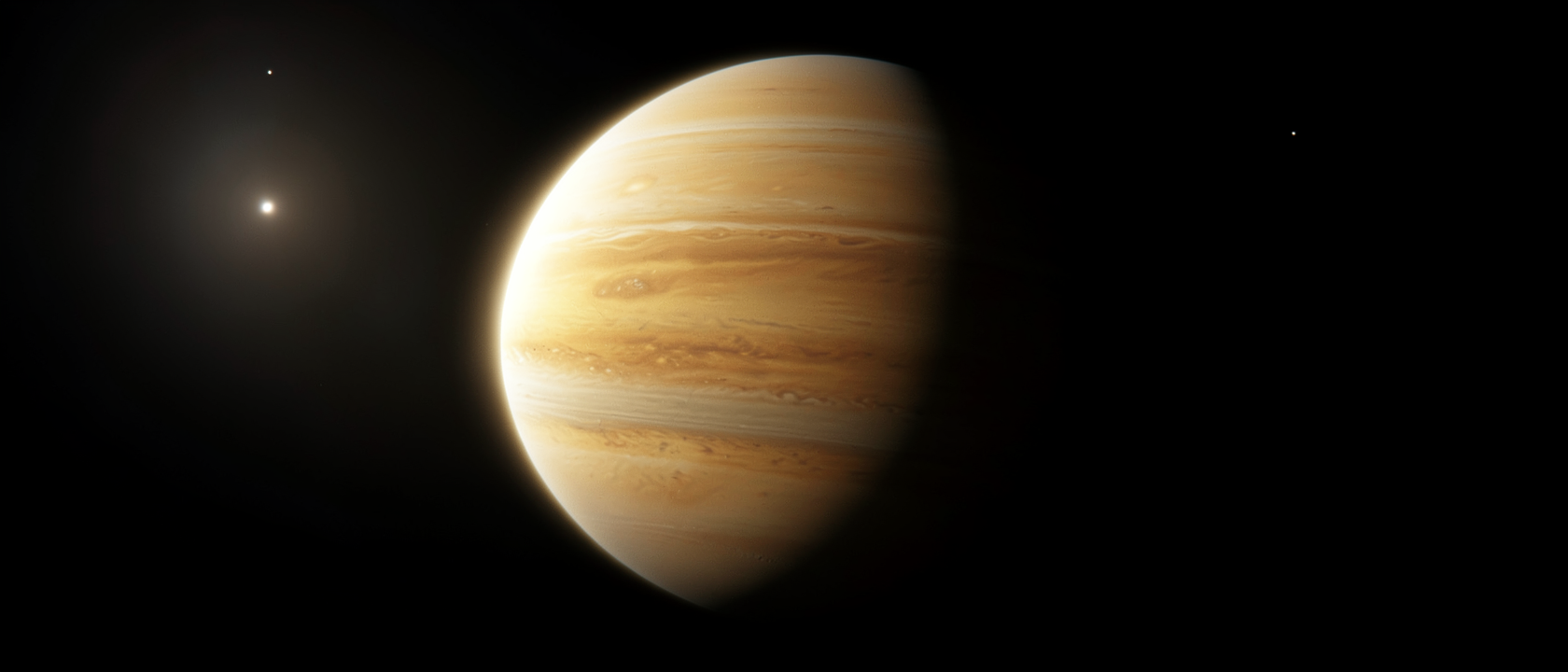
HAT-P-41 b: The Jupiter That Outgrew Jupiter
Jupiter is the one planet most of us have actually seen for ourselves, a pale, striped dot through a cheap pair of binoculars. About 1,101 light-years away there’s a planet built the same way, but swollen to roughly twice Jupiter’s width. It’s called HAT-P-41 b, and it’s a useful reminder that “gas giant” covers a lot more ground than our own solar system shows us.
The measuring stick
HAT-P-41 b’s radius works out to about 91,100 miles (146,600 km). Jupiter’s radius is about 43,400 miles (69,900 km). Divide one into the other and you land on roughly 2.1, NASA’s own exoplanet catalog lists it as 2.05 Jupiter radii, essentially the same answer by a different route. You’ll also see this planet described as 23 Earth radii (22.98, measured by the NASA Exoplanet Archive). That’s accurate, and it’s also the less useful number: it gives you a length, not a sense of what you’re looking at. Setting a gas giant against the one gas giant everyone already pictures does both jobs at once.
How we know
HAT-P-41 b turned up in August 2012, one of three puffed-up, transiting hot Jupiters a survey called HATNet reported finding around bright F-type stars, stars that run hotter than our Sun. HATNet’s telescopes are modest and fully automated, scanning wide patches of sky and flagging any star that dims briefly on a repeating schedule, the signature of a planet crossing its face. Follow-up radial-velocity measurements, which track the tiny wobble a planet’s gravity induces in its star’s light, confirmed the find.
The radius itself isn’t measured directly. It’s calculated from how deep that dimming is, combined with an estimate of the star’s own size, and studies have put HAT-P-41’s radius anywhere from 1.19 to 1.68 times the Sun’s. The planet’s size rides on whichever stellar value goes into that math. Worth knowing, too: the star has a faint companion, a K-dwarf sitting just 3.56 arcseconds away in the sky, a gap too fine to split without careful follow-up observation.
A planet lighter than it looks
Here’s the part that should surprise you more than the width does. The planet’s mass has shifted across studies: the 2012 discovery paper gave 0.8 Jupiter masses; the current NASA Exoplanet Archive composite leans higher, at 1.19 Jupiter masses, with an uncertainty (±0.6) wide enough that both figures stay plausible. Take the higher value, about 2.26 × 10²⁷ kg, divide by the planet’s volume, and the bulk density comes out to roughly 171 kg/m³. Water is 1,000 kg/m³. This planet is under a fifth as dense as something you could run a bath in.
Double Jupiter’s width should mean several Jupiters’ worth of mass, if gas giants scaled the way solid planets do. HAT-P-41 b doesn’t. It got big without getting correspondingly heavy, and that mismatch is the real discovery here, not the raw size.
Why it puffed up
HAT-P-41 b orbits close enough to finish a year in about 2.69 Earth days. Models of the starlight it absorbs put the insolation somewhere between 2,000 and 2,500 times what Earth gets from the Sun, and the same models estimate an equilibrium temperature, the balance between starlight absorbed and heat radiated back out, not a thermometer reading, of around 3,032°F (1,940 K). That kind of heat is thought to puff up a gas giant’s outer atmosphere and inflate the radius astronomers measure.
How completely that explains HAT-P-41 b is still open. Other severely inflated hot Jupiters show more puffiness than heat alone predicts, which suggests something else, tidal forces, deep atmospheric currents, or both, is likely contributing. Nobody has settled which.
What’s still missing
No camera has photographed HAT-P-41 b. Everything above comes from a transit light curve, starlight dipping and recovering, plus the models built on top of it. Any image of the planet itself is an artist’s concept, not a photograph.
That’s not the same as knowing nothing. Hubble’s WFC3 instrument and Spitzer’s photometry have both examined starlight filtering through the planet’s atmosphere during transit, using a technique called transmission spectroscopy, splitting that light into its component wavelengths to hunt for the fingerprints of specific molecules. That work has turned up water vapor and high-altitude clouds, with additional signals still being checked. A planet with no photograph isn’t the same as a planet with no data.