
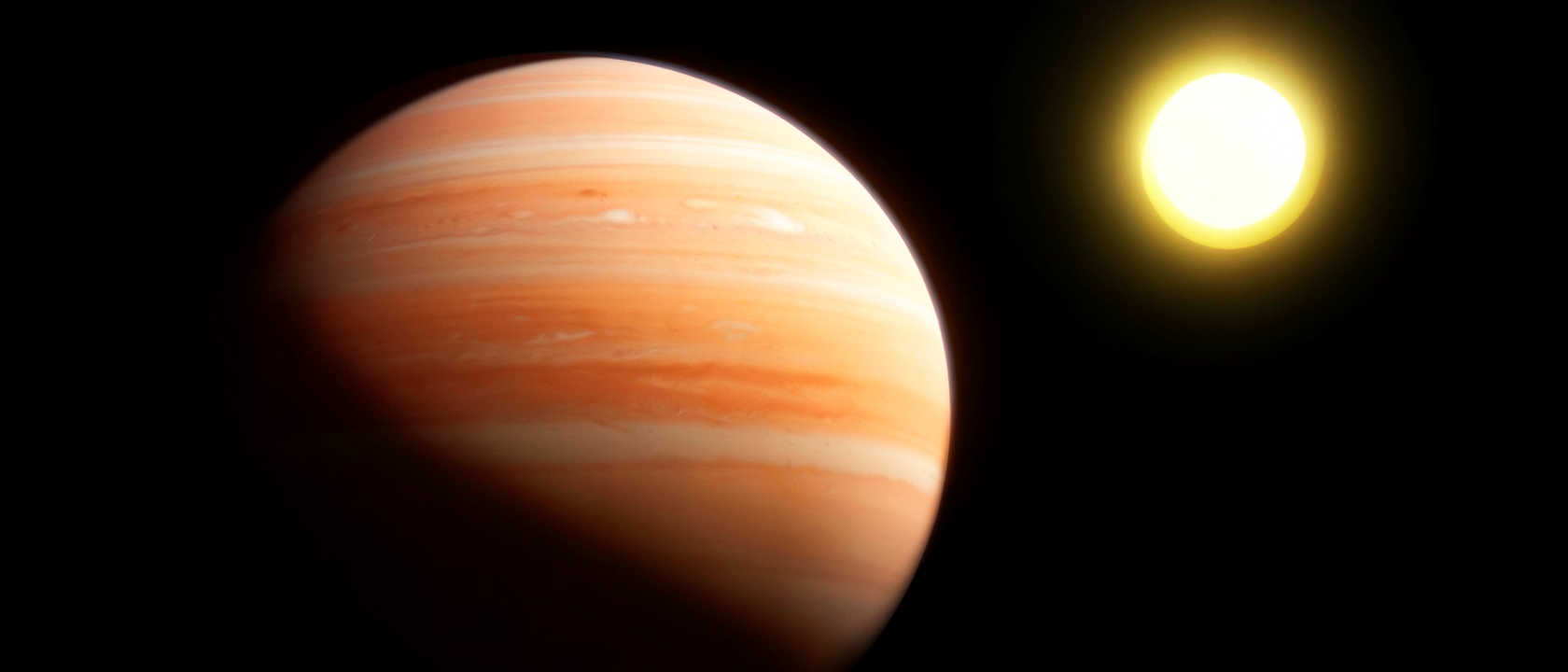
A Gas Giant Glowing Almost as Hot as the Sun’s Surface
Picture something that isn’t a star doing a star’s job: glowing white-hot, running at nearly two-thirds the temperature of the surface we see when we look at the Sun. That’s not a stellar remnant or a failed star. It’s a planet, cataloged as TOI-2109 b, a gas giant circling an F-type star roughly 873 light-years (8.26×10¹⁸ m) away, a distance measured from the tiny shift in the star’s apparent position (its parallax) as Earth orbits the Sun.
The Measuring Stick
The Sun’s photosphere, its visible surface, runs at 5,772 K, the value NASA and ESA solar fact sheets both use as standard. TOI-2109 b’s catalog equilibrium temperature, the modeled figure in NASA’s Exoplanet Archive, sits at 3,646 K. Divide one into the other and you get about 0.63: this planet’s dayside runs at roughly 63% of the Sun’s surface temperature. It is still, by every measurement astronomers have, a planet, just one running at a temperature that would otherwise belong to a small star.
How We Know
That 3,646 K figure is a model, not a thermometer reading. It’s built from how much starlight the planet absorbs and an assumption about how that heat spreads across its surface, and it lives in the Exoplanet Archive’s composite-parameters table as an estimate. The closer thing to a direct measurement comes from the discovery itself: astronomer Ian Wong and colleagues combined a TESS occultation measurement, watching the planet’s light vanish and reappear as it passed behind its star, with a ground-based infrared eclipse observation, and calculated a dayside brightness temperature of 3,631 K, plus or minus 69 K. Published in The Astronomical Journal on November 23, 2021, that result made TOI-2109 b the second-hottest exoplanet known at the time, trailing only KELT-9b, and placed it near the edge of a still poorly understood temperature band, between 3,500 K and 4,500 K, that separates the hottest known gas giants from everything else.
A Tight, Fast Orbit
Nobody has photographed TOI-2109 b. TESS, NASA’s Transiting Exoplanet Survey Satellite, the mission behind the “TOI” in its name, found it by watching its star’s brightness dip by a sliver of a percent every time the planet crossed in front of it. From the depth and timing of those dips, and from radial-velocity measurements that tracked the small wobble the planet’s gravity induces in its star, astronomers worked out an orbit that barely seems possible: one full lap takes 58,101.77 seconds, about 16.14 hours. At the time it was confirmed, that made it the shortest orbital period ever recorded for a gas-giant planet. The planet sits just 0.0179 astronomical units from its star, 8.79 million miles (2.679×10⁹ m), under 2.3 stellar radii, close enough to absorb about 17,900 times the starlight Earth receives per square meter: 2.434×10⁷ watts per square meter, against Earth’s 1,361. That’s the furnace behind the temperature above. No mystery, just proximity.
The Planet Itself
Its planetary nature was verified through radial-velocity measurements that pinned its mass at about 5.02 times Jupiter’s, 2.1×10²⁸ pounds (9.53×10²⁷ kg). Its radius, read from how much starlight it blocks during transit, comes out to 1.347 Jupiter radii, or 59,850 miles (9.630×10⁷ m). Put mass and radius together and the bulk density is only about 2,500 kilograms per cubic meter, low for something this massive, and a signature of a gas giant puffed up by sitting too close to its star for too long, not a scaled-up rocky world. That same mass is heavy enough, researchers note, that tidal forces aren’t expected to tear the planet apart despite its closeness to its star, though exactly how its orbit is changing over time is still being worked out.
What’s Still Open
A few things here are genuinely unsettled. Small variations in the planet’s transit timing once hinted at a hidden companion planet or a slowly decaying orbit, but the most recent analysis favors a period that’s close to constant, the question isn’t fully closed either way. A separate study, reading the planet’s emission spectrum by a different method, found a dayside temperature near 1,748 K and a nightside near 1,555 K, both far cooler than the 3,631 K brightness temperature above, because the two studies are measuring different things under different assumptions, not contradicting each other. And nobody has sampled the atmosphere directly: its composition, its clouds, and whether one face stays permanently lit while the other sits in permanent dark all remain open.
The Picture
Every image of TOI-2109 b in circulation is an artist’s illustration, a glowing, swollen gas giant, sometimes rendered with a comet-like tail. None of it is a photograph. The planet sits too close to its own blinding star, and too far from Earth, for any camera to resolve it directly. What’s real is the light curve: the small, repeating dip in starlight that TESS recorded as the planet passed in front of its star, the same kind of data behind every transiting exoplanet on record. The dip in brightness is the actual picture. The glowing render is a guess dressed up to look like one.