
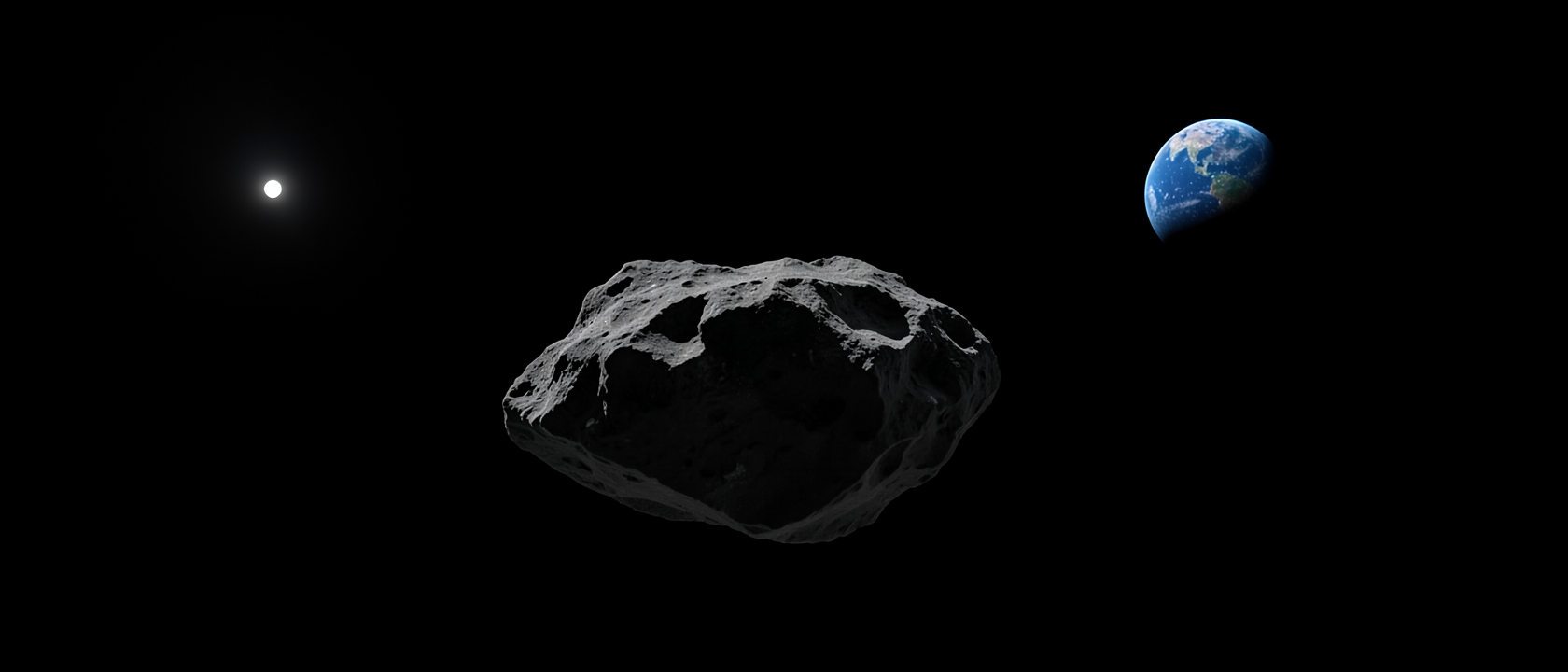
A Rock That Kept Five Moon-Widths of Distance the Whole Way By
On September 30, 2026, at 20:54 UTC, asteroid 2018 SP2 made its closest approach to Earth, and never came closer than 1,197,443 miles (1,927,097 km). That’s 0.01288 astronomical units (an astronomical unit is the average Earth-Sun distance, about 149,597,870 km), or 5.01 lunar distances. No alarms, no close call. Just a quiet pass, logged and done.
The measuring stick
A lunar distance is a measurement most of us have already pictured: Earth to Moon, about 238,855 miles (384,400 km) on average. 2018 SP2 passed exactly five of those gaps away, not five times closer, five Moon-widths farther out than the Moon itself. Line up five Earth-Moon trips end to end, and you’ve reached where the asteroid was.
How we know
NASA’s Jet Propulsion Laboratory tracks approaches like this through its Center for Near-Earth Object Studies (CNEOS). Nobody caught 2018 SP2 in the act. The distance and the time come from an orbit solution: years of positional observations, each one a single point of light against the star field, fed into orbital mechanics and fit to a path. Run that path forward and you get a prediction precise enough to publish to four significant figures and the nearest minute. 2018 SP2 belongs to the Apollo group of near-Earth asteroids, objects whose orbits cross Earth’s, circling the Sun roughly every 325 days, tilted 26.8 degrees from the plane the planets travel in, on an orbit with an eccentricity of 0.206 (a measure of how stretched out it is; zero would be a perfect circle). Which survey first spotted it back in 2018 isn’t part of the close-approach record. That detail stays open.
A point of light, not a sighting
2018 SP2 was closing at 14.3 km/s relative to Earth, about 32,000 mph, while measuring only tens of meters across: far too small and far too dim for the naked eye, or even most backyard telescopes. Nobody watched this asteroid cross the sky on September 30. What they had was a string of earlier sightings, each one a faint dot against the stars, and an orbit built from those dots. Feed that orbit forward in time and the position comes out as math, not guesswork, which is how a rock nobody saw go by still ends up with a distance logged to four figures and a time logged to the minute.
Estimate: the size nobody’s measured
Here’s the number that isn’t settled. 2018 SP2 has an absolute magnitude of H=24.8, a brightness measurement, not a size, and turning that into a diameter means assuming the asteroid’s albedo: how much of the sunlight hitting its surface bounces back. Assume a bright, reflective surface (albedo 0.25) and the estimate comes out near 95 feet (29 m). Assume a dark, charcoal-like one (albedo 0.05) and the same brightness implies something closer to 213 feet (65 m). A single best-guess figure of roughly 128 feet (39 m) has also been floated, less than half the height of the Statue of Liberty’s copper figure, itself about 305 feet (93 m), used here only for scale. None of this is measured. It’s a bracket built on an assumption about surface reflectivity that nobody has confirmed for this particular rock.
Open: what the record doesn’t have
No camera has photographed 2018 SP2, and no radar dish has pinged it either. Every number in this piece, the distance, the speed, the size bracket, comes from brightness measurements and orbit-fitting, not from an image of the object itself. The true diameter stays a bracket, not a figure. Its composition, rotation, and shape are unknown, and so is which survey first flagged it back in 2018. 2018 SP2 is real, tracked, and timed to the minute, and still, in the plainest sense, unseen.