
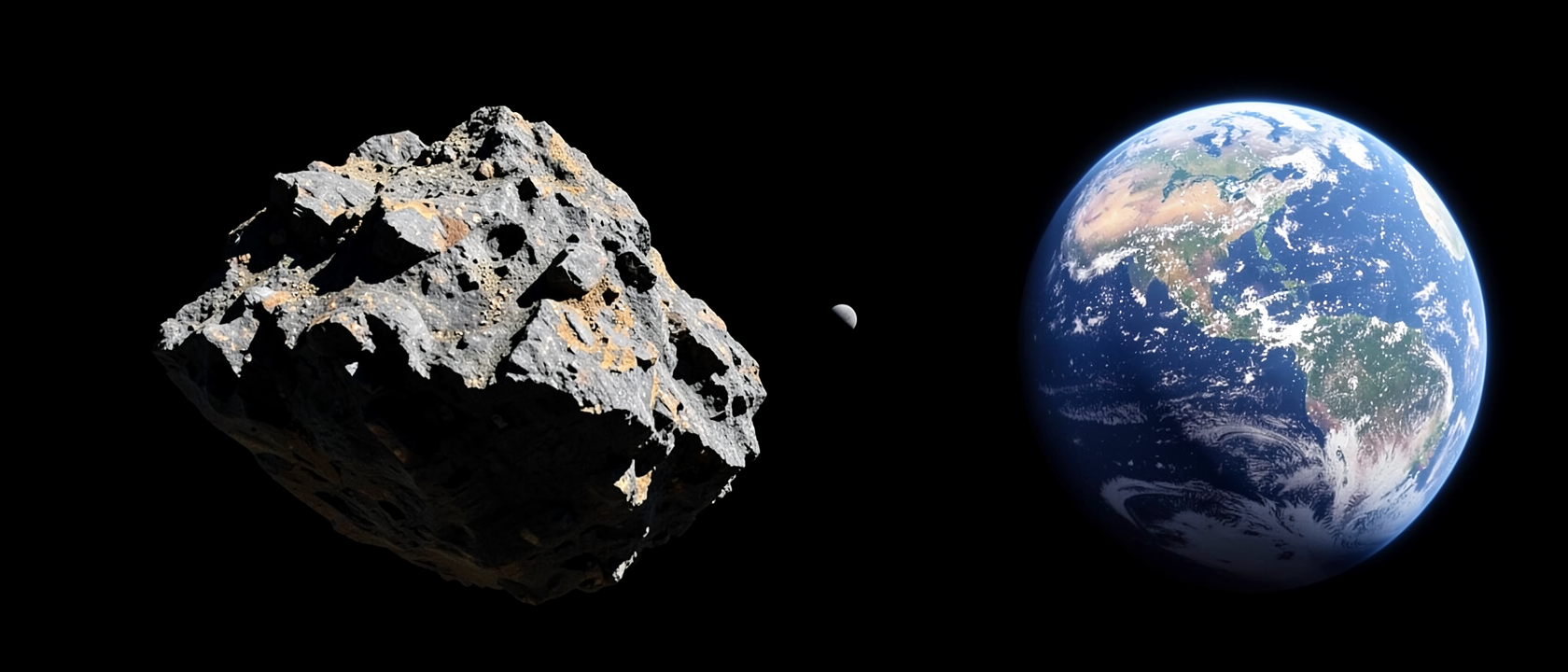
A Rock as Tall as an Apartment Block, and No Photograph of It
A rock roughly the height of a city apartment building slipped past Earth, and no camera anywhere caught it happening. The object is called 2019 AS2. On October 2, 2026, it passed by at roughly 1,069,000 miles (1,720,478 kilometers) out, about 4.5 times farther than the Moon, moving relative to Earth at about 16,330 mph (7.3 km/s). What’s left from the event isn’t a picture. It’s a simulated orbit diagram, math standing in for a photograph nobody took.
The Moon as a Ruler
Astronomers measure passes like this one against the Earth–Moon distance, since it’s the one large distance most people already carry some feel for: an average of 238,855 miles (384,400 kilometers). By that ruler, 2019 AS2 passed about 4.5 lunar distances out, roomy, as these things go.
But a ruler can flatter. At 16,330 mph, the asteroid could cross that entire Earth–Moon gap, start to finish, in about fourteen and a half hours, well under a day. “Roomy” is a matter of units. “Fast” is a matter of physics, and the two don’t cancel each other out.
How You Measure a Distance Without a Picture
Nobody pointed one telescope at 2019 AS2 and read the distance off a screen. The figure traces back to NASA’s Jet Propulsion Laboratory, whose Center for Near-Earth Object Studies, known as CNEOS, keeps a running catalog of close approaches. Telescopes scattered around the world log the asteroid’s position against the background stars on different nights; those positions get fitted into a single orbit. Once that orbit is solved tightly enough, its position at any given moment, including October 2, 2026, comes from calculation, not a camera. That’s what counts as “measured” for a rock this small: not an image, but an orbit good enough to predict one.
A Size Nobody Has Actually Measured
The asteroid’s width is usually quoted as a range: about 121 to 269 feet (37 to 82 meters) across, somewhere between a ten-story building and a tower more than twice that tall. Nobody has measured that directly. What is on record is the asteroid’s intrinsic brightness, a standardized value astronomers call absolute magnitude, cataloged at H=24.3. Turning brightness into size means guessing how much sunlight the surface reflects, its albedo. A small, pale rock and a larger, dark one can look identical from Earth. Run the math assuming a bright surface, albedo 0.25, and you land near the small end; assume a dark, sooty one, albedo 0.05, and you land near the large end. The 148-foot spread between those numbers isn’t sloppy work. It’s the actual size of what isn’t known yet.
Why Close Is How We Found It
There’s a reason an object like this only turns up on anyone’s list once it’s already near. Far from Earth, 2019 AS2 sits around apparent magnitude 23, far fainter than anything visible to the naked eye, and close to the limit of what even dedicated survey telescopes can pick out. It becomes easy to track only when it swings close, which is exactly what happened on October 2, 2026. The same proximity that sounds like cause for concern is the reason 2019 AS2 is cataloged at all. Objects this size aren’t quietly sitting out there, safely distant and unseen; they’re invisible, full stop, until a pass like this one puts them within reach of a telescope.
What’s Still Open
No photograph of 2019 AS2 is known to exist. What CNEOS publishes is a diagram, a simulation of the orbit, not an image of the rock, and that’s exactly what it’s labeled as. Its precise diameter, composition, shape, and spin remain unconfirmed; the 121-to-269-foot range stands until radar or a sharper set of eyes measures it directly. Even the “2019” in its name only marks the year it entered the catalog, not the details of how it was first spotted. Size, shape, spin, first sighting, all of it stays open, unless 2019 AS2 swings back around for another look.