
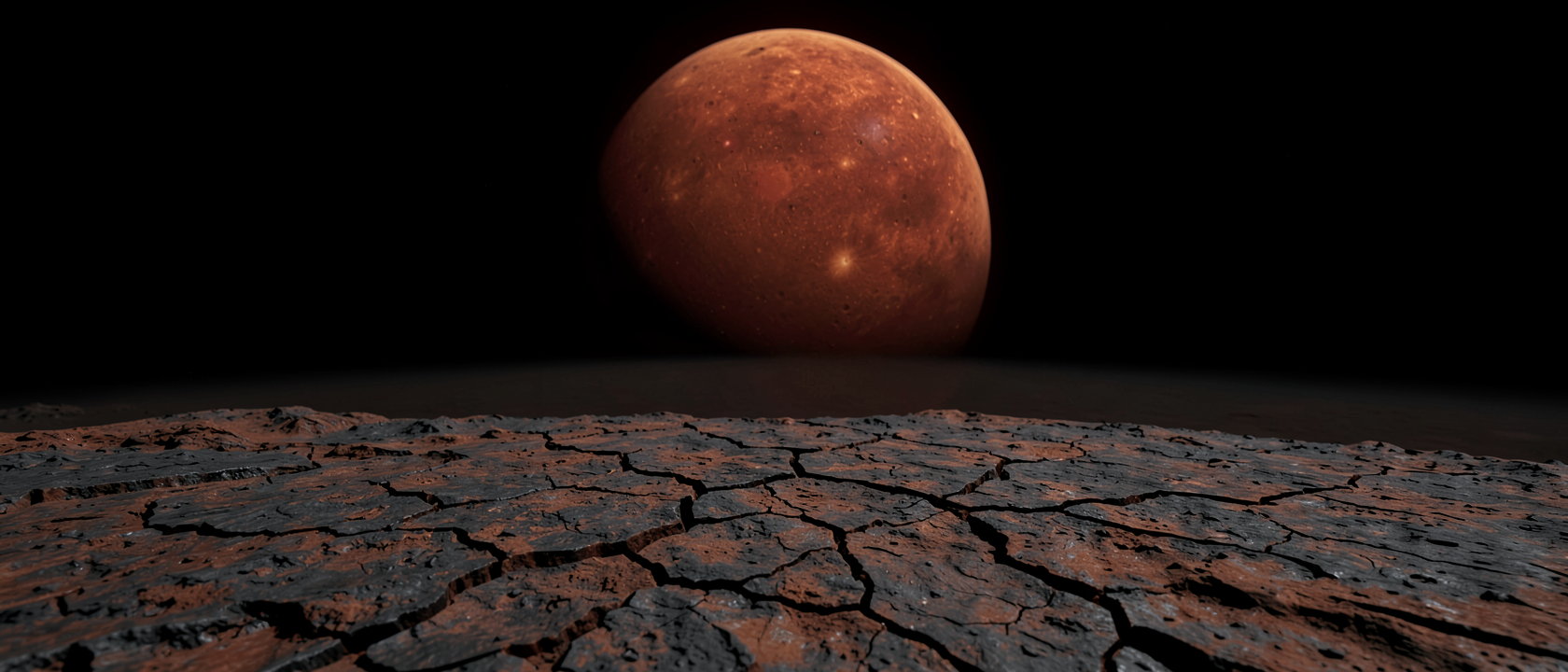
A World Where the Whole Year Happens Before Lunch
Clock in for a day shift, and by early afternoon a planet on the other side of the galaxy has already run through an entire year, not a season, the whole cycle, start to finish, in roughly four hours. Earth’s orbit around the Sun takes 365.25 days, or 31,557,600 seconds. This planet’s orbit takes 15,527.7 seconds, and that number comes from an instrument watching a star blink, not from a guess.
The planet is K2-137 b. Its “year”, astronomers keep the word even here, works out to 4.3135 hours, or just divide 15,527.7 by 3,600 yourself and you’ll land on about 4.31 hours. Set that next to Earth’s year and the ratio comes out to roughly 4.92×10⁻⁴: an Earth year is about 2,033 times longer. That multiplier won’t mean much on its own, so try the version your body can actually check: divide Earth’s 24-hour day by K2-137 b’s 4.3-hour year, and you get about 5.6. Nearly six full years on that world pass between one sunrise here and the next.
How We Know
NASA’s Kepler spacecraft found K2-137 b during its extended K2 mission, a repurposed survey flown after a mechanical failure ended Kepler’s original observing program. Pointed at a field in the constellation Virgo during its tenth observing campaign, Kepler caught the planet crossing in front of its star over and over, each pass blocking a small, regular sliver of light. Smith and colleagues timed those dips and published the period, 15,527.7 seconds, accurate to a fraction of a second, in the Monthly Notices of the Royal Astronomical Society, with the paper appearing in March 2018 after first circulating in November 2017. The NASA Exoplanet Archive lists 2017 as the official discovery year.
The star itself, cataloged as K2-137, is a small red dwarf of a type called M3V, sitting about 320 light-years away (99 parsecs), a distance measured through parallax, the tiny shift in the star’s apparent position as Earth orbits the Sun. Kepler never saw the planet directly. It only ever saw the star’s light dim, briefly, every 15,527.7 seconds, which makes this the second-shortest confirmed orbital period known for any planet, trailing a still-unconfirmed candidate called KOI 1843.03 by just four minutes. The discovery paper noted that K2-137 b held a Guinness World Record for the shortest confirmed orbital period on record.
Why So Fast
Nothing unusual happened to K2-137 b to make it move this quickly. It’s simply close. The planet orbits its star at about 540,600 miles (870,000 kilometers) out, just 0.0058 times the distance between Earth and the Sun, well under 1% of it. Kepler’s third law, the same rule that ties Earth’s distance from the Sun to its 365-day year, says a tighter orbit means a shorter period. Pull a planet in that close, and a “year” stops being measured in months and starts being measured in hours.
What’s Still Open
No telescope has photographed K2-137 b, and none currently can, it’s too small and sits too close to its star’s glare to resolve. What exists instead is the transit light curve itself, a real, measured dip in starlight, plus the occasional artist’s illustration, which is a guess dressed up as a picture and should be labeled as one.
Two commonly quoted numbers are softer than they sound. The planet’s temperature, often given as about 2,188°F (1,471 K), is a modeled equilibrium estimate built from the star’s brightness and assumptions about how much light the planet reflects, not a thermometer reading from an atmosphere nobody has confirmed exists. Its mass is even less settled: the transit method that found K2-137 b reveals size and timing, not mass. The NASA Exoplanet Archive lists only an upper limit, under about 159 Earth masses, while other estimates, based on an assumed rocky composition, put it somewhere between 0.89 and 1.01 Earth masses. Even its radius has two different answers on record, 0.89 Earth radii from the discovery paper, 0.64 Earth radii in the Exoplanet Archive’s composite solution, and nobody has settled which fits better.
One figure is reported as a clean zero: the orbit’s eccentricity, meaning it’s close to a perfect circle rather than an oval. Whether that holds over time is its own question. Tides could, in principle, drag a planet orbiting this close into its star eventually, but how fast depends on a property of the star’s interior that hasn’t been measured. Estimates built on an Earth-like mass put that process on the scale of billions of years. Whether K2-137 b has that long left is something nobody can answer yet.